
Hair transplant
Types of hair transplant, explained honestly
Two ways to harvest grafts, a few sensible variations, and many marketing names.
There are really only a few types of hair transplant: FUT, FUE, a hybrid of the two, long hair FUE, body hair transplant and corrective surgery. Names such as DHI, sapphire and Bio FUE describe methods or packages, not new types. The right choice depends on your donor area, your pattern of loss and your plans for the years ahead.
Last updated · Medical review: Dr. Ashutosh Shah, M.B.B.S., M.S., M.Ch., D.N.B. (Plastic Surgery), Gujarat Medical Council Reg. No. G-26257
 FUT, FUE and hybrid
How the types really differ
Every hair transplant moves your own follicular units, the natural groups of one to a few hairs, from a stable donor area to a thinning area. What changes from one type to another is mainly how the grafts are harvested, which donor source is used and whether the operation is a first procedure or a repair.
There are two ways to harvest grafts from the scalp. In FUT a thin strip of donor skin is removed and divided into grafts. In FUE grafts are taken out one at a time. Most other names you will see are either a combination of these, a variation in how grafts are placed, or a brand name for a package of supportive treatments.
No single type suits everyone. A good plan starts with a diagnosis, an examination of the donor area and an honest talk about how much hair you may need over your lifetime, and only then chooses a technique.
FUT, or strip surgery
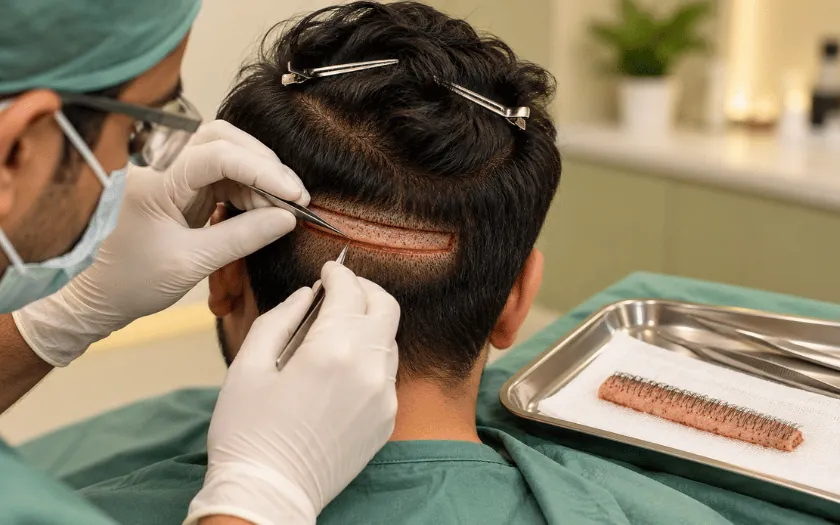
Follicular unit transplantation removes a thin strip of scalp from the back of the head, where hair tends to resist pattern thinning. The strip is divided under magnification into individual follicular units, and the wound is closed with sutures, leaving a fine line that is usually hidden by the surrounding hair.
- Can yield large graft numbers in selected patients
- Makes efficient use of the donor supply
- May preserve untouched donor area for future sessions
- Low transection of follicles in experienced hands
- Suitable in selected advanced hair loss
- Leaves a fine linear scar
- Needs sutures and their removal
- Donor healing takes longer than with FUE
- May limit very short hairstyles at the back
Scalp laxity, meaning how loose the scalp is, helps decide whether FUT is a sensible option for you.
FUE, one graft at a time
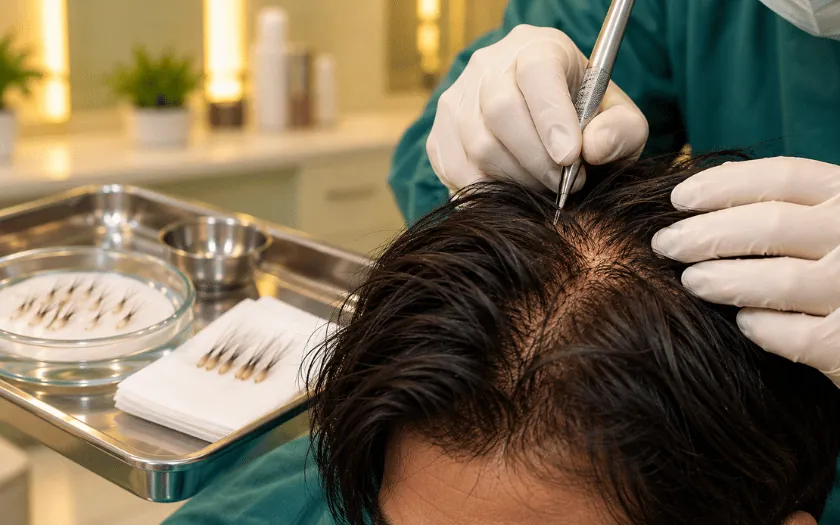
Follicular unit extraction removes each graft individually with a small punch. It leaves many small round marks rather than one long line, which suits people who like to keep their hair short at the back. Scalp hair and, in selected cases, body hair can be used.
The main caution with FUE is overharvesting. Grafts must be spread evenly across the safe donor zone and kept within safe limits, because taking too many from one area can leave the donor region visibly thin or patchy.
Hybrid and long hair FUE
Hybrid FUT and FUE
For selected patients who need a high number of grafts, a strip may be combined with FUE from areas the strip does not reach. The aim is to make fuller use of the donor supply while respecting its limits. It is usually considered in more advanced patterns of loss, and the donor strategy is planned before either technique is used.
Long hair FUE
Long hair FUE is a partial or non shaven approach. Some or all of the existing hair is kept longer, so the procedure is easier to conceal in the first weeks. The trade off is honest to state: it takes more time and technical care, it often suits smaller sessions, and not every patient is a good candidate. Suitability is decided after your hair length, density and graft needs are assessed.
Body hair as a donor source
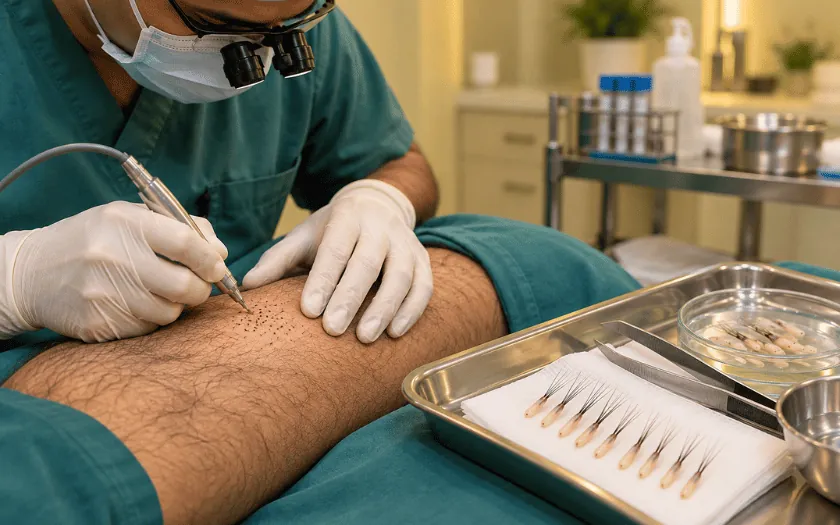
When scalp donor hair is limited, hair from the beard, chest or other sites may add grafts. Beard to scalp is the most commonly used, followed by chest to scalp, with other donor sites considered case by case.
Body hair is different from scalp hair. It often differs in thickness, curl, growth cycle and the length it will reach, so it rarely looks identical to scalp hair. For this reason it is mainly a supplementary source, often used to add coverage in the crown or to soften areas behind the hairline, rather than to build the front edge.
Corrective and repair transplants
Some patients come after an earlier procedure that did not look right. Repair work is often more complex than a first transplant, because donor hair may already be depleted and scar tissue can affect graft survival. It may include:
- Correcting a poorly shaped or unnatural hairline
- Repairing old pluggy grafts
- Correcting a hairline placed too low
- Redirecting hair that grows in the wrong direction
- Camouflaging an overharvested or depleted donor area
- Scar revision
- Improving thin density
- Removing and redistributing misplaced grafts
Assessment of the earlier work and of the remaining donor hair comes first. Only then can realistic corrections be explained.
DHI, sapphire and Bio FUE: methods, not types
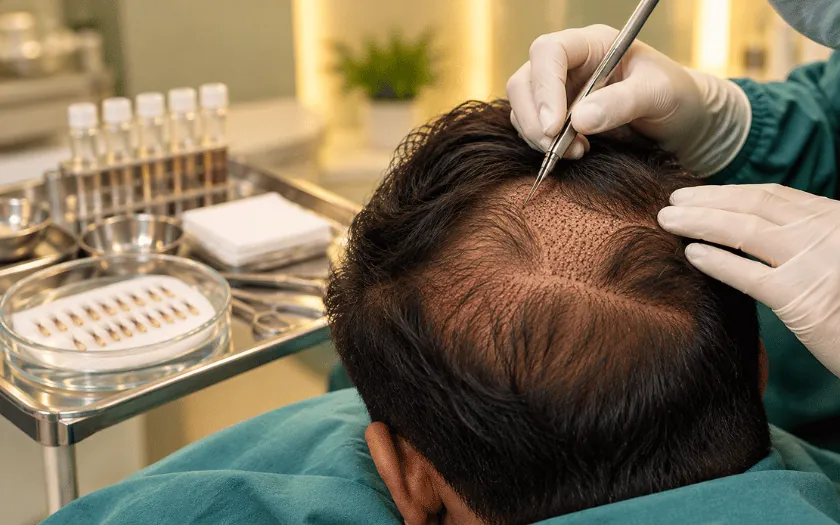
DHI, or direct hair implantation, is an implantation method. Grafts, usually harvested by FUE, are loaded into pen like implanter devices and placed into the scalp. It changes how grafts are placed, not what kind of transplant you have.
Sapphire FUE refers to the blade material used to make recipient sites. The result depends far more on planning, graft handling, angle, direction, density and surgical skill than on the branding of the blade.
Bio FUE is a marketing term without one agreed definition. It usually means FUE combined with PRP, growth factors or other supportive treatments. If a package uses the name, ask exactly what is included and what evidence supports each part.
Read the full guide: DHI Hair Transplant →
How the right type is chosen
The choice is made for your scalp, not from a menu. The factors that matter most include:
- The cause of your hair loss and whether it has stabilised
- Donor density, hair calibre and scalp laxity
- How many grafts you may need now and in the future
- How you like to wear your hair, short or longer
- Any earlier surgery or scarring
- Your wish for concealment during recovery
Whichever type is chosen, a transplant redistributes donor hair. It does not stop the thinning of untreated native hair, so medical treatment is often advised alongside surgery.
Suitability, risks and recovery differ for each patient and are discussed during consultation.
Not sure which type suits you?
Your donor area and pattern of loss are examined in person before any technique is recommended.
At a glance
The main types of transplant
Which one suits you is decided after your scalp and donor area are examined.

Questions about techniques
Still have a question?
Answers to what patients ask most about the different techniques. Your own plan is confirmed only after an examination.
No. DHI is a way of placing grafts with pen like implanter devices. The grafts are usually harvested by FUE, so it is a method within FUE rather than a separate type.
Sapphire only describes the blade used to make recipient sites. Growth depends much more on planning, graft handling, site angle and density, and the skill of the team.
There is no single definition. It usually means FUE combined with PRP, growth factors or other supportive treatments. Ask for a clear list of what is included and why.
Yes. In selected patients with high graft needs, the two can be combined in one session or used in separate sessions, so that more of the donor supply can be used safely.
Not usually. Body hair often differs in thickness, curl, growth cycle and length. It is mainly used as a supplementary source when scalp donor hair is limited.
Not always. It can be partial or non shaven depending on the case. It takes longer and suits carefully selected patients and session sizes.
Often it can be improved, but how much depends on the earlier work and the donor hair that remains. Options may include redesigning the hairline, removing or redirecting grafts and adding density.
Book a consultation
Begin with a conversation.
Every plan starts with an in person assessment by Dr. Ashutosh Shah. Call or WhatsApp the clinic and our team will get back to you.
Book on WhatsApp
Chat with our team on WhatsApp about any treatment, consultation or appointment.
- Ask about any treatment
- Book a consultation
- Get directions to our clinics
WhatsApp opens with a short message ready to send. The clinic team replies during working hours.