Hair loss treatment
Laser hair growth therapy and device based hair therapy
Light, needling and delivery devices, in their proper supporting role.
Laser hair growth therapy, also called low level laser or light therapy, is one form of device based hair therapy, alongside LED photobiomodulation, microneedling and infusion devices. Low level light therapy may help some people, and microneedling can support topical treatment, but devices play an adjunctive role and work alongside a medical plan chosen after diagnosis, not in place of one.
Last updated · Medical review: Dr. Ashutosh Shah, M.B.B.S., M.S., M.Ch., D.N.B. (Plastic Surgery), Gujarat Medical Council Reg. No. G-26257
 Adjunctive, not stand alone
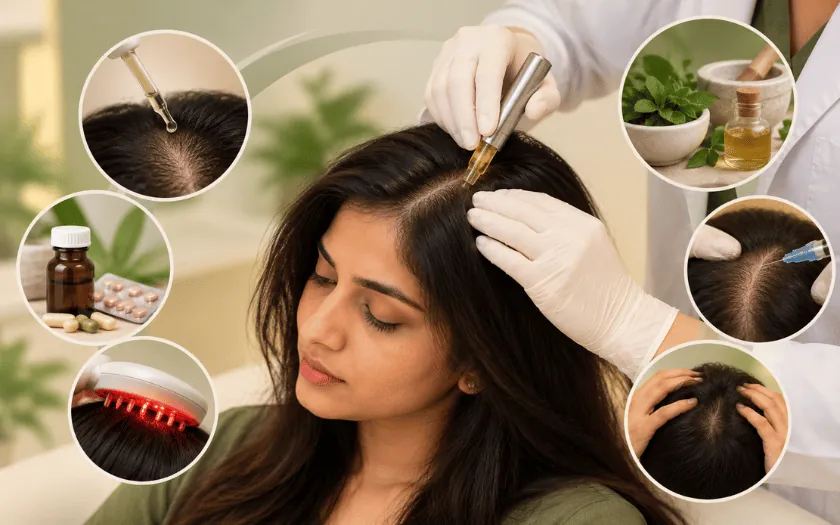
Where devices fit in a treatment plan
Devices appeal because they feel modern and involve no tablets. Some have reasonable evidence as a support therapy, while others are sold with claims that go far beyond the research. The honest position is that a device can add to a plan built on the right diagnosis and, where suitable, proven medicines.
Whether a device helps depends on the cause of your hair loss, how early it is, the quality of the device and whether it is used correctly and consistently. Which devices may be discussed or offered to you is decided after assessment. Hair loss that has already become smooth and shiny, with no visible follicles, is unlikely to respond to any device.
Low level laser hair growth and light therapy
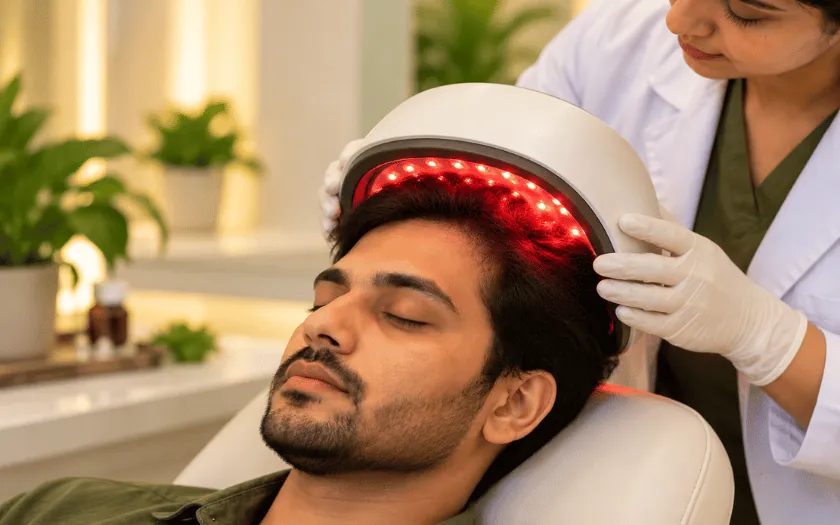
Low level laser or light therapy, often shortened to LLLT, shines low energy red light on the scalp. It does not cut or heat the skin. The light is thought to act on cell energy processes in the follicle and may help prolong the growth phase in some people.
Forms of LLLT
- Helmets and caps worn at home for set sessions
- In clinic devices used during visits
- Home hand held devices passed over the scalp, which are harder to use evenly
Frequency and candidate selection
LLLT needs regular use, usually several times a week, over months before any effect can be judged, and the benefit continues only with continued use. It is most often considered for early to moderate pattern hair loss in men and women, and for people who cannot use or do not want certain medicines, usually still alongside other treatment.
Eye safety and device quality
Devices differ widely in wavelength, power and coverage. A device should come from a reputable source, and the eyes should be protected as directed, particularly with lasers. People with light sensitive conditions or on medicines that increase light sensitivity should discuss this first.
LED photobiomodulation versus laser
LED devices use light emitting diodes. LEDs give off broader, non coherent light that spreads out, while lasers produce a single, focused wavelength. Both are grouped under photobiomodulation, but they are not interchangeable, and results from laser studies cannot simply be applied to LED products.
- Single wavelength, coherent light
- More studies in pattern hair loss
- Eye protection matters more
- Broader, non coherent light
- Output varies widely between products
- Evidence is more limited and device specific
Scalp microneedling
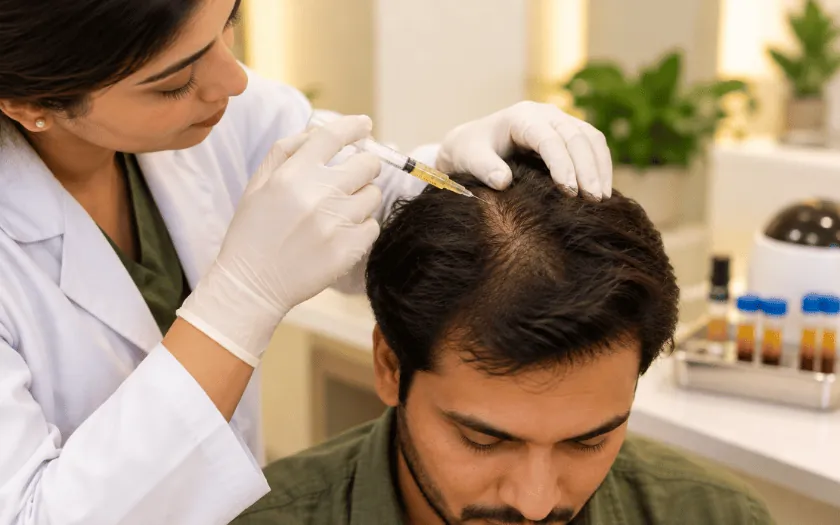
Microneedling uses fine needles to make controlled tiny punctures in the scalp. The minor injury is thought to trigger healing signals that may support hair growth, and it can help some topical treatments reach the skin. It is often combined with medicines such as minoxidil.
- Assessment
The scalp is checked for infection, inflammation, open wounds or active skin disease, which rule out treatment until settled.
- Sterile preparation
The scalp is cleaned and single use or sterilised needles are used to reduce the risk of infection.
- Controlled needling
Depth and pressure are adjusted to the area, with numbing if needed.
- Planned intervals
Sessions are spaced to let the scalp recover, and topical treatments may be paused briefly afterwards as advised.
Redness and tenderness are common for a short time. Microneedling is avoided with active infection, uncontrolled diabetes, bleeding problems, keloid tendency or inflamed scalp conditions. Home derma rollers carry real risks of infection, skin injury and pigment change, particularly when rollers are reused or shared, so home use should be discussed before you start.
Electroporation and scalp infusion
Electroporation, also called transdermal infusion, uses mild electrical pulses to help topical solutions pass into the skin without needles. It is a delivery aid, not a treatment on its own, so any benefit depends on what is being delivered and whether that product is itself useful for your hair loss.
Scalp oxygenation and infusion treatments may feel refreshing and can help cleanse the scalp. There is no reliable evidence that applying oxygen to the scalp regrows hair, so these are described only as comfort or cleansing treatments where they are offered.
Before you buy or book a device
- Confirm the diagnosis first; a device will not treat a thyroid problem, deficiency or scarring condition
- Ask what the device emits, at what wavelength and power, and what evidence supports it
- Be cautious of claims that one device suits every type of hair loss
- Plan how progress will be measured, ideally with standard photographs
- Agree a point at which you will review and stop if there is no benefit
Devices are most useful when they fit into a wider plan that may include medical hair treatment, scalp care and, in selected people, regenerative therapies.
How we approach device therapy
A device is suggested only when it fits your diagnosis and you are likely to use it consistently. You should leave the consultation knowing what the device can realistically do, how often it needs to be used, what it costs over the full course and how progress will be judged.
- Diagnosis and medical options are discussed first
- Claims are explained against the evidence, including where it is limited
- Microneedling is done with sterile technique and only on a healthy scalp
- You are told plainly if a device is unlikely to help you
Suitability, risks and recovery differ for each patient and are discussed during consultation.
Thinking about a laser cap?
Ask whether it suits your hair loss before you buy. Your plan is decided at an in person consultation.
What this includes
Devices, in brief
Which device, if any, may be discussed or offered depends on your diagnosis and assessment.
Device therapy questions
Still have a question?
Answers to common questions about light devices and microneedling. Whether a device suits you is decided after an examination.
They may help some people with early to moderate pattern hair loss when used regularly over months. Results vary, the device quality matters, and the effect lasts only with continued use.
Often, yes. Light therapy is usually used alongside medical treatment rather than instead of it. Ask how to time the two, since some topical products are meant to be applied to a dry scalp after the session.
Not exactly. Both use red light, but lasers emit a single focused wavelength while LEDs give broader light. Evidence for one type of device cannot simply be assumed for another.
Home rollers can cause infection, skin injury and pigment change, especially when they are reused, shared or pressed too hard. Discuss it with a doctor first, and avoid it on an inflamed or infected scalp.
Most people feel prickling or mild discomfort. Numbing cream can be used, and redness or tenderness usually settles within a day or two.
There is no reliable evidence that oxygen applied to the scalp regrows hair. It may feel refreshing and help cleanse the scalp, but it should not be relied on to treat hair loss.
Book a consultation
Begin with a conversation.
Every plan starts with an in person assessment by Dr. Ashutosh Shah. Call or WhatsApp the clinic and our team will get back to you.
Book on WhatsApp
Chat with our team on WhatsApp about any treatment, consultation or appointment.
- Ask about any treatment
- Book a consultation
- Get directions to our clinics
WhatsApp opens with a short message ready to send. The clinic team replies during working hours.