
Hair transplant
Hair transplant side effects and complications, explained honestly
No surgery is risk free. You deserve the full picture before you decide.
Most hair transplant side effects are minor and short lived, such as swelling, soreness and itching. Some problems are less common, and a few can be lasting, such as poor growth or an overharvested donor area. This page explains what can happen, how often it tends to settle, and how careful planning and follow up reduce the risk.
Last updated · Medical review: Dr. Ashutosh Shah, M.B.B.S., M.S., M.Ch., D.N.B. (Plastic Surgery), Gujarat Medical Council Reg. No. G-26257
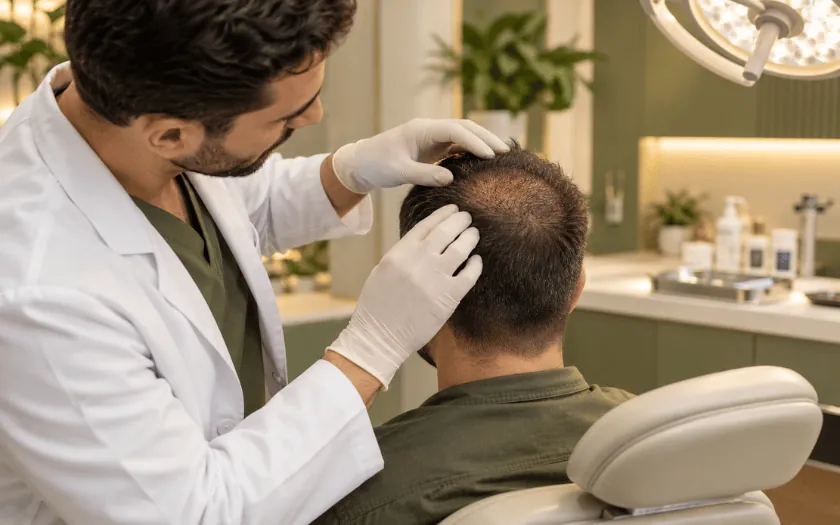 Transparent about risk
Common hair transplant side effects, usually short lived
These effects are expected in many patients and usually settle with time and simple care:
- Pain and soreness: felt mainly in the donor area for the first days, managed with prescribed medicines
- Swelling: of the forehead and sometimes around the eyes, usually settling within a week
- Minor bleeding: small oozing on the first night, usually controlled with gentle pressure
- Itching: common as crusts form and heal; scratching should be avoided
- Temporary numbness: of the donor or recipient area, which usually improves over weeks to months
- Redness: which fades gradually; persistent redness is followed up, particularly in fair skin
Infection, folliculitis and cysts
Infection after a hair transplant is uncommon when sterile technique and aftercare are followed, but it can happen. Signs include increasing pain, spreading redness, warmth, pus or fever, and these need prompt review.
Folliculitis is inflammation of hair follicles, often seen as small pimples when new hairs push through the skin in the months after surgery. Most cases are mild and settle with local care or treatment when needed. Small cysts can occasionally form where a graft was buried or placed too deep, and are managed if they persist.
Shock loss and shedding
Most transplanted hairs shed in the first weeks, which is expected and not a complication. Shock loss is different: it is the temporary shedding of native hair around the transplanted area, and sometimes in the donor area, caused by the stress of surgery.
Shock loss usually recovers over a few months. Hairs that were already miniaturised and close to being lost may not return. Medical treatment before and after surgery, and careful site creation between existing hairs, may reduce the risk.
Poor growth and unnatural appearance
Growth varies between people and cannot be promised. Poor or uneven growth can relate to graft handling, the time grafts spend outside the body, placement, the blood supply of the area, smoking, scar tissue, an unrecognised scalp condition or the patient's own healing.
- Unnatural hairline: a line that is too low, too straight or too dense at the edge
- Cobblestoning: small bumps around grafts, sometimes from grafts sitting too high
- Pitting: small depressions where grafts sit too deep
- Wrong direction: hair growing at an angle that does not match its neighbours
Many of these are prevented by planning and technique, and several can be improved with corrective work if they occur.
Donor problems and scarring
Every technique leaves some scarring. FUT leaves a fine linear scar, and FUE leaves many small dot scars. These are usually hidden by the surrounding hair, but can show with very short hairstyles or in people prone to poor healing.
- Donor overharvesting: taking too many grafts leaves the donor area visibly thin, and removed follicles do not regrow
- Moth eaten donor: a patchy look from uneven or clustered extraction
- Keloid or thick scars: more likely in people with a personal or family tendency
- Wide FUT scar: sometimes seen with tight closure or a very tight scalp
Uncommon but serious
Necrosis, the loss of a patch of skin because of a poor blood supply, is uncommon. The risk is reduced by avoiding overly dense packing, taking extra care in scar tissue and in smokers, and reviewing any unusual darkening of the skin early.
Unrealistic expectations
Dissatisfaction is often not a surgical complication at all, but a gap between what was hoped for and what the donor supply can give. A transplant can create a convincing appearance of fullness, but it cannot recreate the density of a young scalp or stop thinning of untreated native hair. Honest planning, clear photographs and a written plan help close that gap before surgery.
How risk is reduced
Safety depends on people and systems, not on the name of a technique:
- Qualified surgeon supervision of the whole procedure
- Strict sterility in the procedure room
- Emergency preparedness and trained staff
- Monitoring during local anaesthesia
- Accurate, transparent graft counting
- A trained, experienced team for graft handling
- Documented follow up with photographs
- Early management of any complication
You can help too: share your full medical history and medicines, stop smoking before and after surgery, and follow your aftercare instructions closely. If something worries you, contact the clinic early rather than waiting.
Suitability, risks and recovery differ for each patient and are discussed during consultation.
Ask about risk, openly
Your personal risks and how they are managed are discussed at an in person consultation.
Questions about risk
Still have a question?
Answers to what patients ask about side effects. Your own risks are discussed before you consent.
Shock loss is temporary shedding of existing hair after surgery. It usually recovers over a few months, although hairs that were already very thin may not return.
Small pimples can appear as new hairs grow through, a form of mild folliculitis. Most settle on their own or with simple treatment. Painful, spreading or pus filled spots should be checked.
Numbness of the scalp is common and usually improves over weeks to a few months as small nerves recover. Persistent numbness is uncommon.
Growth takes time, and the result is usually judged at around a year. If growth is poor after that, the cause is assessed and options such as further treatment or a corrective session are discussed.
Yes, if too many grafts are taken. Removed follicles do not regrow, so overharvesting can leave lasting thinning. Harvesting within safe limits reduces this risk.
Smoking reduces blood flow to the skin and can affect healing and graft survival. Stopping before and after surgery is strongly advised.
Contact the team that performed your surgery as early as possible, using the details in your aftercare instructions. Early review makes most problems easier to manage.
Book a consultation
Begin with a conversation.
Every plan starts with an in person assessment by Dr. Ashutosh Shah. Call or WhatsApp the clinic and our team will get back to you.
Book on WhatsApp
Chat with our team on WhatsApp about any treatment, consultation or appointment.
- Ask about any treatment
- Book a consultation
- Get directions to our clinics
WhatsApp opens with a short message ready to send. The clinic team replies during working hours.