
Hair & scalp conditions
Hair loss diagnosis, step by step
A structured consultation, not a product pitch.
A proper hair loss diagnosis combines your history, a careful scalp and hair examination, magnified trichoscopy and standardised photographs, with blood tests or a biopsy only when your situation calls for them. The aim is to name the cause, or causes, before any treatment is chosen.
Last updated · Medical review: Dr. Ashutosh Shah, M.B.B.S., M.S., M.Ch., D.N.B. (Plastic Surgery), Gujarat Medical Council Reg. No. G-26257
 Diagnosis before treatment
Why hair loss diagnosis comes first
Hair loss has many causes, and several can look similar in a mirror. Pattern thinning, telogen effluvium, alopecia areata, scalp infection and early scarring alopecia each need different care. Treating the wrong cause wastes time, money and, sometimes, hair that could have been saved.
Not every patient with hair fall needs a transplant, and not every patient needs a long list of tests. A structured consultation is designed to find what is actually happening, explain it clearly, and build a plan that fits your situation, whether that is reassurance, scalp care, medical treatment, supportive therapy or, when suitable, surgery.
Your history, in detail
Most diagnoses begin with listening. You may be asked about:
- Detailed and family history: your general health, and whether parents, grandparents or siblings have similar thinning
- Hair loss timeline: when it began, whether it came on suddenly or gradually, and what has changed since
- Hormonal, menstrual and pregnancy history: for women, cycle pattern, heavy periods, pregnancy, breastfeeding, contraception and menopause
- Diet and weight loss history: vegetarian or restricted diets, fasting, crash dieting and recent weight change
- Medication history: current and recent medicines and supplements, including any started a few months before the shedding
- Hair care history: colouring, straightening, heat styling, tight hairstyles, oils and products used
- Earlier treatment: what you have tried, for how long, and how your hair responded
Because shedding often follows its trigger by a few months, the timeline is especially useful. It helps to think back before your visit. The hair growth cycle page explains why.
Scalp and hair examination
The examination looks at both the scalp skin and the hair itself.
- Pattern of loss: hairline, temples, crown, parting width, patches or diffuse thinning
- Scalp skin: redness, scaling, pustules, shiny or scarred areas, and loss of follicle openings
- Hair shafts: breakage, fragile or unusual hairs, and variation in thickness
- Other areas: eyebrows, beard, body hair and nails when relevant
The hair pull test
A small group of hairs is held gently between the fingers and eased along their length. The number that comes out, and the appearance of their roots, gives a simple indication of whether active shedding is happening at that moment. It is one clue among several, not a diagnosis on its own.
Trichoscopy and standardised photography
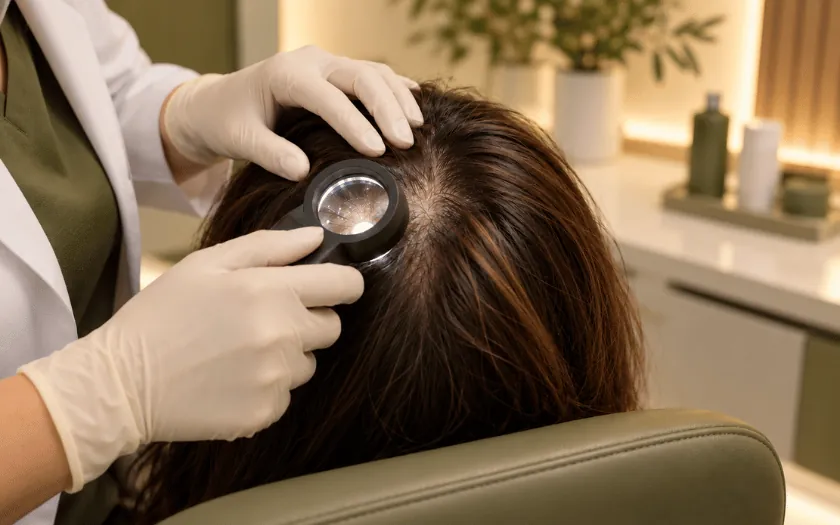
Trichoscopy, also called dermoscopy of the scalp, uses a handheld magnifying device to look at the scalp surface, follicle openings and hair shafts in detail. It can show variation in hair thickness that suggests miniaturisation, typical signs of alopecia areata, scaling patterns of scalp conditions, and changes that raise suspicion of scarring alopecia.
Standardised photographs are taken from fixed angles in consistent lighting: front, top, sides, crown and donor area. Hair loss and regrowth are slow, and memory is unreliable, so comparing photographs over time is the fairest way to judge whether hair is stable, improving or thinning.
Density, calibre and donor assessment
Measuring how many hairs grow in an area (density) and how thick they are (calibre) helps grade the severity of thinning and track response to treatment. A mix of thick and fine hairs in the same area is a typical sign of pattern hair loss.
For anyone who may consider a transplant in future, the donor area at the back and sides of the scalp is assessed too: its density, hair characteristics and whether it shows thinning itself. Donor hair is limited, so knowing its capacity early helps plan realistically for a lifetime, even if surgery is years away or never needed. Learn more about hair transplant planning.
Blood tests, individualised
There is no single test panel that suits every patient, and a fixed package sold to everyone is not good practice. Tests are chosen according to your history and examination. Depending on the picture, they may include:
- Complete blood count
- Ferritin and iron profile
- Thyroid profile
- Vitamin B12 and vitamin D
- Zinc
- Blood glucose or HbA1c
- Liver and kidney function
- Hormonal evaluation in selected women, for example with suspected PCOS
- Autoimmune tests only where the clinical picture suggests them
Some people need no blood tests at all, for example when the pattern is typical and there are no other symptoms. Recent reports you already have can often be used, so bring them along.
Scalp biopsy in selected cases
A scalp biopsy is not routine. It is considered when the diagnosis remains unclear after examination and trichoscopy, and especially when scarring alopecia is suspected, because early diagnosis of scarring conditions can help protect remaining follicles.
The procedure is done under local anaesthesia. A small sample of scalp is taken, usually from the active edge of a patch, and the area is closed with a stitch or two. The sample is examined under the microscope, and results guide treatment and, where relevant, whether and when surgery could be considered.
A long term plan
At the end of the assessment, the diagnosis is explained in plain language, along with what can and cannot be expected. A plan may combine:
- Scalp care
Treating dandruff, infection or inflammation first. See scalp conditions.
- Correcting contributors
Addressing deficiencies, hormonal issues or triggers identified in the tests.
- Medical treatment
To slow or reduce progression where the type of hair loss responds to it.
- Supportive therapies
Options such as PRP, considered as supportive care rather than a substitute for diagnosis.
- Restoration when suitable
Camouflage, hair replacement or a transplant, only when the cause is stable and the donor area allows.
- Review and photographs
Follow up visits to measure response and adjust the plan over time.
Suitability, risks and recovery differ for each patient and are discussed during consultation.
Ready for a clear answer?
Bring your previous reports, medicines list and a note of when your hair loss began.
What the assessment includes
Tools used in diagnosis
Not every step is needed for everyone. What is used depends on your history and scalp.



Consultation questions
Still have a question?
Answers to what people ask before a hair loss assessment. Your own tests depend on your history and examination.
Bring any recent blood reports, a list of current medicines and supplements, details of treatments you have tried, and old photographs if you have them. A rough timeline of when the hair loss started is very helpful.
Come with clean hair washed as usual, without oil, gel or hair fibres. Heavy products can hide the scalp surface and make trichoscopy and photographs less accurate.
No. It is a magnified camera or handheld device placed gently on the scalp. There are no needles and nothing is removed.
Not always. Tests are suggested only when your history or examination points to a possible cause they can identify, and recent reports can often be used.
Mainly when the diagnosis is unclear or scarring alopecia is suspected. It is a small procedure under local anaesthesia, and most people with hair loss never need one.
Photos can give a helpful first impression and guide what to check, but they cannot replace an in person examination, trichoscopy and, where needed, tests.
Review intervals depend on the diagnosis and treatment, but progress is usually judged over months with comparable photographs rather than week to week.
Book a consultation
Begin with a conversation.
Every plan starts with an in person assessment by Dr. Ashutosh Shah. Call or WhatsApp the clinic and our team will get back to you.
Book on WhatsApp
Chat with our team on WhatsApp about any treatment, consultation or appointment.
- Ask about any treatment
- Book a consultation
- Get directions to our clinics
WhatsApp opens with a short message ready to send. The clinic team replies during working hours.