
Patient resources
Hair transplant blog and hair loss education centre
Plain English guides, so every decision is an informed one.
Our hair transplant blog and hair loss education centre gathers guides, videos and answers on why hair falls, how the cause is found and what each treatment can and cannot do. It is written to help you understand your options and ask better questions at your consultation, not to replace one.
Last updated · Medical review: Dr. Ashutosh Shah, M.B.B.S., M.S., M.Ch., D.N.B. (Plastic Surgery), Gujarat Medical Council Reg. No. G-26257
 Learn before you decide
Why understanding comes first
Hair loss is common, and so is confusing advice about it. Friends recommend oils, advertisements promise regrowth, and online clinics quote graft numbers from a single photo. Very little of this starts with the most important question: what is actually causing your hair loss?
Pattern hair loss, shedding after illness or stress, nutritional deficiency, thyroid imbalance, alopecia areata, traction from tight hairstyles and scarring conditions of the scalp can look alike at first, yet they are managed very differently. A transplant, for example, moves donor hair to a thinning area; it does not stop the hair you already have from thinning, and donor hair is limited for life.
The guides here are organised in the order most people need them: first understanding the condition, then the medical and supportive treatments, then hair transplant planning. Each summary below links to a detailed page.
Guides on hair and scalp conditions
Start here if you are not yet sure why your hair is thinning or falling.
Understanding the hair cycle
Every hair grows, rests and sheds in a cycle. Knowing the phases explains why some shedding is normal, why hair fall can appear months after a trigger, and why any treatment takes time to show a result.
Causes of hair fall
Genetics and DHT, hormonal changes, pregnancy and the months after childbirth, PCOS, thyroid disorders, low iron or other deficiencies, crash dieting, illness, some medicines and tight hairstyles may all contribute. Often more than one factor is involved.
Types of alopecia
Alopecia simply means hair loss. This guide explains the common forms, from androgenetic alopecia in men and women to alopecia areata, telogen effluvium and traction alopecia.
Scarring alopecia and scar hair transplantation
Some conditions destroy follicles and leave scar tissue. They must be diagnosed early and be stable before any transplant is considered. The guide also covers hair restoration in surgical, injury and burn scars.
Scalp conditions
Dandruff, seborrhoeic dermatitis, psoriasis, folliculitis and other scalp problems can worsen hair fall and often need treatment before any procedure.
How hair loss is diagnosed
What a structured assessment includes: history, scalp examination, pull test, trichoscopy, standardised photographs, donor assessment, blood tests where indicated and, in selected cases, a scalp biopsy.
Guides on treatment
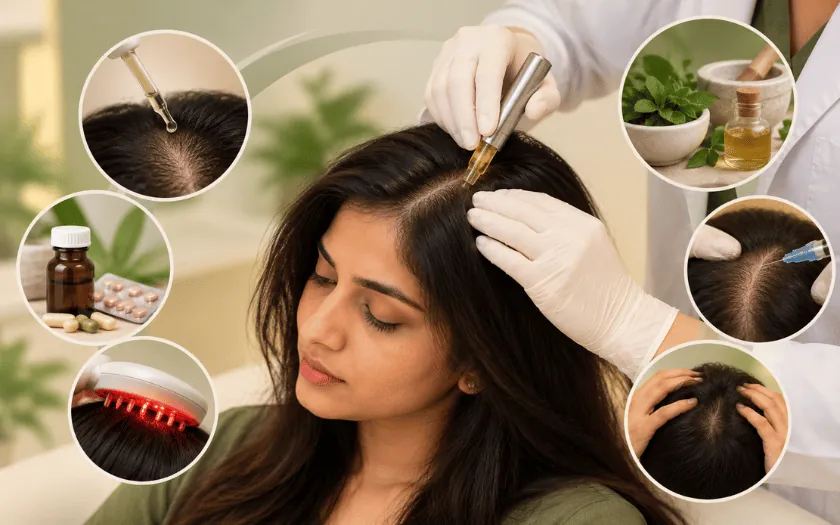
Medical treatment is the foundation of care for most people with hair loss, whether or not they later have a transplant.
Medical hair treatment
How minoxidil, finasteride and other prescribed treatments work, why they help only while they are used, and what side effects to discuss with your doctor.
Regenerative and adjunctive treatment
PRP, microneedling and newer options such as exosome products are discussed honestly. They may support some patients, the evidence varies, and none is a substitute for diagnosis or proven medical care.
Device based therapies
Low level light devices and other equipment used at home or in the clinic, what they can reasonably offer and where they fit within a wider plan.
Nutritional and deficiency correction
Why supplements help mainly when a deficiency has been documented, and why high doses taken without need can do more harm than good.
Lifestyle and multidisciplinary care
Sleep, stress, smoking, diet and hair care habits, and when a gynaecologist, endocrinologist or dietician may need to be involved.
Guides on hair transplant
If you are considering surgery, these guides explain how a responsible plan is made and what to expect.
- Types of hair transplant: FUT, FUE and combined approaches, and why DHI and sapphire describe methods rather than separate types
- FUE hair transplant: how follicles are extracted one by one, and its benefits and limits
- Hair transplant by patient group: planning for younger men, women and transgender individuals
- Hairline design: shaping a hairline that suits your age and face and allows for future loss
- Donor area planning: treating donor hair as a limited, lifetime resource
- Non scalp hair transplant: eyebrow, beard, moustache and scar restoration
- The patient journey: from assessment to the first year of growth
- Post transplant maintenance: protecting native hair in the long term
- Complications: possible risks, how they are reduced and when to seek help
Before choosing where to have surgery, read how to choose a hair transplant clinic. It explains the questions worth asking about who plans and performs each step.
Video library
Short explainer videos cover the questions patients ask most often. Videos are being added to the clinic YouTube channel, and each topic below opens the channel.
Reading health information with care
Whatever you read, here or elsewhere, a few simple checks help separate reliable information from marketing.
- Be cautious of promises of guaranteed density, fixed growth dates or a result with no risk
- Question offers of very large graft numbers in one sitting without an examination of the donor area
- Look for honest discussion of limits, side effects and who is not suitable
- Remember that a technique name, such as DHI or sapphire, does not by itself decide the result
- Check common beliefs against the evidence; the hair transplant FAQ covers eight of the most common myths
If something you have read worries you or seems to promise too much, bring it to your consultation. It is always better to ask than to guess.
Guides being prepared
The education centre grows as new material is added. The following resources are being prepared and will appear here when they are ready:
- Downloadable care instructions for before and after procedures
- A transplant preparation guide: what to arrange, avoid and expect in the days before surgery
- A post operative guide to caring for the donor and recipient areas
- A nutrition guide explaining how diet and documented deficiencies relate to hair health
- Patient stories, published only with written consent
- Balanced summaries of new research and emerging treatments
Suitability, risks and recovery differ for each patient and are discussed during consultation.
Reading is a start, examination is the answer.
The cause of your own hair loss is confirmed only after an in person assessment.
The library
Six ways to learn
Choose the format that suits you. Every route leads back to the same principle: diagnosis before treatment.





Education centre questions
Learning well.
How to get the most from the guides and videos. They are general education, not personal advice.
If you are not sure why your hair is thinning, start with the causes of hair fall and the hair cycle. If you already know the cause and are thinking about surgery, the types of hair transplant and donor planning guides are a good next step.
Because results and responses vary between people. Honest medical information describes what usually happens without promising a fixed outcome, and your own likely result can only be judged after an examination.
No. A guide can help you understand the options and prepare questions, but choosing a treatment needs a diagnosis. Several causes of hair loss look alike and need different care.
The videos are being added to the YouTube channel linked from the video library on this page. Each topic opens the channel, where new explainers appear as they are published.
Reliable advice explains limits and risks, avoids promises of guaranteed results, and does not quote graft numbers or prices without an examination. Be wary of any source that sells a single product as the answer for everyone.
Yes, and it is a good idea. Writing down what you have read and the questions it raised helps make the consultation focused and ensures nothing important is forgotten.
Book a consultation
Begin with a conversation.
Every plan starts with an in person assessment by Dr. Ashutosh Shah. Call or WhatsApp the clinic and our team will get back to you.
Book on WhatsApp
Chat with our team on WhatsApp about any treatment, consultation or appointment.
- Ask about any treatment
- Book a consultation
- Get directions to our clinics
WhatsApp opens with a short message ready to send. The clinic team replies during working hours.