
Hair transplant
FUE hair transplant in Surat
Your own follicles, moved one by one, with no long linear scar.
An FUE hair transplant in Surat moves your own hair follicles one by one from the back and sides of the scalp into thinning areas. It leaves small scattered marks instead of one long line, and suitability depends on your donor area and the cause of your hair loss.
Last updated · Medical review: Dr. Ashutosh Shah, M.B.B.S., M.S., M.Ch., D.N.B. (Plastic Surgery), Gujarat Medical Council Reg. No. G-26257
 Planned by a plastic surgeon
What is an FUE hair transplant?
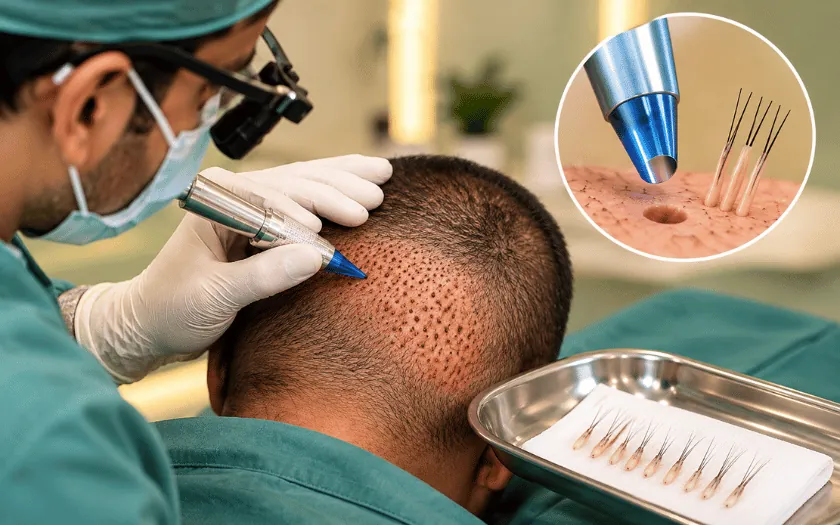
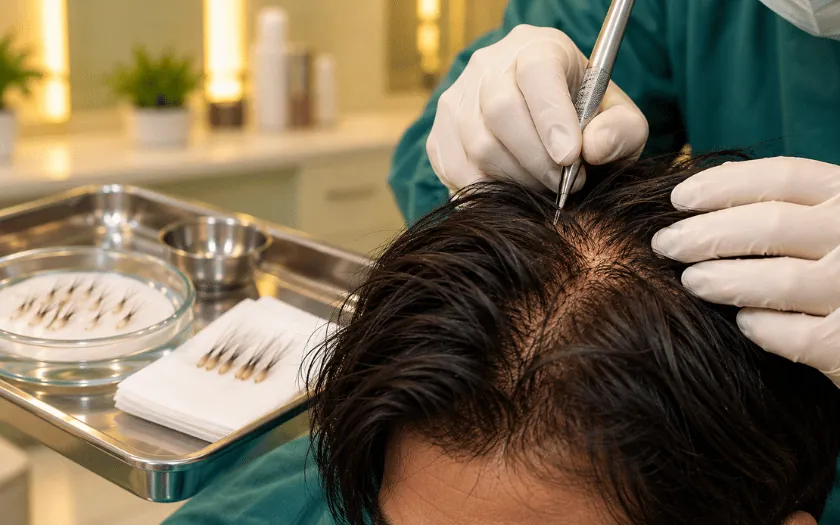
FUE stands for follicular unit extraction. Hair naturally grows in small groups of one to a few hairs called follicular units. In FUE, these units are taken out one at a time from the donor area, usually the back and sides of the scalp where hair tends to resist pattern thinning, and placed into areas that have thinned or receded.
Because each graft is removed individually, the donor area is left with small circular wounds that heal as tiny scattered marks rather than one long line. Short hair usually hides them well once healed.
Why you may consider FUE
FUE may suit you if your hair loss has a clear cause and has stabilised, and your donor area has enough healthy hair to share. It is often considered for:
- A receding hairline or temple recession
- Thinning at the crown
- People who prefer to wear their hair short at the back
- Selected eyebrow, beard and scar restoration
- Adding grafts in patients who have had FUT before
It may not be the right first step if hair loss is still actively progressing, if a scalp condition needs treatment first, or if the donor area is limited. Some people are better served by medical treatment before, or instead of, surgery.
How the procedure works
- Assessment and planning
Your scalp, donor density and pattern of loss are examined, and the hairline is drawn to suit your age and face.
- Local anaesthesia
The donor and recipient areas are numbed, so you stay awake and comfortable.
- Controlled extraction
Follicular units are removed one by one, spread evenly so the donor area is not overharvested.
- Recipient sites and implantation
Tiny sites are made at the natural angle and direction of growth, and grafts are placed into them.
- Aftercare and follow up
You go home with written instructions and review visits to follow healing and growth.
Approaches we may use
Neither FUE nor FUT is better for everyone. FUT removes a thin strip of donor scalp that is divided into grafts, while FUE removes grafts individually. The choice depends on your donor area, how many grafts you may need over your lifetime and how you like to wear your hair. Some patients benefit from a combination of both.
Implanter based methods such as DHI, and sapphire blade FUE, describe how grafts are placed or how sites are made. They are variations in method, not separate types of transplant, and results depend far more on planning, graft handling and skill.
Benefits and limitations
- No long linear scar in the donor area
- Suits short hairstyles at the back
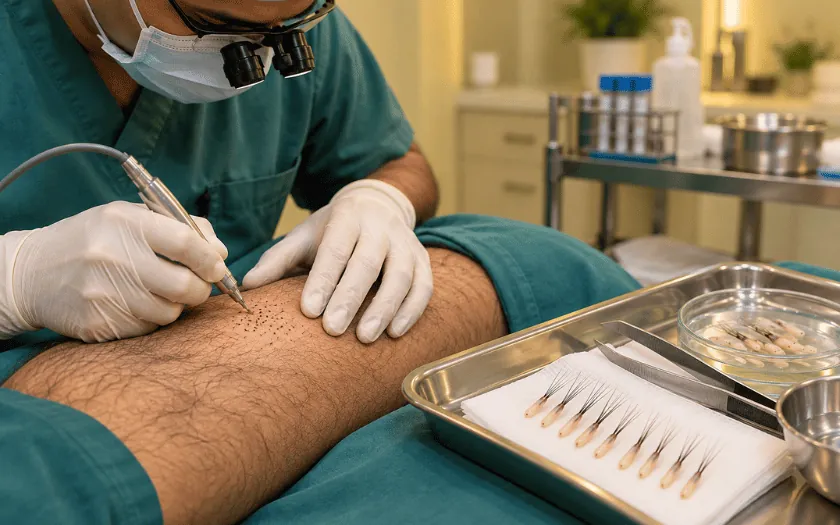
- Can use selected body hair as an extra donor source
- Useful for adding grafts after earlier FUT
- Donor hair is limited and must be planned for life
- Overharvesting can thin the donor area if not controlled
- The donor area is usually trimmed short for the procedure
- Does not stop thinning of your untreated original hair
Possible risks
No surgery is risk free. Possible effects include pain, swelling, minor bleeding, itching, temporary numbness, infection or folliculitis, temporary shedding of existing hair (shock loss), patchy or slower growth, and visible marks if the donor area is overharvested. Risks are reduced by careful planning, sterile technique, controlled extraction and early review of any concern, and they should be discussed with you in consultation.
Recovery and growth
Most people return to routine activity within days, following the washing and sleeping instructions they are given. Transplanted hairs commonly shed in the first weeks, new growth often starts after a few months, and results are usually judged at around a year, with the crown sometimes taking longer. Timelines vary from person to person.
What affects the cost?
The exact cost can be discussed after consultation and assessment. It depends on the area to be covered, the number of grafts planned, whether FUE is combined with FUT or medical treatment, the complexity of the case, and follow up care.
Why choose Elegance Clinic
- Your transplant is planned by a plastic surgeon
- Donor extraction is planned against your lifetime supply, not a single session
- Hairline design follows your age, face and likely future hair loss
- Medical treatment is considered alongside surgery where it helps
- Consultations at two centres in Surat: Adajan and Vesu
Suitability, risks and recovery differ for each patient and are discussed during consultation.
Ready to talk, privately?
Your suitability, graft plan and donor strategy are decided at an in person consultation.
What this includes
FUE, approaches we offer
Which approach suits you is decided after your scalp and donor area are examined.


FUE questions
Still have a question?
Answers to what patients ask most about FUE. Your own plan is confirmed only after an examination.
FUE leaves many small round marks rather than one long line. They are usually hidden by short hair once healed, but they are not invisible, and overharvesting can make the donor area look thin.
Not for everyone. FUE avoids a linear scar, while FUT can suit people who need more grafts over time. The right choice depends on your donor area, your graft needs and your hairstyle.
It is done under local anaesthesia, so most people feel the injections at the start and pressure afterwards. Soreness in the first few days is common and is managed with prescribed medicines.
It depends on the area to cover, the density you want, your hair type and how much donor hair you have. A graft estimate is made at consultation and is planned against your lifetime donor supply.
A follicle that is removed does not grow back in the donor area. This is why donor hair is limited and why extraction is spread out carefully.
Many people with desk jobs return within days, depending on swelling, crusting and how visible the area is. Your own timeline is discussed before surgery.
Often, yes. Transplanted hair usually lasts, but untreated original hair can keep thinning. Medical treatment may be advised to protect the hair you already have.
Book a consultation
Begin with a conversation.
Every plan starts with an in person assessment by Dr. Ashutosh Shah. Call or WhatsApp the clinic and our team will get back to you.
Book on WhatsApp
Chat with our team on WhatsApp about any treatment, consultation or appointment.
- Ask about any treatment
- Book a consultation
- Get directions to our clinics
WhatsApp opens with a short message ready to send. The clinic team replies during working hours.