
Hair Transplant
Does Hair Transplant Leave Scars? FUE Dots, FUT Lines and the Donor Area
Yes, every hair transplant leaves some scars. FUE leaves many tiny dot scars, while FUT leaves one fine line, and both are usually hidden by surrounding hair.
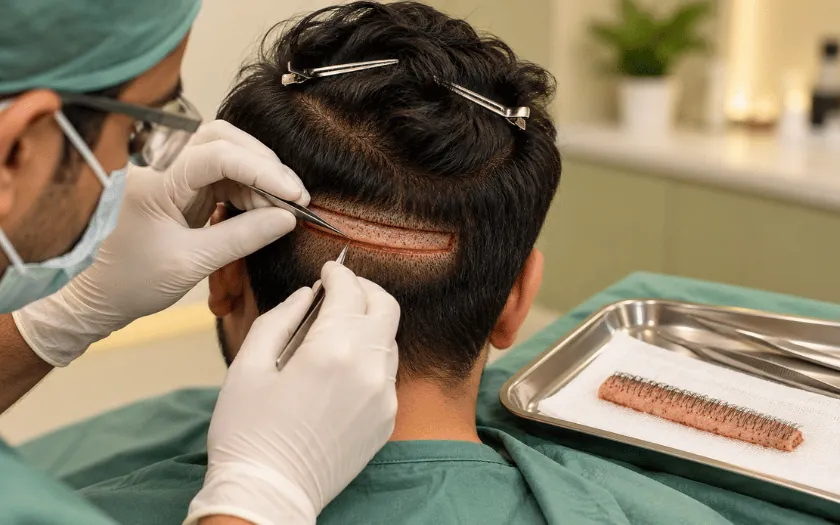
Does hair transplant leave scars? Yes. Every hair transplant method leaves some scarring, because follicles are removed through the skin. With FUE the scars are many tiny dots spread across the donor area, and with FUT there is one fine linear scar. In most people these scars are hidden by surrounding hair, but how visible they are depends on technique, healing and hairstyle.
- No technique is free of scars. The type and pattern of scarring differs.
- FUE scars are small, scattered dots. FUT leaves a single line at the back of the head.
- Overharvesting, tension on the wound and personal healing tendency affect how scars look.
- Visible scars can often be improved with scar grafting or scalp micropigmentation.
Why does a hair transplant leave scars?
A scar forms whenever the full thickness of the skin is cut and then heals. In a hair transplant, follicles are taken from the donor area, usually the back and sides of the scalp, and placed in thinning areas. Removing them requires small cuts, and healing of these cuts leaves marks.
The recipient area also receives tiny incisions for each graft. These usually heal with very little visible change, although small bumps, slight pitting or colour changes can occasionally occur.
What do FUE scars look like?
In follicular unit excision, known as FUE hair transplant, a small round punch, typically under one millimetre wide, is used to remove each graft. Each removal leaves one small round scar.
- Appearance: tiny white or pale dots, sometimes slightly larger than the punch used.
- Pattern: scattered randomly, which makes them hard to see.
- Short hair: they are generally less noticeable than a line with very short haircuts, provided the donor area was not overharvested.
An interesting point, noted by the International Society of Hair Restoration Surgery, is that FUE can create more total scar tissue than strip surgery for the same number of grafts. The eye simply notices a line more easily than scattered dots.
What is the FUT linear scar?
In follicular unit transplantation, or FUT hair transplant, a thin strip of scalp is removed from the back of the head and the edges are closed with stitches. This leaves one linear scar, usually running from ear to ear behind the head.
- When healed well, the line is often narrow and hidden under hair of moderate length.
- It may show with very short clipper cuts or if it heals wider than expected.
- Techniques such as a closure that allows hair to grow through the scar can help camouflage it.
A wider scar is more likely when too much skin is removed, when the wound is closed under high tension or when the skin is naturally lax or prone to stretching.
What makes donor area scars more visible?
Overharvesting
Taking too many grafts from one area thins the donor zone. The scalp can look see through or patchy, and the damage cannot be reversed. Careful donor area planning spreads extraction and keeps enough hair to cover the scars.
Punch size and depth
Larger punches or rough extraction can leave bigger dots. Damage to nearby follicles, called transection, can also reduce local density.
Personal healing tendency
Some people naturally form thicker, raised scars, including keloids. Darker skin types may show lighter or darker marks. Tell your doctor if you have ever had a keloid or unusual scar.
Hairstyle
Very short or shaved styles reveal more of the donor area. If you like to keep your hair very short, discuss this before choosing a technique.
Does hair transplant leave scars in the recipient area?
Usually very little. The small slits heal quickly. Occasionally patients notice tiny bumps, a slight ridge, small cysts or areas of lighter skin. These are more common with larger incisions or when grafts are placed too deep or too shallow. Most settle over months.
How long do scars take to settle?
Healing follows a general pattern, although it varies:
- First 1 to 2 weeks: small scabs form and fall away. FUT stitches are usually removed around 10 to 14 days.
- First few months: scars may look pink or red and gradually fade.
- 6 to 12 months: scars usually mature, becoming paler and flatter.
Can hair transplant scars be treated or hidden?
Yes, several options can make scars less noticeable:
- Letting hair grow slightly longer over the donor area.
- Grafting into the scar, placing follicles into a linear scar or a patch of dots. Our page on scar hair transplant explains this.
- Scalp micropigmentation, which uses tiny pigment dots to blend scars with the surrounding shaved hair.
- Medical scar treatment for raised or thick scars, as advised by a doctor.
Choosing a technique with scars in mind
Neither FUE nor FUT is right for everyone. FUE may suit people who wear short hair and need a moderate number of grafts. FUT may suit some people who need many grafts and wear their hair longer. Your doctor can explain the trade offs for your scalp, and the cost factors for each, such as graft numbers and time in surgery. The exact cost can be discussed after consultation and assessment.
When should you see a doctor about a scar?
Ask for a review if a scar becomes thick, raised, itchy or painful, if it keeps widening after the first few months, or if the donor area looks noticeably thinner than before surgery. Signs of infection, such as spreading redness, pus or fever during healing, need prompt attention. If you are planning a transplant and have had problem scars in the past, mention this at your first visit so the plan can take it into account.
Book a consultation at Elegance Hair Restoration Centre in Surat to discuss your donor area, your preferred hairstyle and the technique that fits you.
Related treatments and conditions
Sources
- ISHRS: Is FUE scarless?
- Journal of Cutaneous and Aesthetic Surgery (PMC): Donor harvesting, follicular unit excision
- International Journal of Trichology (PMC): Complications of hair restoration surgery, a retrospective analysis
- NHS: Hair transplant
This article is for general information only. Treatment depends on each patient’s condition and should be decided after consultation with a qualified doctor. Medically reviewed by Dr. Ashutosh Shah, M.B.B.S., M.S., M.Ch., D.N.B. (Plastic Surgery), Gujarat Medical Council Reg. No. G-26257. See the medical disclaimer.
More in Hair Transplant
Questions patients ask
Straight answers, before you decide.
These are the questions that come up most often in consultation. If yours is not here, send it on WhatsApp and the team will reply.
Many people can wear quite short hair after FUE, because the dot scars are scattered. With a completely shaved head, small pale dots may still be visible up close, especially if many grafts were taken. How noticeable they are depends on skin tone, hair colour, extraction density and healing.
Most FUT scars settle in the first year and then stay stable. Some can stretch, particularly if the scalp was very tight, the wound was closed under tension or a person is prone to wide scars. Avoiding heavy strain on the neck and scalp while healing may help, and your surgeon will give specific advice.
Scars fade and become paler over 6 to 12 months, but they do not disappear entirely. In most people they are hidden by surrounding hair. When they remain visible, grafting hair into the scar or pigment camouflage can reduce how much they show.
A history of keloids needs careful discussion. Some surgeons may suggest a small test session first to see how the scalp heals before a larger procedure. The risk of raised scars in both the donor and recipient areas should be weighed against the expected benefit.
Neither avoids scars. FUE leaves many small dots that are harder to see with short hair, while FUT leaves one line that is hidden with longer hair. The choice depends on hairstyle, graft needs, donor density and scalp laxity, so it is best judged after an examination.