
Types of hair transplant
FUT hair transplant, or strip surgery
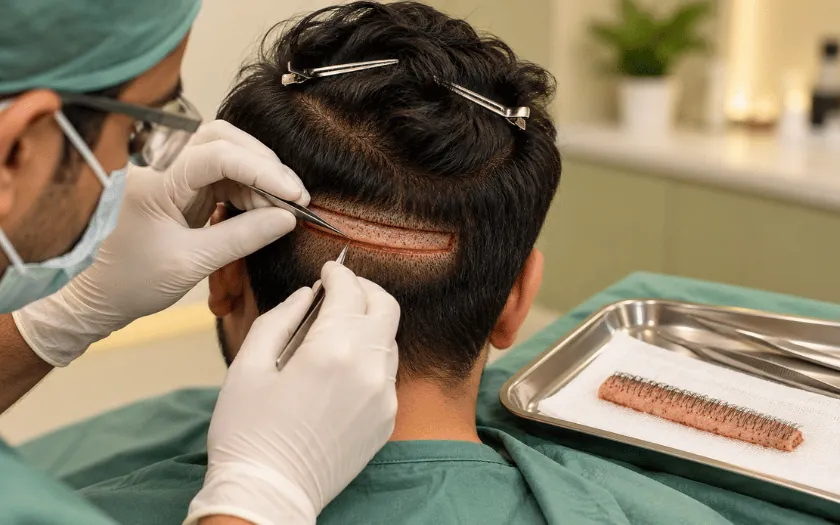
A thin strip of donor scalp, divided into natural grafts under magnification.
An FUT hair transplant removes a thin strip of scalp from the back of the head, divides it into follicular units and places them where hair has thinned. It can make efficient use of the donor supply in selected patients, at the cost of a fine linear scar, so it is chosen after your scalp, donor area and future needs are examined.
Last updated · Medical review: Dr. Ashutosh Shah, M.B.B.S., M.S., M.Ch., D.N.B. (Plastic Surgery), Gujarat Medical Council Reg. No. G-26257
 Strip harvesting, planned for life
What is an FUT hair transplant?
FUT stands for follicular unit transplantation. It is one of the two ways to harvest grafts from the scalp, the other being FUE. In FUT, a thin strip of skin is taken from the donor area at the back and sides of the head, where hair tends to resist pattern thinning. The wound is closed with stitches, and the strip is then divided into follicular units, the natural groups of one to a few hairs.
Because the grafts are cut out of the strip under magnification rather than punched out one by one, many surgeons regard FUT as an efficient way to obtain a larger number of grafts from a limited area. The trade off is a single fine line in the donor area, which is usually covered by the hair around it but is not invisible if the hair is cut very short.
Like every hair transplant, FUT redistributes hair you already have. It does not create new hair, and it does not stop untreated native hair from continuing to thin.
Who FUT suits, and who it may not
FUT is not an old technique to be avoided, nor is it right for everyone. It may be considered for:
- Selected advanced hair loss where a large number of grafts may be needed
- People who wear their hair medium length or longer at the back
- Patients who want to keep the rest of the donor area untouched for possible future sessions
- People with a scalp that is loose enough to close comfortably after a strip is removed
- Planned hybrid cases, where FUT is combined with FUE to use more of the donor supply
It may not suit people who like a very short or clipped haircut at the back, those with a tight scalp, people who tend to form wide or raised scars, or anyone whose hair loss has not yet been diagnosed and stabilised. Young patients with an uncertain future pattern need particularly careful planning, whatever technique is used.
How you are assessed for FUT
The decision starts with a diagnosis, not with a technique. The cause of your hair loss is confirmed, and any scalp condition or active shedding is treated first. The donor area is then examined in detail:
- Scalp laxity: how easily the scalp moves, which affects how wide a strip can be closed without tension
- Donor density and hair calibre: how many follicular units there are and how thick each hair is
- Signs of donor thinning: miniaturisation in the donor area can make it less reliable
- Earlier surgery: an old FUT scar or earlier FUE harvesting changes the plan
- Lifetime graft needs: how much coverage you may want now and in later years
Your hairline and the areas to be covered are then drawn to suit your age and face, and FUT is compared honestly with FUE and a hybrid approach before anything is decided.
How strip surgery is done
- Marking and anaesthesia
The strip and recipient areas are marked, and both are numbed with local anaesthesia, so you stay awake.
- Strip removal
A thin strip is taken from within the safe donor zone. Only the strip area needs trimming, so the hair above can often cover it the same day.
- Donor closure
The wound is closed with stitches or staples. Some surgeons use a closure that lets hair grow through the scar edge to help it blend.
- Graft dissection
The strip is divided under magnification into individual follicular units and kept cool and moist while the rest of the work continues.
- Recipient sites and placement
Tiny sites are made at the natural angle and direction of growth, with finer single hair grafts at the front, and grafts are placed into them.
The procedure usually takes most of a day. Graft handling, the time grafts spend outside the body and careful placement matter far more to the result than the name of the technique.
FUT versus FUE, an honest comparison
- Can yield large graft numbers in selected patients
- Efficient use of a limited donor supply
- Low transection of follicles in experienced hands
- Only the strip area needs trimming
- May preserve untouched donor area for later
- Leaves a fine linear scar
- Needs stitches or staples and their removal
- Donor area heals more slowly than after FUE
- Tightness and numbness are common for a while
- May limit very short hairstyles at the back
FUE avoids a linear scar and suits short hairstyles, but grafts must be spread carefully to avoid overharvesting. In some patients both are used together, or in separate sessions, so that more of the donor supply can be used safely. You can read more on the FUE hair transplant page.
FUT recovery, side effects and risks
Most people return to desk work within days to about a week, depending on comfort and how visible the recipient area is. The donor area often feels tight and sore at first, and stitches or staples are usually removed after around one to two weeks. Strenuous exercise and bending are limited for a period so the donor wound can heal without strain.
No surgery is risk free. Possible side effects include pain, swelling of the forehead, minor bleeding, numbness or altered sensation around the donor area, infection, a scar that widens or thickens, temporary shedding of nearby hair (shock loss) and patchy or slower growth. A wider scar is more likely when the scalp is tight or tension is high. Risks are reduced by careful selection, sterile technique and early review of any concern.
Transplanted hairs commonly shed in the first weeks. New growth often begins after a few months, and the result is usually judged at around a year. Results vary, and they depend on donor quality, graft handling, the density planned and whether native hair is protected with medical treatment.
FUT cost factors and choosing a specialist
The cost of an FUT hair transplant is discussed after consultation. It depends on the area to be covered, the number of grafts planned, whether FUT is combined with FUE, the complexity of the case, medical treatment alongside surgery and follow up care. A very low package price offered before any examination is a reason to ask more questions.
When you compare an FUT hair transplant clinic or doctor, ask who examines your donor area, who is the senior doctor responsible for your surgery and which steps each team member performs. An FUT hair transplant specialist should talk about scalp laxity, the scar, your lifetime donor supply and the alternatives, not just graft numbers. If you would feel more comfortable with a lady doctor or a male doctor present during examination, it is reasonable to ask when you book. At Elegance Clinic in Adajan and Vesu, every transplant is planned by a plastic surgeon, and FUT is recommended only when it fits your scalp and your plans.
Suitability, risks and recovery differ for each patient and are discussed during consultation.
Is FUT right for your scalp?
Laxity, donor density and lifetime graft needs are checked in person before any technique is advised.
FUT questions
Still have a question?
Answers to what patients ask most about strip surgery. Your own plan is confirmed only after an examination.
It is usually a fine line hidden by the hair around it. It can show with very short clipped hair, and it can widen in some people, especially when the scalp is tight.
Usually not. Only the strip area is trimmed, and the longer hair above often covers it. The recipient area may or may not need trimming depending on the plan.
No. It remains a valid option for selected patients, particularly those who may need many grafts over time. Whether it suits you depends on laxity, donor density and hairstyle.
Often, yes. FUE can take grafts from areas the strip did not reach, and grafts can sometimes be placed into an old scar to soften it.
Tightness usually eases over the first weeks. Numbness or altered sensation can last longer and commonly settles gradually over months. Tell your surgeon if it worsens.
In some people a second strip can be taken, usually including the old scar, if the scalp is still loose enough. Donor supply is limited, so later sessions are planned from the start.
Often, yes. Transplanted hair usually lasts, but untreated native hair can keep thinning. Your doctor may advise medical treatment to protect the hair you already have.
Book a consultation
Begin with a conversation.
Every plan starts with an in person assessment by Dr. Ashutosh Shah. Call or WhatsApp the clinic and our team will get back to you.
Book on WhatsApp
Chat with our team on WhatsApp about any treatment, consultation or appointment.
- Ask about any treatment
- Book a consultation
- Get directions to our clinics
WhatsApp opens with a short message ready to send. The clinic team replies during working hours.