
Hair transplant FAQ: 33 questions answered
Every question, answered plainly.
This hair transplant FAQ brings together the 33 questions patients ask most, from suitability and grafts to recovery, women, myths and shock loss. Type a word to find an answer quickly.
Questions patients ask
Straight answers, before you decide.
These answers are general. Your own suitability, plan and likely result can only be judged after an examination, and results vary from person to person.
Suitability depends on the cause of your hair loss, how stable it is, the quality and quantity of your donor hair, your general health and your expectations. Some causes of hair loss are better treated medically, and a transplant is not the right first step for everyone. An examination is needed to answer this properly.
There is no single correct age. In young patients the final pattern of hair loss is often not yet clear, so surgery done too early may leave an unnatural look as loss progresses. Younger patients are usually advised to stabilise their hair loss medically and plan carefully before considering surgery.
Hair taken from the safe donor zone is generally less sensitive to DHT, so transplanted follicles often keep growing for the long term. However, no outcome can be promised. Growth varies between individuals, and the hair around the transplant may continue to thin.
Possibly, yes. A transplant redistributes donor hair; it does not stop pattern hair loss in your native hair. This is why medical treatment to protect existing hair is often advised alongside surgery, and why planning must allow for future loss.
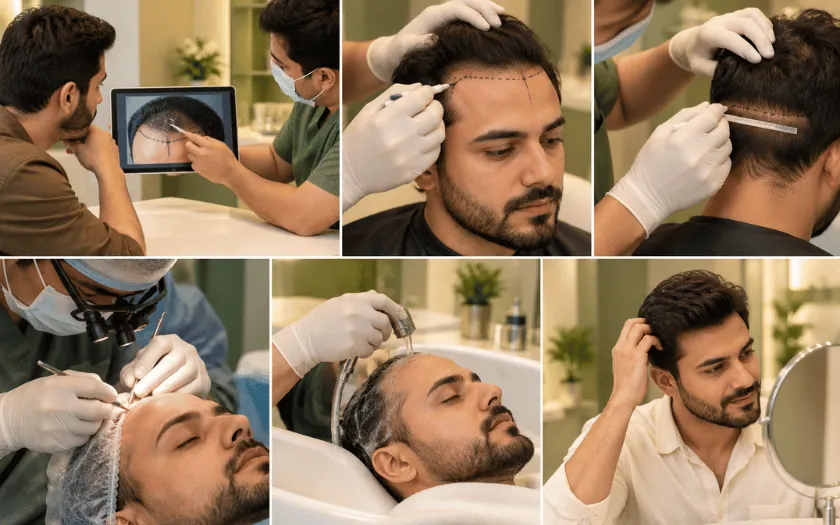
Neither is better for everyone. FUT removes a strip of scalp and leaves a fine linear scar, and it can be useful when a large number of grafts is needed. FUE extracts follicles one by one and leaves small dot scars. The right choice depends on your donor area, hairstyle, future needs and the surgeon's assessment.
DHI is not a separate type of transplant. It is a way of implanting grafts using implanter devices, and the grafts are usually extracted by FUE. Whether implanters, forceps or another method is used, the result depends far more on planning, graft handling and surgical skill than on the name of the technique.
Sapphire refers to the material of the blade used to make the small recipient sites where grafts are placed. It is one choice of instrument, not a different kind of transplant. It does not by itself guarantee better growth or density.
It depends on the area to be covered, the density you hope for, the character of your hair and, most importantly, how much donor hair you have. A reliable estimate can only be given after examination. Graft numbers should be planned against your lifetime donor supply, not just the current bald area.
No. Donor hair is limited, and each follicle removed does not grow back in the donor area. Taking too many grafts can leave the donor area visibly thin or patchy. Responsible planning keeps enough donor reserve for the future.
The procedure is done under local anaesthesia, so most of the discomfort is felt during the anaesthetic injections. Afterwards, soreness, tightness or swelling can occur for a few days and is usually managed with prescribed medicines. It is not painless, but most patients find it manageable.
Yes, every technique leaves some scarring. FUT leaves a fine linear scar at the back of the head, and FUE leaves many small dot scars. With adequate hair length these are usually well hidden, but they may be visible if the head is shaved very short.
Many people with desk based work return within a few days to a week, depending on the technique and how comfortable they are with visible scabs and redness. Physically demanding work, heavy exercise and helmet use usually need a longer break. You will be given specific advice for your situation.
Transplanted hairs often shed in the first few weeks, which is expected. New growth commonly starts a few months later and continues to mature and thicken over many months. The crown and scar areas are often slower, and the timeline varies from person to person.
Yes, in selected cases, such as a stable frontal hairline concern, traction alopecia, scars or eyebrow restoration. Many women have diffuse thinning that also affects the donor area, and in these cases medical diagnosis and treatment come first. A careful assessment, sometimes including blood tests, is essential.
Yes. Grey or white hair can be transplanted in the same way as dark hair. The transplanted hair keeps its original colour, so grey hair will grow back grey.
In selected patients, beard hair can be used as an additional donor source when scalp donor hair is limited. Beard hair has a different texture and growth pattern, so it is usually placed to add density, often in the crown, rather than at the front hairline. Whether it suits you depends on examination.
Often, yes, once the scar is mature and stable and has adequate blood supply. Scar tissue can accept grafts less reliably than normal scalp, so growth may be lower and more than one session is sometimes needed. A smaller test session may be advised in some cases.
Many can be improved. Correction may involve removing or redistributing poorly placed grafts, refining the hairline, adding grafts for density or using scalp micropigmentation. What is possible depends largely on how much donor hair remains.
Well controlled diabetes or thyroid disease does not usually rule out surgery, but both need assessment beforehand. Poor sugar control can slow healing and raise the risk of infection. An untreated thyroid imbalance can itself cause hair shedding, so it should be corrected first.
No. PRP is a supportive treatment that may help some patients, and the evidence for it is mixed. It is not a substitute for diagnosis or for proven medical treatment, and a transplant does not require it. Whether it is worth adding is an individual decision.
Minoxidil works only while it is being used. If it is stopped, the hair it was supporting tends to shed over the following months. It does not affect the transplanted hair in the same way, but it can help preserve native hair, so your doctor will advise whether continuing makes sense for you.
Finasteride lowers DHT while it is taken. After stopping, DHT levels return and pattern hair loss usually resumes, so the benefit is gradually lost over months. Any decision to start or stop it should be made with your doctor, who can discuss benefits and possible side effects.
No. There is no scientific evidence that masturbation causes hair loss. Pattern hair loss is driven mainly by genetics and the effect of DHT on sensitive follicles.
No, a helmet does not cause pattern hair loss. A very tight helmet worn for long hours can cause friction or traction, and a sweaty, unclean lining can irritate the scalp. Wearing a well fitting helmet with a clean lining or cotton cap is sensible, and safety should always come first.
No. The hairs seen after washing are usually hairs that were already in the shedding phase and would have fallen anyway. Regular washing with a suitable shampoo keeps the scalp clean and can help conditions such as dandruff.
No. Shaving does not change the number, thickness or growth of follicles. Regrowing hair can feel coarser because it has a blunt tip, which is why this belief is common.
No. Oils can condition the hair shaft and make hair feel softer, but no oil can regrow follicles that have been lost. Heavy oiling may even worsen dandruff in some people.
Yes. Significant physical or emotional stress can trigger telogen effluvium, a diffuse shedding that often appears a few months after the stressful event and usually settles once the trigger resolves. Stress can also be associated with alopecia areata in some people.
Yes. Rapid weight loss and low protein or low calorie intake can trigger diffuse shedding, often noticed a few months later. Hair usually recovers once nutrition is restored, but any deficiency should be checked and corrected.
Usually not. Supplements help mainly when there is a documented deficiency, and they do not treat pattern hair loss. Taking high doses without need offers no benefit, and some, such as excess vitamin A or selenium, can even worsen hair fall. Biotin can also interfere with some blood tests.
Shock loss is temporary shedding of existing native hair near the recipient or donor area after surgery. It usually recovers over the following months. Hairs that were already very weak or miniaturised may not return, which is one reason medical treatment is often advised around surgery.
No. A follicle that has been fully extracted is moved to the recipient area and does not regrow in the donor site. This is why donor hair is treated as a limited, lifetime resource and must be planned carefully.
Signs include visible see through thinning at the back or sides, a patchy or moth eaten look, clusters of white dot scars, and extraction outside the stable donor zone. If you are concerned about your donor area after a previous transplant, an examination can assess what reserve remains.
How to read this hair transplant FAQ
Every answer on this page is written to be true for most people most of the time. That is useful when you are starting to learn, but it has a limit. Hair loss has many causes, and two people with the same bald patch can need completely different care. A general answer can point you in the right direction; it cannot tell you what is right for your own scalp.
You will notice that the answers often use words such as may, often and usually. This is deliberate. Growth after a transplant, the speed of recovery and the response to medicines all vary from person to person, and honest medical writing reflects that. Be cautious of any source that promises a fixed result, a fixed date or a fixed number of grafts before you have been examined.
- Use the search box to find a word such as grafts, pain, women, helmet or shock loss
- Read the related guide when an answer mentions a topic you want to understand in depth
- Note the questions that matter to you and bring them to your consultation
- Treat every answer as general education, not as a diagnosis or a treatment plan
Questions grouped by topic
The 33 questions follow the order most patients think things through: first whether a transplant is right for them, then how it is done, what recovery is like, and finally the many beliefs about hair fall that circulate among friends and online.
Suitability, age and permanence
Suitability depends on the cause of your hair loss, how stable it is and how much donor hair you have. Transplanted hair from the stable donor zone often keeps growing, but a transplant does not stop thinning of the hair you already have. The guide on hair transplant by patient group explains how planning differs for younger men, women and other groups.
Techniques and grafts
FUE, FUT, DHI and sapphire blades are often presented as competing products. In reality, FUE and FUT are two ways of taking grafts, while DHI and sapphire describe how grafts are placed or how sites are made. Read types of hair transplant and donor area planning to understand why graft numbers must be planned against a limited, lifetime supply.
Pain, scars, recovery and growth
These answers cover local anaesthesia, the marks each technique leaves, time off work and the months it takes for new hair to grow. The patient journey page walks through the timeline from the day of surgery to the first year and beyond.
Special situations
Women, grey hair, beard hair used on the scalp, burn scars and correction of an earlier transplant all need extra care in planning. See scarring alopecia and scar hair transplantation and non scalp hair transplant for more detail.
Medicines and general health
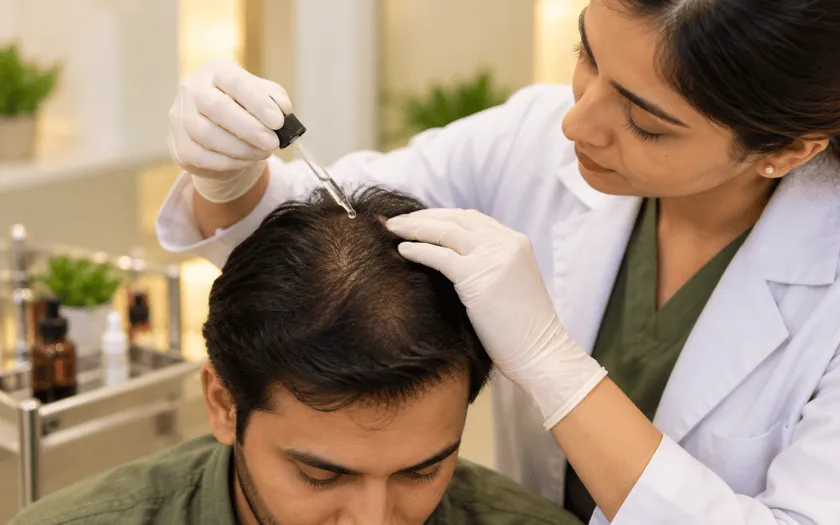
Diabetes, thyroid disease, PRP, minoxidil and finasteride come up in almost every consultation. The medical hair treatment guide explains how medicines protect native hair and why they work only while they are used.
Why myths about hair fall matter
Eight of the questions on this page are myths: masturbation, helmets, frequent shampooing, shaving, oils, stress, crash dieting and supplements. Some are simply untrue, and some contain a grain of truth that has been stretched. Stress and crash dieting, for example, really can trigger a temporary shedding, while helmets and shampooing do not cause pattern hair loss.
Myths matter because they delay proper care. A person who believes oil will regrow lost follicles may spend years on remedies while treatable hair loss progresses. Another may take high dose supplements without a documented deficiency, which offers no benefit and can occasionally make hair fall worse. If you have been told something about your hair that worries you, it is worth checking it against the answers here, and against the guide on causes of hair fall.
When a general answer is not enough
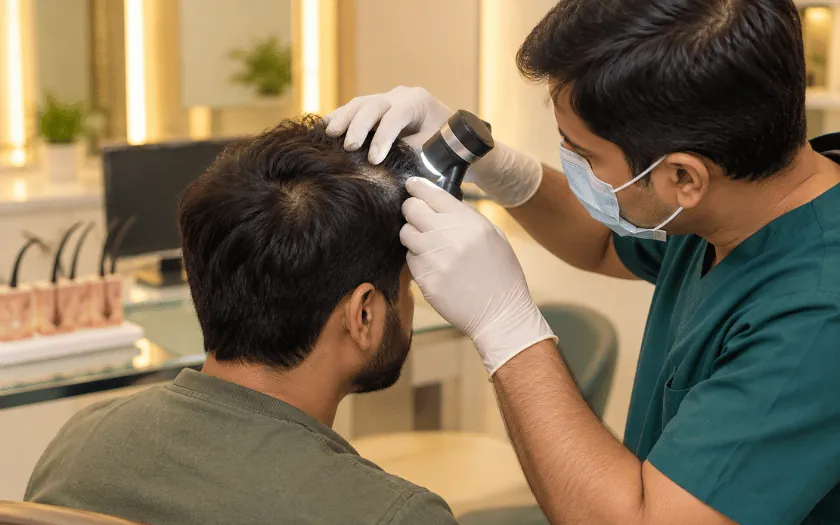
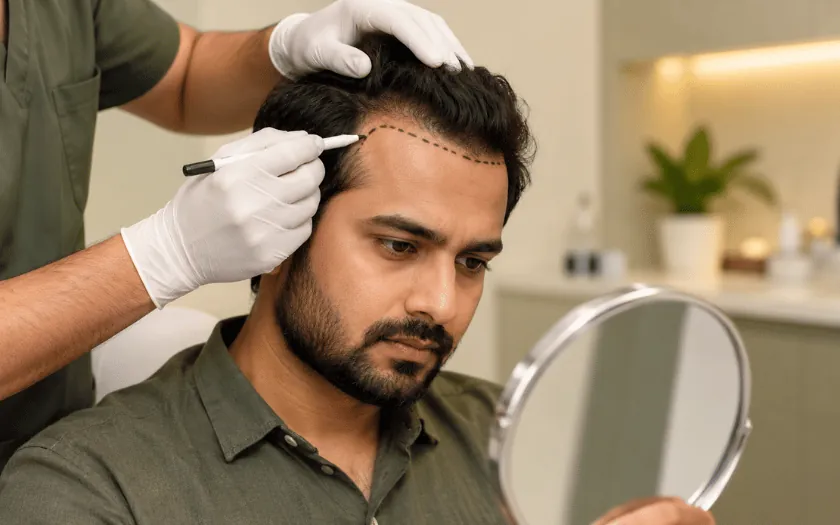
Some questions can only be answered for you personally. How many grafts you need, what your hairline should look like, whether your donor area can support a second session, or whether your shedding is temporary all depend on an examination of your scalp and your history.
- Send clear photos
An online hair assessment gives a preliminary opinion from photos and a short history. It is not a diagnosis.
- Book an in person consultation
Your scalp, hair shaft and donor area are examined, and tests are advised only where they are needed.
- Discuss a plan in your own terms
Options are explained, including medical treatment, non surgical choices and surgery, so you can decide without pressure.
Have a question not listed here?
Ask it in person. Your suitability and plan are decided only after an examination.
Browse by topic
Where each answer leads next
Each group of questions has a detailed guide behind it, for when a short answer is not enough.


Book a consultation
Begin with a conversation.
Every plan starts with an in person assessment by Dr. Ashutosh Shah. Call or WhatsApp the clinic and our team will get back to you.
Book on WhatsApp
Chat with our team on WhatsApp about any treatment, consultation or appointment.
- Ask about any treatment
- Book a consultation
- Get directions to our clinics
WhatsApp opens with a short message ready to send. The clinic team replies during working hours.