Hair Restoration Centres at Adajan & Vesu, Surat

Hair transplant in Surat

Your hairline, thoughtfully restored.

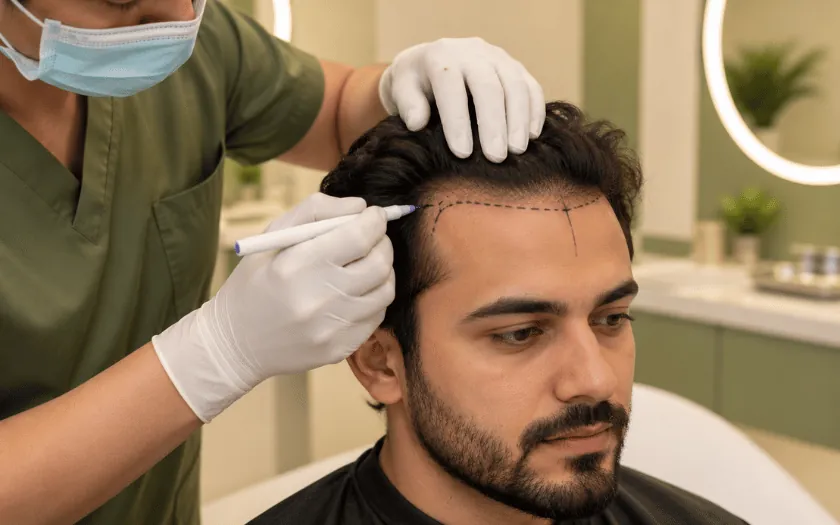
Plastic surgeon led FUE, FUT and hybrid hair transplantation in Surat, with every hairline planned around your face, your age and the donor hair you will need for the years ahead.

FUE · FUT

And hybrid techniques

2

Centres at Adajan & Vesu

Overview

What is a hair transplant?

A hair transplant is a surgical procedure that moves your own healthy follicles from a stable donor area to places where hair has thinned or been lost. Done well, the result grows, behaves and ages like your own hair, because it is your own hair.

Donor dominance. Hair at the back and sides of the scalp is usually far less sensitive to DHT, the hormone behind pattern hair loss. When these follicles are moved, they generally keep that resistance. This stable band is often called the stable donor zone, although its size and quality differ from person to person.

Follicular units. Hair grows naturally in small groups of one to four hairs. Modern surgery moves these units intact, which is what allows a soft, natural look rather than the tufted plugs of older methods.

Hairline planning. Before any graft is taken, the new hairline and the areas to be covered are designed around your facial proportions, age, pattern of loss and available donor hair.

Harvesting. Grafts are taken either as a thin strip (FUT) or as individual units (FUE), then trimmed and kept cool and moist until they are placed.

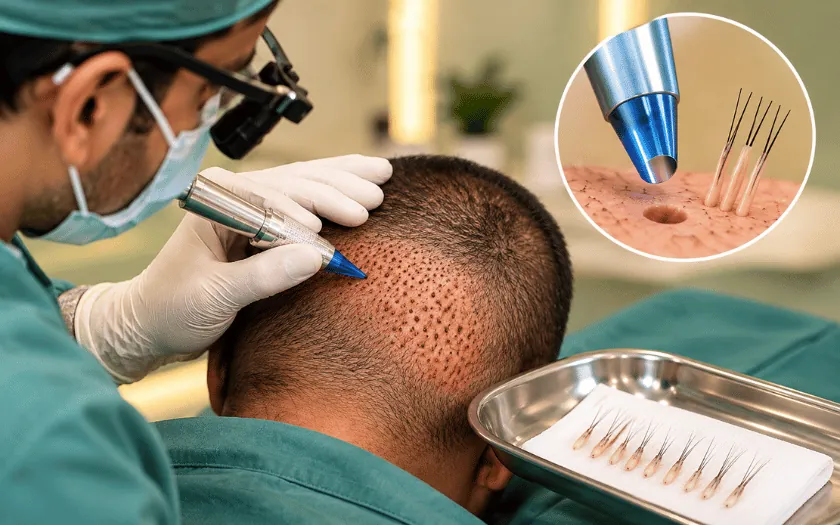
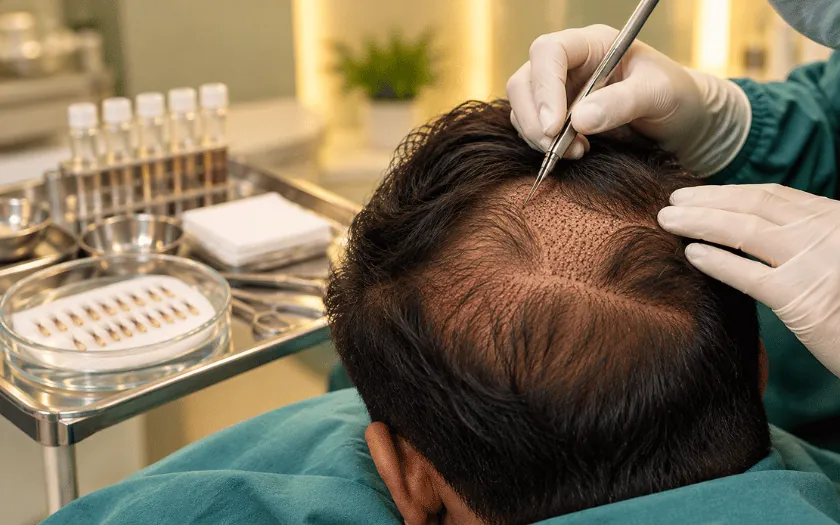
Recipient sites and implantation. Tiny openings are made in the thinning area at a planned angle, direction and density. Grafts are then placed one by one, with the thinnest single hair grafts at the front.

Healing, shedding and regrowth. Small crusts settle within the first couple of weeks. Most transplanted hairs then shed, which is expected. The follicles remain beneath the skin and usually begin to regrow after a few months, maturing over a year or more.

Density expectations. A transplant can create a convincing appearance of fullness, but it cannot recreate the original density of a young scalp. Honest planning matches the goal to the donor supply.

Your existing hair still needs care. Native hair around the transplant may continue to thin unless it is medically managed.

A transplant redistributes donor hair. It does not stop the genetic thinning of untreated native hair.

Techniques

Types of hair transplant.

There are two ways to harvest grafts, FUT and FUE, and many names for variations on them. Here is what each term really means, including the ones that are mostly marketing.

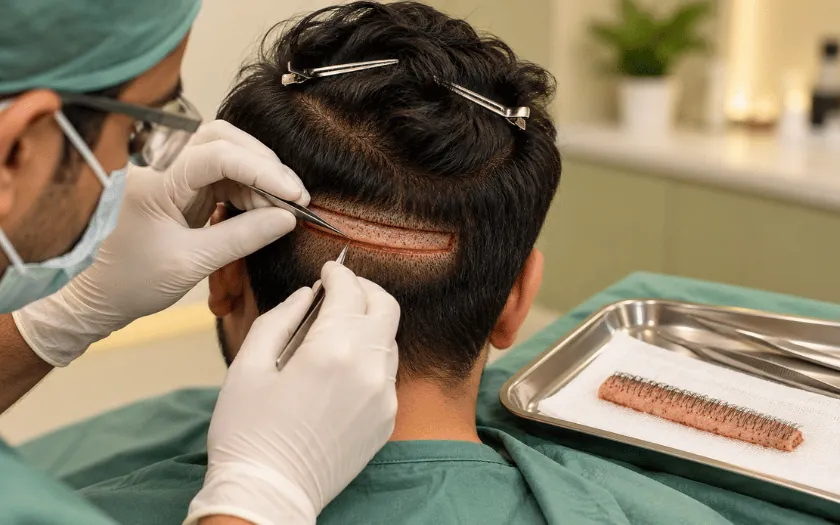
Donor strip and sutured donor area during an FUT hair transplant
01

FUT (strip surgery)

A thin strip of scalp is removed from the donor zone and divided under magnification into follicular units. It can yield large graft numbers efficiently and may preserve donor area for future sessions. The trade off is a fine linear scar, sutures and longer donor healing, which can limit very short hairstyles.

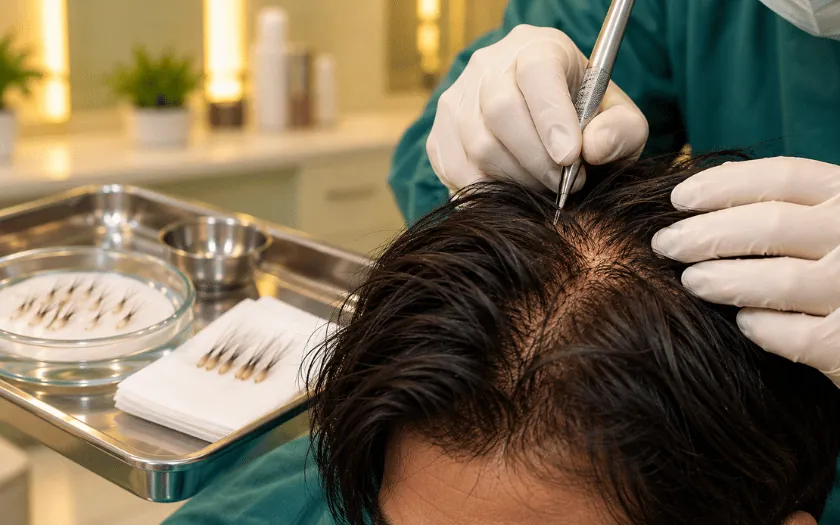
Surgeon extracting follicular units during an FUE hair transplant
02

FUE

Follicular units are extracted one at a time with a small punch, leaving tiny circular marks instead of a long linear scar. Scalp and selected body hair can be used. Extraction must be spread evenly and kept within safe limits, because overharvesting can leave the donor area visibly thin.

Read about FUE →
FUE graft extraction and hairline placement during a hair transplant
03

Hybrid FUT + FUE

For selected patients who need a high number of grafts, combining a strip with FUE from areas the strip does not reach can make fuller use of the donor supply while respecting its limits.

Grafts placed in long hair during an unshaven long hair FUE
04

Long hair FUE

A partial or non shaven approach that keeps existing hair longer, so the procedure is easier to conceal early on. It takes more time and technical care, and suits carefully selected patients and session sizes.

Surgeon implanting grafts with an implanter pen during a DHI hair transplant
05

DHI

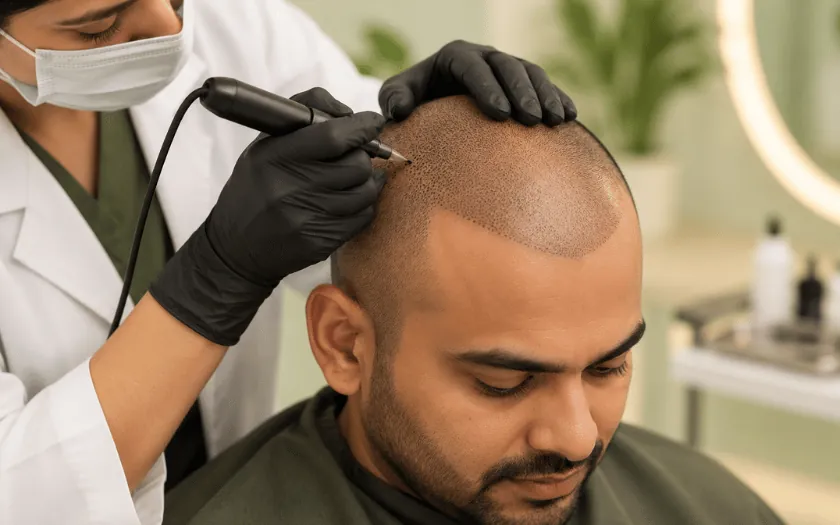
Direct Hair Implantation is an implantation method in which grafts are loaded into pen like implanter devices and placed into the scalp. It is a way of placing grafts, usually harvested by FUE, not a separate biological type of transplant.

Surgeon opening recipient sites with a sapphire blade
06

Sapphire FUE

Sapphire refers to the blade material used to make recipient sites. The result depends far more on planning, graft handling, angle, direction, density and surgical skill than on the blade's branding.

PRP prepared alongside grafts during an FUE hair transplant
07

Bio FUE

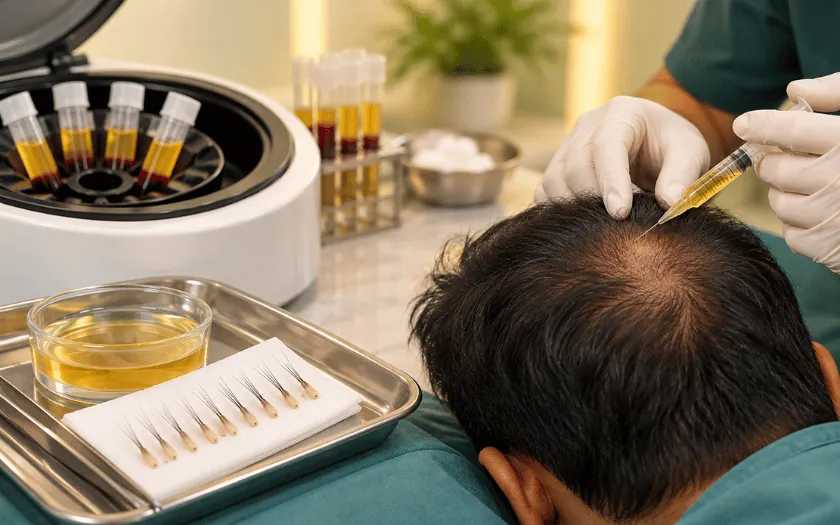
A marketing term without one agreed definition. It usually means FUE combined with PRP, growth factors or other supportive treatments. We describe exactly what is included, rather than rely on the label.

Surgeon extracting body hair grafts from the leg for a hair transplant
08

Body hair transplant

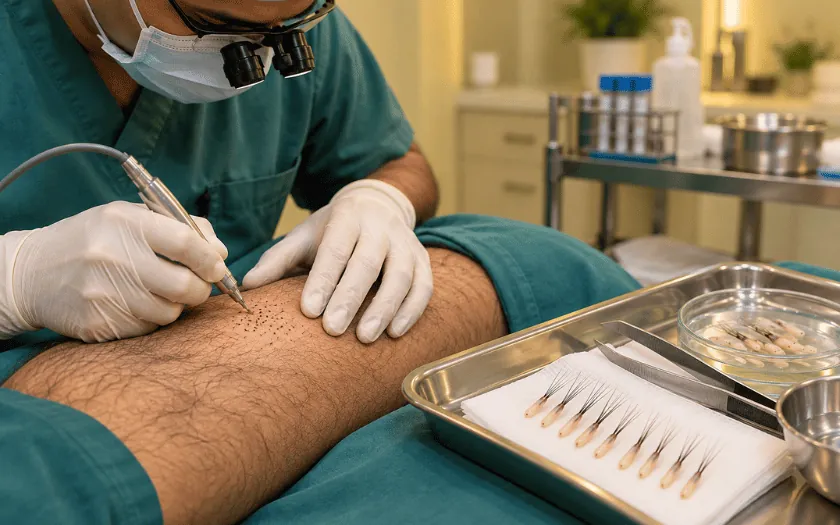
Beard to scalp, chest to scalp and other donor sites can add grafts when scalp donor hair is limited. Body hair differs in calibre, curl, growth cycle and length, so it is mainly a supplementary source, often used to add coverage in the crown.

Surgeon placing grafts to correct an earlier hair transplant at the crown
09

Corrective and repair transplant

Repair of earlier work: pluggy grafts, a hairline placed too low or looking unnatural, hair growing in the wrong direction, thin density, an overharvested donor area that needs camouflage, scar revision, and removal and redistribution of misplaced grafts.

Read the full guide: Types of hair transplant →

Who it is for

Planned around who you are.

Suitability depends on the cause and stability of your hair loss, the quality of your donor area and what you hope to achieve. Every plan begins with a diagnosis, not a graft number.

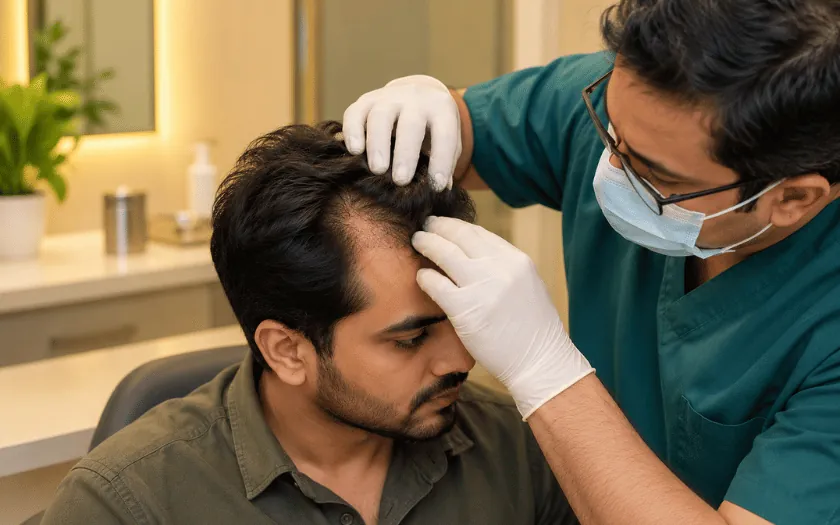
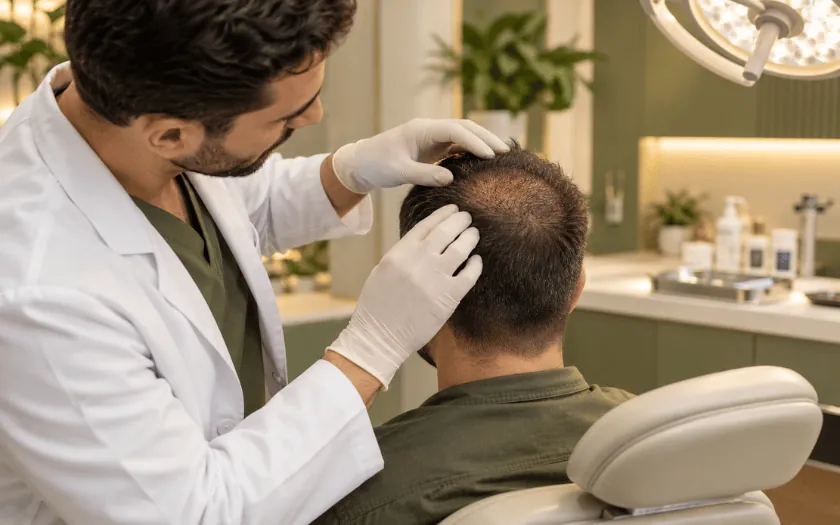
Doctor examining a man's receding hairline before a hair transplant
01

Male hair transplant

For a receding hairline, frontal or crown hair loss and advanced grades, usually combined with medical treatment to protect the hair you still have.

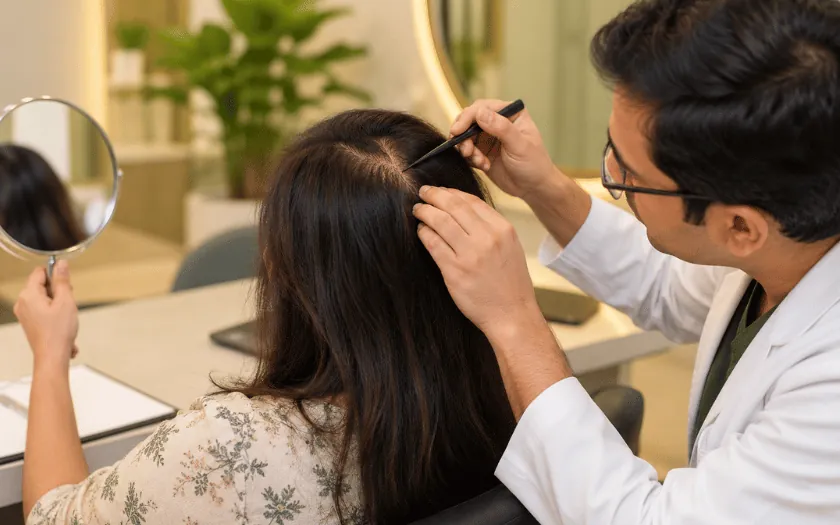
Doctor assessing a woman's hairline and parting for a hair transplant
02

Female hair transplant

For hairline lowering, temporal recession, stable female pattern loss, traction alopecia once the tension has stopped, and scar correction. The donor area needs particularly careful assessment in women.

Doctor assessing a woman's hairline and parting for a hair transplant
03

Young patients

Hair loss is progressive and the future pattern is uncertain. We favour medical stabilisation first, a conservative hairline, donor preservation and a long term plan that allows for possible future sessions.

Doctor examining a man's receding hairline before a hair transplant
04

Advanced grade hair loss

With limited donor supply, grafts go to priority zones first. Options include FUT, FUE or hybrid, beard graft supplementation, staged surgery, and combining with SMP or a hair system for a realistic result.

Doctor reviewing scalp images of an earlier hair transplant with a patient
05

Revision hair transplant

For results from a previous procedure that did not meet expectations. We assess the earlier work and remaining donor hair first, then explain which corrections are realistic.

Read the full guide: Hair transplant by patient group →

Patient waiting lounge at Elegance Clinic, Surat

Gender affirming care

Transgender hair restoration, with respect.

  1. i

    Feminising hairline transplant

    A softer, rounder and often lower hairline with temple closure, planned with your donor supply and any facial feminisation surgery in mind.

  2. ii

    Masculinising facial hair transplant

    Beard, moustache and sideburn design, with direction and angle planned for natural growth, after assessing hormone status.

  3. iii

    Temporal and frontal contouring

    Reshaping temple points and the frontal contour to support overall facial balance, alone or with a hairline transplant.

  4. iv

    Beard and moustache creation

    Full facial hair design using scalp donor hair, with density planning, aftercare and regular trimming explained in advance.

  5. v

    Restoration after facial surgery

    Hair restoration around scars or hairline changes after facial feminisation or other surgery, timed to healing and often staged.

  6. vi

    Hormonal therapy coordination

    Oestrogen, anti androgens and testosterone can all affect scalp and facial hair. Surgery is timed around your therapy, in coordination with your endocrinologist.

  7. vii

    Privacy and gender affirming care

    Your chosen name and pronouns, private consultations, confidential records and photographs taken only with your consent.

Beyond the scalp

Eyebrow, beard and scar.

The same principles of graft handling and design apply to the face and to scars, where direction, angle and a surgeon's understanding of healing tissue matter even more.

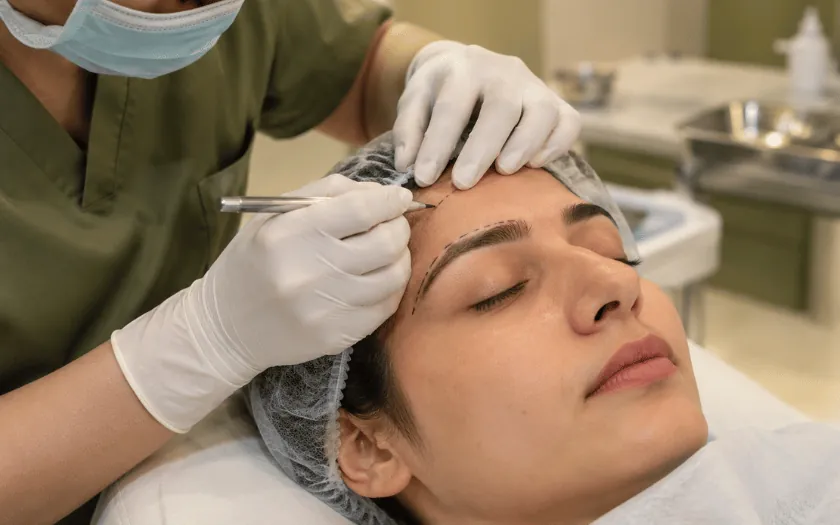
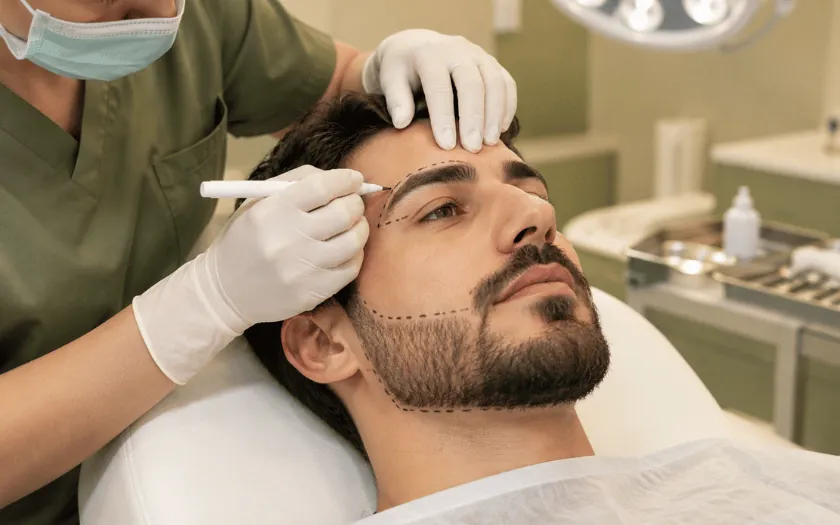
Surgeon marking the eyebrow design before an eyebrow transplant
01

Eyebrow transplantation

For naturally thin brows, over plucking, scars and burns, or stable alopecia related loss. Grafts are placed almost flat, following the natural direction of each part of the brow. Because the hair comes from the scalp, it keeps growing and needs regular trimming.

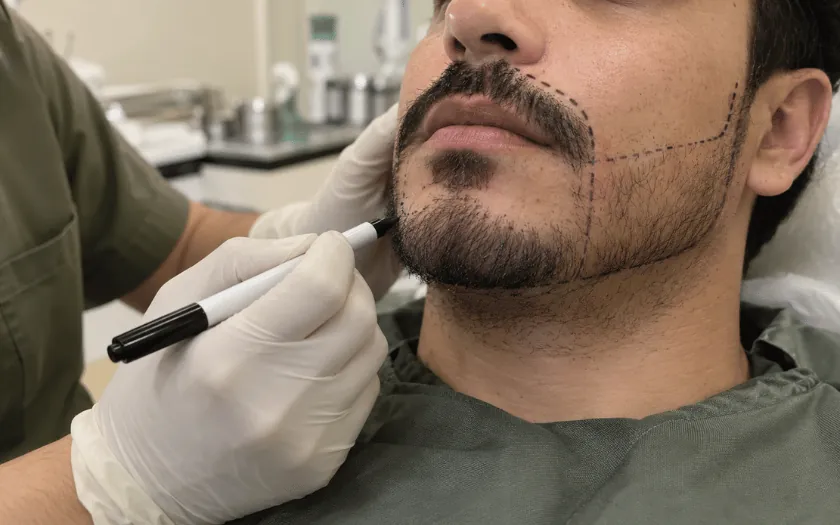
Surgeon marking a man's beard line before a beard transplant
02

Beard & moustache transplantation

For a patchy beard, naturally low density, scar correction or masculinisation. Each area is planned for the direction and angle of natural facial hair so the result blends as it grows.

Surgeon marking a man's beard line before a beard transplant
03

Sideburn transplantation

Reconstruction of sideburns that are thin, absent or lost after surgery, with careful design, density and direction planning so they connect naturally with the scalp and beard.

Surgeon extracting body hair grafts from the leg for a hair transplant
04

Chest hair restoration

Considered only for carefully selected patients, after a frank discussion of donor use and realistic expectations.

Doctor examining a scar in the hair before a scar hair transplant
05

Scar hair transplantation

Hair restoration into trauma, burn, surgical, cleft related, facelift, neurosurgical, previous FUT and accident scars. Scar tissue has a poorer blood supply, so grafts are spaced with care and treatment is often staged.

Intimate hair restoration may also be available under reconstructive care, for loss after scarring, burns, surgery or congenital absence, discussed only in a private and confidential consultation.

Read the full guide: Beard, eyebrow and non scalp transplant →

Design

Hairline design, for a lifetime.

A hairline is the first thing people notice and the hardest thing to undo. It should suit your face today and still look right as you age and as any further loss appears around it.

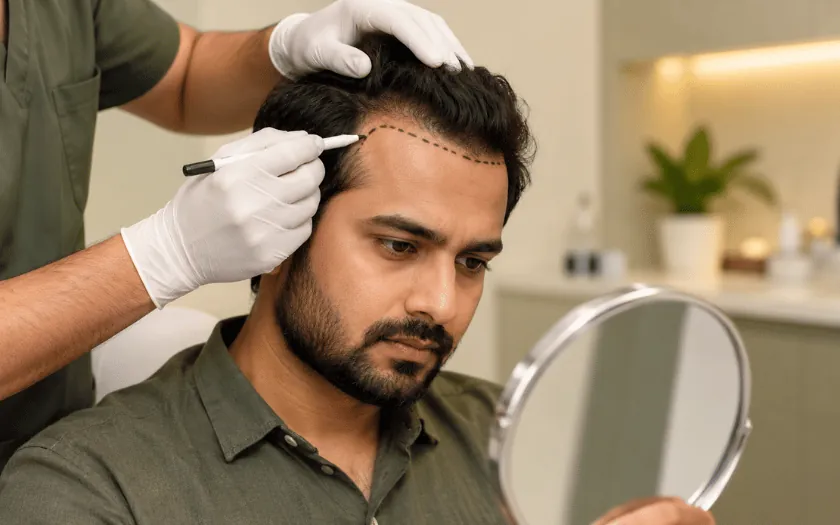
Surgeon marking a new hairline on a man before a hair transplant
01

Age appropriate

A hairline that will still suit you in twenty years, not only this year.

Doctor examining a man's receding hairline before a hair transplant
02

Facial proportions

Balanced with the forehead, brows and the overall shape of the face.

Surgeon drawing a natural hairline on a man's forehead
03

Forehead height

Set with your features and long term donor supply in mind.

Surgeon drawing a natural hairline on a man's forehead
04

Temple points

Framing the face, especially important in feminising and advanced cases.

Practitioner applying scalp micropigmentation to a shaved scalp
05

Irregular micro design

Natural hairlines are never straight. Gentle irregularity avoids a ruled edge.

Surgeon drawing a natural hairline on a man's forehead
06

Single hair grafts in front

The thinnest grafts lead the hairline so it looks soft at close range.

Surgeon marking a new hairline on a man before a hair transplant
07

Transition zone

Density builds gradually from the front edge into the fuller area behind.

Doctor examining a man's receding hairline before a hair transplant
08

Masculine or feminine

Squarer corners with recession, or a rounder shape with closed temples.

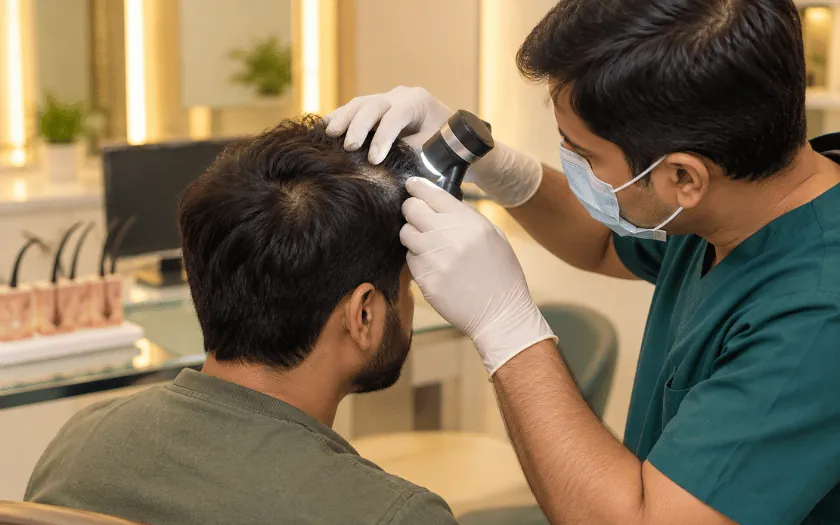
Doctor examining a patient's scalp with a dermatoscope during assessment
09

Ethnic variation

Hair character and hairline shape differ across backgrounds and are respected.

Surgeon marking a new hairline on a man before a hair transplant
10

Future loss planning

Leaving room for thinning that may still happen behind the new hairline.

Surgeon drawing a natural hairline on a man's forehead
11

Not too low

An unnaturally low hairline can look artificial and uses donor hair you may need later.

Read the full guide: Hairline design →

Donor strategy

Donor area planning.

Every graft moved to the front is one fewer in the donor area. Before recommending surgery, we examine how much donor hair you have, how good it is and how stable it is likely to stay, then plan how it should be spent across your lifetime.

Surgeon marking the safe donor area at the back of the scalp
01

Safe donor area

The zone most likely to stay stable as pattern loss progresses.

Surgeon marking the safe donor area at the back of the scalp
02

Density and calibre

How many hairs you have and how thick each one is shape the achievable coverage.

Surgeon extracting follicular units during an FUE hair transplant
03

Follicular unit distribution

The share of one, two and three hair units guides design and density.

Donor strip and sutured donor area during an FUT hair transplant
04

Scalp laxity

How loose the scalp is helps decide whether FUT is a sensible option.

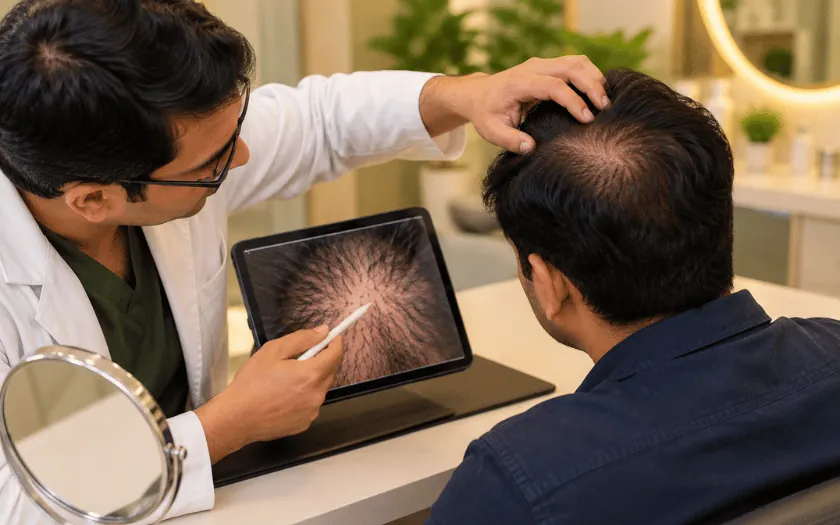
Doctor examining a man's scalp with a digital trichoscope and screen
05

Donor miniaturisation

Thinning hairs within the donor zone suggest it may be less stable.

Receding hairline and crown thinning in male pattern hair loss
06

Retrograde alopecia

Thinning of the lower back and sides that can shrink the usable donor area.

Different patterns of hair loss shown on the scalp
07

DUPA

Diffuse unpatterned alopecia affects the whole scalp, including the donor area, and often makes surgery unsuitable.

Doctor reviewing scalp images of an earlier hair transplant with a patient
08

Previous surgery

Earlier FUE harvesting or a FUT scar changes what remains available.

Surgeon marking the safe donor area at the back of the scalp
09

FUE extraction spread

Grafts taken evenly across the zone to avoid patchy, visibly thin areas.

Surgeon extracting body hair grafts from the leg for a hair transplant
10

Beard and body hair

Supplementary sources when scalp donor hair alone is not enough.

Surgeon extracting follicular units during an FUE hair transplant
11

Lifetime graft budget

A reserve kept for future needs, rather than spent in a single session.

Donor hair is limited. It must be planned for your lifetime, not for one surgery.

Read the full guide: Donor area planning →

Patient journey

From first visit to full growth.

Knowing what happens at each stage makes the experience calmer. Here is how a typical transplant is prepared, performed and followed up.

Surgeon marking a new hairline on a man before a hair transplant
01 · Before

Before surgery

Careful preparation and an honest plan.

  • Medical history and scalp evaluation
  • Blood tests where needed
  • Standard photography
  • Hairline design and graft estimate
  • Review of your current medicines
  • Advice on smoking and hair washing
  • Written informed consent
  • Clear financial counselling
  • A long term hair plan
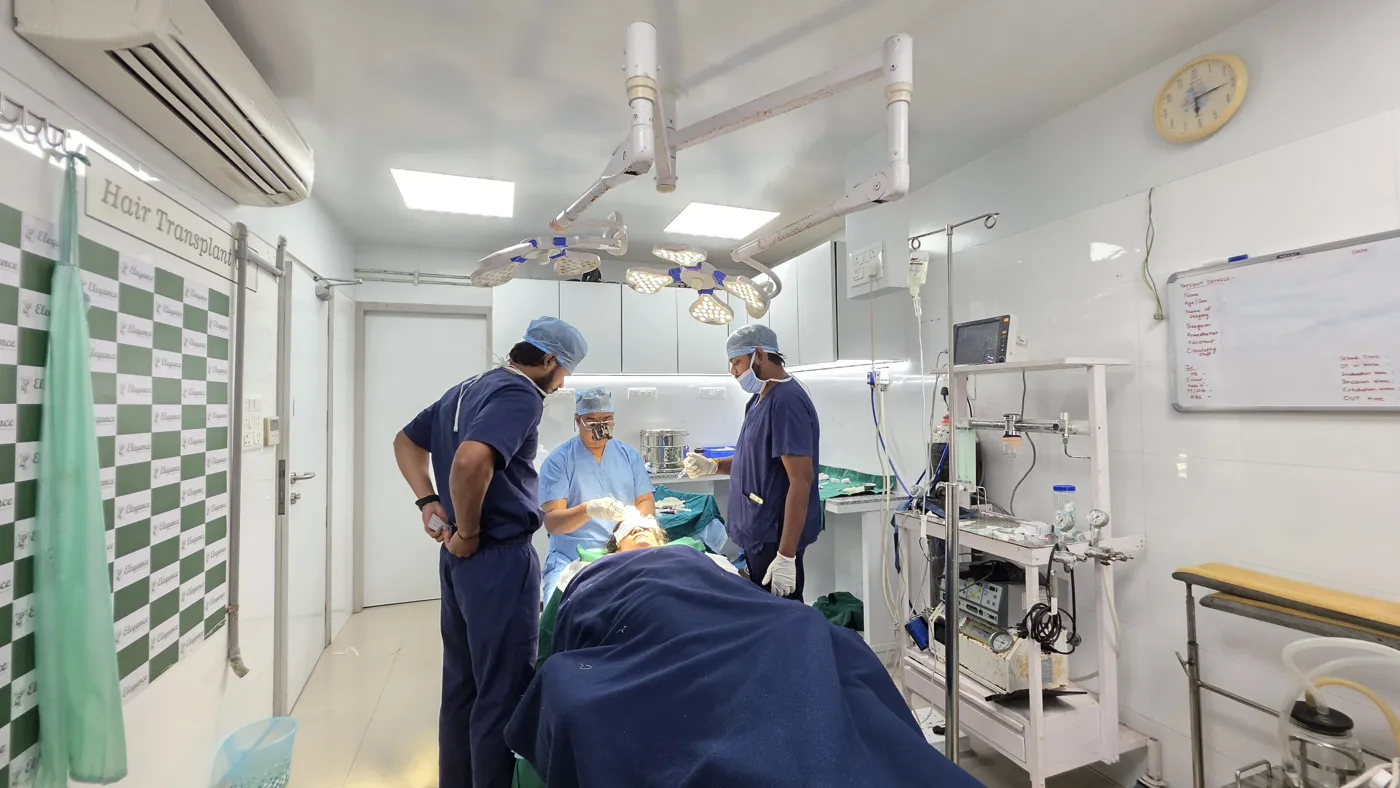
Hair transplant procedure room with the surgical team at Elegance Clinic, Surat
02 · On the day

On the day

A long but calm day, under local anaesthesia.

  • Marking of the hairline and donor area
  • Local anaesthesia
  • Donor harvesting
  • Graft sorting under magnification
  • Recipient site creation
  • Implantation
  • Rest breaks and monitoring
  • Dressing and written instructions
Doctor checking a patient's scalp at a follow up after a hair transplant
03 · After

After surgery

Protecting grafts while they settle.

  • Swelling precautions and sleeping position
  • Prescribed medicines
  • Gentle graft protection
  • A guided washing routine
  • Crust and donor area care
  • Scheduled reviews and photographs

Recovery timeline.

First 24 to 48 hours

Swelling precautions, a slightly raised sleeping position, prescribed medicines and careful protection of the new grafts.

Days 3 to 7

A gentle washing routine begins, crusts are cared for and the donor area starts to heal.

Days 8 to 14

Crusts usually clear and most people return to their normal routine.

Weeks 2 to 8

Transplanted hairs commonly shed; the follicles remain. The donor area recovers. Some nearby native hair may shed temporarily, known as shock loss.

Months 3 to 4

Early regrowth often begins, with fine new hairs appearing.

Months 5 to 8

Density and length gradually increase as hairs thicken.

Months 9 to 12

Hair continues to mature in texture and fullness.

Beyond 12 months

The crown often matures more slowly. Ongoing care of your original hair continues.

These timings are indicative and vary from person to person. Growth dates and percentages cannot be guaranteed.

Read the full guide: The patient journey →

Long term care

Post transplant maintenance.

Transplanted hair usually keeps growing, but the native hair around it can keep thinning. Medical maintenance protects the overall result for years to come.

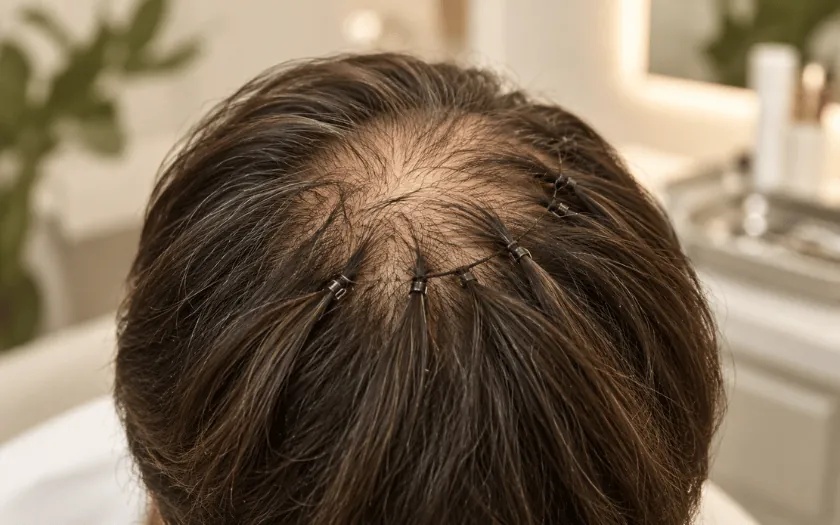
Hair weaving attached with small anchor points on a thinning scalp

Managing native hair

A plan for the hair you still have, which remains sensitive to genetic loss.

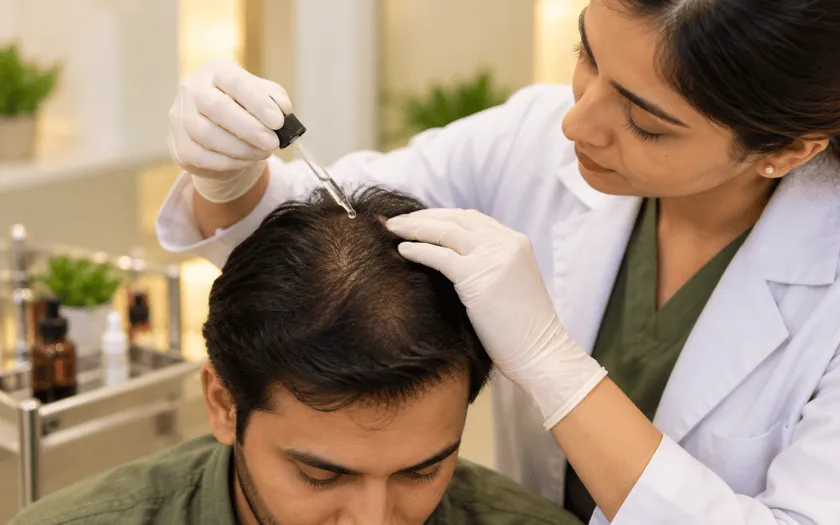
Doctor applying a topical treatment to a man's scalp with a dropper

Minoxidil, finasteride or dutasteride

Prescribed only where suitable, after discussing benefits and possible side effects.

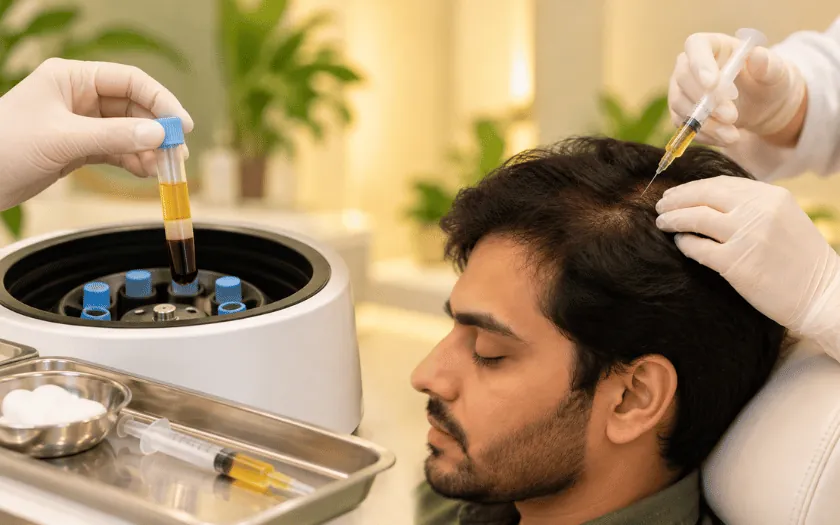
PRP prepared in a centrifuge and injected into the scalp

PRP and adjunctive therapy

Supportive treatments that may help some patients, never a substitute for diagnosis.

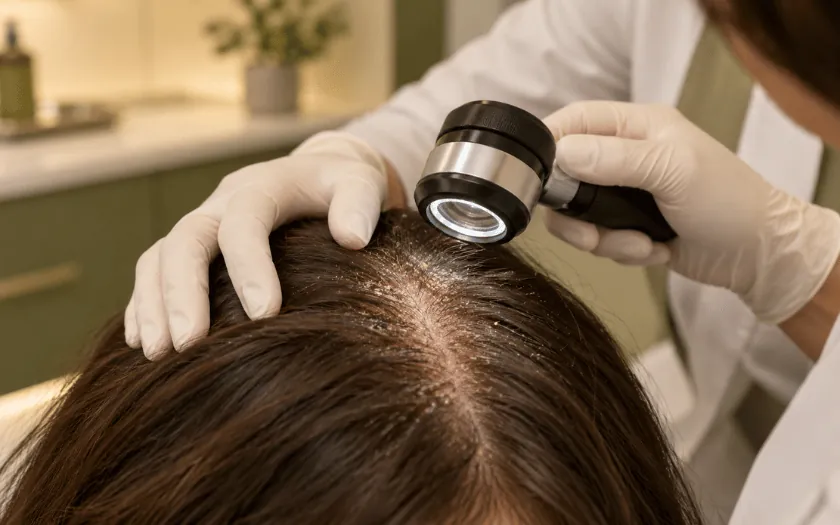
Doctor examining dandruff on a woman's scalp with a dermatoscope

Dandruff control

A healthy, calm scalp supports both transplanted and native hair.

Man taking a supplement beside foods rich in protein, iron and vitamins

Nutrition correction

Testing and correcting documented deficiencies rather than guessing.

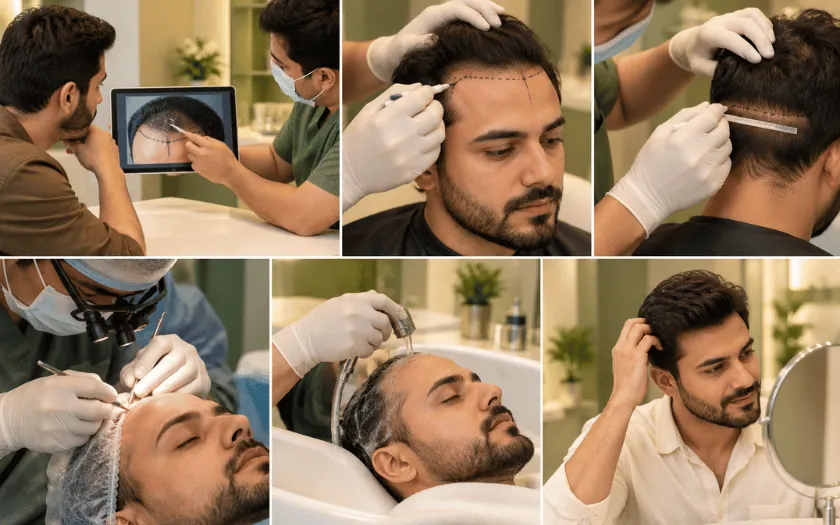
Stages of hair transplant recovery from consultation to regrowth

Follow up photography

Standardised photographs to track growth and spot early change.

Doctor checking a patient's scalp at a follow up after a hair transplant

Annual assessment

A yearly review of the scalp, donor area and treatment plan.

Receding hairline and crown thinning in male pattern hair loss

Preventing miniaturisation

Acting early when native hairs start to thin further.

Stages of hair transplant recovery from consultation to regrowth

Planning future procedures

If more surgery is ever needed, it draws on the donor reserve planned from the start.

Read the full guide: Post transplant maintenance →

Transparency

Complications & how risk is minimised.

No surgery is risk free. Most issues after a hair transplant are minor and temporary, but you deserve to know the full picture before deciding.

Doctor reviewing a patient's crown for side effects after a hair transplant
Possible complications

What can happen

Some are common and short lived; others are uncommon.

  • Pain and swelling
  • Bleeding
  • Infection
  • Folliculitis
  • Itching
  • Temporary numbness
  • Shock loss
  • Poor or uneven growth
  • An unnatural looking hairline
  • Cobblestoning or pitting
  • Scarring and keloid tendency
  • Donor overharvesting
  • A moth eaten donor appearance
  • Necrosis, which is uncommon
  • Cysts
  • Persistent redness
  • Dissatisfaction from unrealistic expectations
Doctor reviewing a patient's crown for side effects after a hair transplant
Our safeguards

How risk is minimised

Safety depends on people and systems, not on a technique name.

  • Supervision by a qualified surgeon
  • Strict sterility
  • Emergency preparedness
  • Monitoring during local anaesthesia
  • Accurate, transparent graft counting
  • A trained, experienced team
  • Documented follow up
  • Early management of any complication
How to choose a hair transplant clinic →

Read the full guide: Complications →

Questions patients ask

Straight answers, before you decide.

Honest answers to the questions we hear most often about hair transplant surgery. Your own consultation will cover what applies to you.

You may be suitable if your hair loss has a clear diagnosis, is reasonably stable and you have enough good quality donor hair to cover the area that matters to you. Some conditions, such as active scarring alopecia or diffuse thinning that includes the donor area, need treatment or may make surgery unsuitable. An in person examination is the only reliable way to know.

There is no single correct age. In younger patients the final pattern of loss is often not yet clear, so medical treatment and observation usually come first. If surgery is chosen, the hairline is kept conservative and donor hair is preserved for possible future needs.

Hair taken from the stable donor zone usually keeps its resistance to DHT after it is moved, so it tends to grow long term. It still ages naturally, and the donor zone itself can thin in some people, so lifelong results cannot be promised.

You may. A transplant redistributes donor hair but does not stop genetic thinning of the native hair around it. That is why medical maintenance and regular reviews are usually recommended after surgery.

Neither is better for everyone. FUE avoids a linear scar and suits short hairstyles, but needs careful spread to avoid overharvesting. FUT leaves a fine linear scar but can yield many grafts efficiently and may help preserve donor hair. Some patients benefit from a combination of both.

It depends on the size of the area, your donor density and hair calibre, the look you want and what must be kept in reserve for the future. A realistic estimate can only be given after an examination, and it should always be balanced against your lifetime donor supply.

No. Donor hair is limited, and a follicle removed completely does not grow back in the donor area. Taking too many grafts can leave the donor area visibly thin or patchy, so extraction should always stay within safe limits.

The procedure is done under local anaesthesia. The anaesthetic injections are felt at the start, after which most patients feel pressure rather than pain. Soreness and tightness afterwards are common and are usually managed with prescribed medicines.

Yes, every technique leaves some scarring. FUT leaves a fine linear scar and FUE leaves many small dot scars. With good technique these are usually hidden by surrounding hair, though they may show with very short hairstyles or in people prone to poor healing.

Transplanted hairs usually shed in the first weeks, which is expected. New growth often begins around three to four months, improves over the following months and continues to mature for a year or longer, with the crown often slower. Timing varies between individuals.

Book a consultation

Begin with a conversation.

Every plan starts with an in person assessment by Dr. Ashutosh Shah. Call or WhatsApp the clinic and our team will get back to you.

Call NowBook Consultation