
Types of hair transplant
Corrective hair transplant, repairing earlier work with care
When a previous transplant does not look right, careful repair can often help.
A corrective hair transplant aims to improve the result of an earlier procedure, such as an unnatural hairline, pluggy grafts, hair growing in the wrong direction or an overharvested donor area. Repair is often more complex than a first transplant, so it starts with a careful assessment of the earlier work and of the donor hair that remains.
Last updated · Medical review: Dr. Ashutosh Shah, M.B.B.S., M.S., M.Ch., D.N.B. (Plastic Surgery), Gujarat Medical Council Reg. No. G-26257
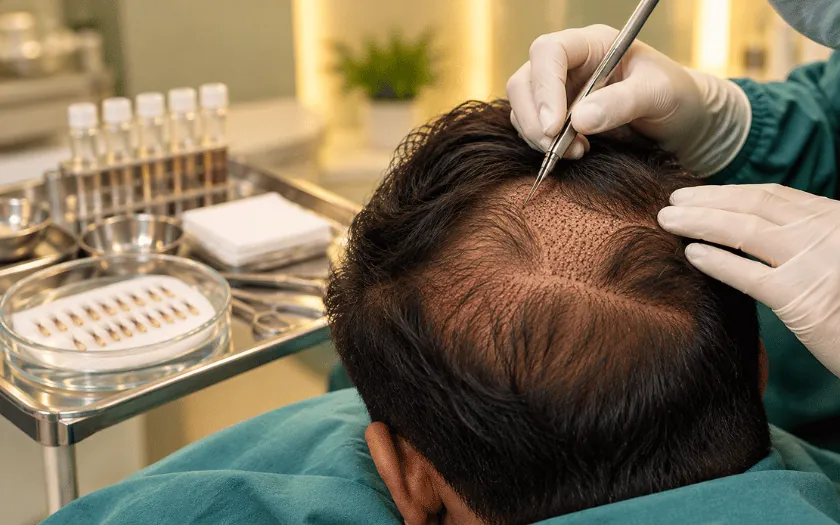 Repair planned by a plastic surgeon
What is a corrective hair transplant?
Corrective, or repair, hair transplant surgery is for people who are unhappy with the look of an earlier transplant. The concern may be at the front, in the density, in the direction of growth, or in the donor area from which grafts were taken. Sometimes it is a mix of several problems.
Repair is rarely a single step. The team has to work with scar tissue from earlier surgery, grafts that are already in place and a donor supply that may have been reduced. The aim is to make the result look more natural and balanced, with honest limits on what can be changed. Feeling let down by an earlier procedure is common, and a calm, unhurried discussion is part of the care.
Problems that can often be improved
Hairline problems
- Poor hairline correction: a straight, harsh or wrongly shaped front edge can be softened with fine single hair grafts and a more irregular design
- Low hairline correction: a hairline placed too low for your age and face may need grafts removed, redistributed or camouflaged
- Pluggy graft repair: older large grafts that look like clumps can be thinned, removed or disguised with finer grafts in front of them
Direction and density
- Wrong direction correction: hair pointing upward or sideways can be removed and replaced at the natural angle
- Density correction: thin or uneven areas may be improved with additional grafts where donor supply allows
- Removal and redistribution of misplaced grafts: grafts in the wrong place can be extracted and, where suitable, reused elsewhere
Donor and scar problems
- Donor overharvesting camouflage: a thin, patchy donor area can sometimes be softened with grafts or scalp micropigmentation
- Depletion camouflage: where donor hair is very limited, other options may help the area look fuller
- Scar revision: a wide or visible FUT scar may be revised surgically, or grafts may be placed into it
How a repair is assessed
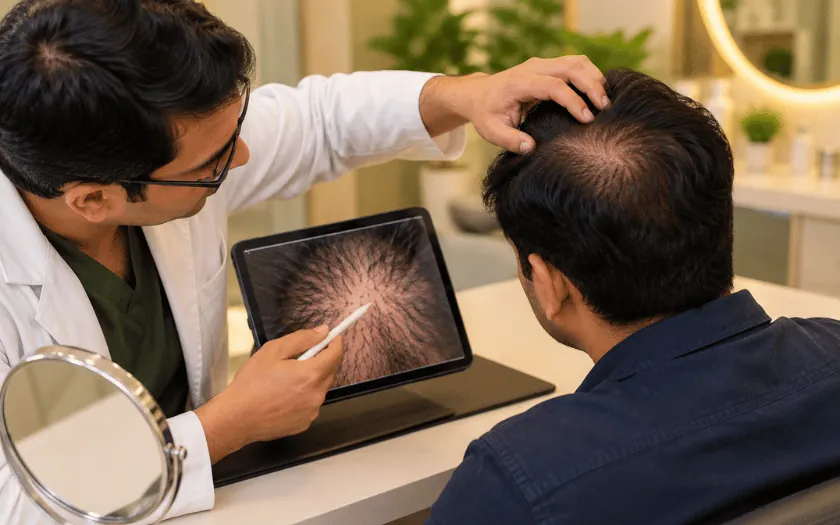
Assessment usually takes more time than for a first transplant. It may cover:
- The details of the earlier surgery, if you have them, including the technique and approximate number of grafts
- How long ago it was done, since grafts need time to mature before their final look can be judged
- The position, angle and direction of existing grafts
- The state of the donor area, including scars, thinning and remaining density
- Whether native hair is still thinning and needs medical treatment
- What bothers you most, and what you hope to change
With this picture, a realistic plan can be explained. Some problems can be improved a great deal; others can only be softened. It is better to hear this before surgery than after.
How corrective surgery is done
- Priorities and sequence
The most visible problems are usually addressed first, and the work may be planned in stages.
- Removing or reducing grafts
Misplaced, pluggy or wrongly angled grafts may be extracted by FUE or, in some cases, removed by small excision.
- Reusing grafts
Grafts that are removed may be divided and replanted in a better position where suitable.
- Adding and refining
Fine grafts are placed to soften the hairline and add density, within what the donor supply allows.
- Donor and scar work
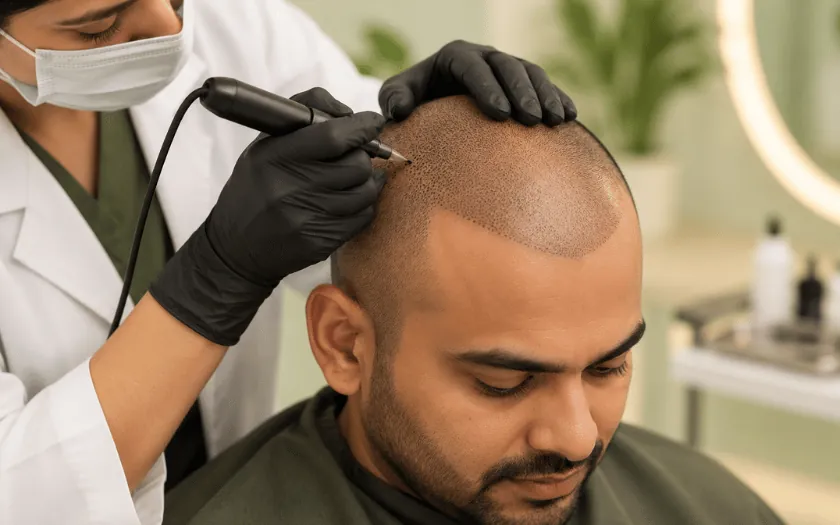
Scars may be revised or grafted, and camouflage such as scalp micropigmentation may be discussed.
Local anaesthesia is used, and more than one session may be needed, with time between them for healing and growth.
Recovery, risks and realistic results
Recovery is similar to a first transplant. Crusts often settle within the first one to two weeks, transplanted hairs commonly shed in the first weeks, and new growth often starts after a few months. The result of each stage is usually judged at around a year, and a further stage is planned only after that.
No surgery is risk free. Scar tissue can have a poorer blood supply, so graft growth may be less predictable than in untouched skin. Other possible side effects include pain, swelling, infection, shock loss, visible marks where grafts are removed and further donor thinning. Results vary. The aim is a more natural and balanced look, not a return to how the scalp looked before any surgery.
Alternatives to further surgery
Not every concern needs more grafts. Depending on the problem, options may include scalp micropigmentation to soften a thin donor area or scar, medical treatment to protect native hair around the earlier grafts, hair reduction methods for a few misplaced hairs in selected cases, or simply a change of hairstyle while grafts mature. Sometimes the kindest advice is to wait and review again.
It is worth seeking a review soon if you notice signs of infection, a painful or spreading area of redness, unusual swelling, or marked loss of native hair after an earlier transplant. These need attention whatever the plan for repair.
Cost factors and choosing a repair surgeon
Cost is discussed after consultation. It depends on how many problems need correcting, whether grafts must be removed as well as added, the number of sessions, scar revision or camouflage work, and follow up care.
When comparing a corrective hair transplant clinic, doctor or specialist, ask to see how repair cases are assessed, who is the senior doctor responsible for your surgery and how the remaining donor supply will be protected. A repair surgeon should be comfortable with both hair transplant techniques and scar work. If you would prefer a lady doctor or a male doctor for your examination, you can ask when you book. At Elegance Clinic, corrective work is part of the transplant experience of a plastic surgeon, and repair plans are made only after the earlier work is carefully examined.
Suitability, risks and recovery differ for each patient and are discussed during consultation.
Unhappy with an earlier transplant?
Share your photos and history. A realistic repair plan starts with an in person examination.
What repair can include
Common corrections
Which corrections are possible is decided after the earlier work and donor area are examined.

Repair questions
Still have a question?
Answers to what patients ask most about repairing an earlier transplant. Your own plan is confirmed only after an examination.
Grafts usually need around a year to show their final look, so repair is often planned after that. An earlier review is still useful to understand the problem and your options.
Sometimes. Grafts at the front can be removed and reused elsewhere, but this takes time and may leave small marks. How far it can be improved depends on the case.
Options may include careful grafting from the remaining donor, body hair in selected cases, and camouflage such as scalp micropigmentation. What is possible depends on how much hair remains.
Often they can be improved by reducing or removing them and placing finer grafts in front, so the edge looks softer and more natural.
Sometimes, but many repairs need more than one stage, with time for healing and growth in between.
Any records of your earlier surgery, photos from before and after it, and a list of what bothers you most. These help build a realistic plan.
Book a consultation
Begin with a conversation.
Every plan starts with an in person assessment by Dr. Ashutosh Shah. Call or WhatsApp the clinic and our team will get back to you.
Book on WhatsApp
Chat with our team on WhatsApp about any treatment, consultation or appointment.
- Ask about any treatment
- Book a consultation
- Get directions to our clinics
WhatsApp opens with a short message ready to send. The clinic team replies during working hours.