
Patient groups
Revision hair transplant, after a result that disappointed
A calm, careful second look at earlier work, your remaining donor hair and what can realistically be improved.
A revision hair transplant is for people who have already had a transplant, here or elsewhere, and are unhappy with how it looks or how it grew. The earlier work and the donor hair that remains are assessed first, because what can be improved depends on both, and a second procedure is not always the right first step.
Last updated · Medical review: Dr. Ashutosh Shah, M.B.B.S., M.S., M.Ch., D.N.B. (Plastic Surgery), Gujarat Medical Council Reg. No. G-26257
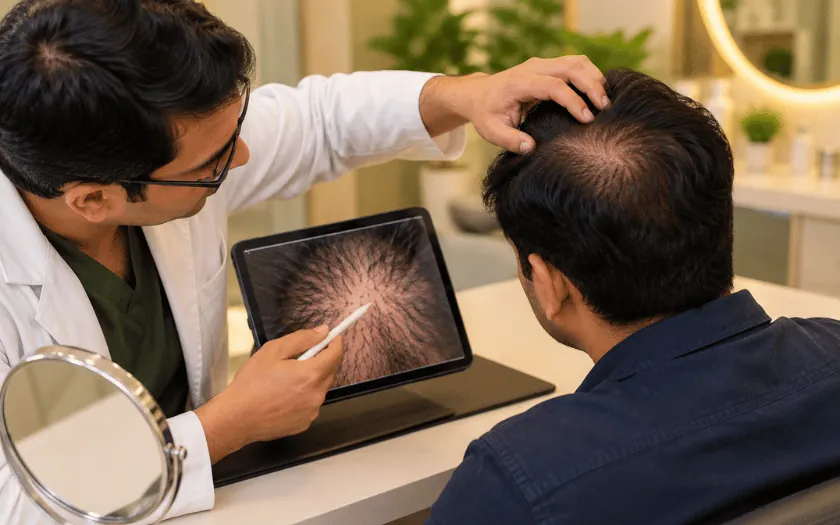 Assessment before any plan
What a revision hair transplant means
Revision is about you, the patient who has been through surgery before and did not get the result you hoped for. The concern might be how the hair looks, how much grew, how the donor area was left, or simply that the plan never suited you. A revision hair transplant starts with understanding what went wrong and why, before deciding what, if anything, should be done next.
It is common to feel frustrated, anxious or wary of trusting another surgeon. Those feelings are understandable. A good revision consultation takes time, explains findings plainly and does not rush you into a second operation.
Revision or corrective: what is the difference?
This page covers the revision journey: deciding whether the result is truly final, assessing the earlier work and your donor reserve, and choosing between surgery, medical treatment and non surgical options. The surgical repair techniques themselves, such as reshaping a hairline, repairing pluggy grafts or redirecting misplaced hair, are explained on our corrective hair transplant page.
Common reasons people seek revision
- Poor or patchy growth: less hair grew than expected, or growth is uneven
- An unnatural hairline: too low, too straight, too sharp at the temples, or not suited to your age
- Pluggy or clustered grafts: visible tufts, often from older techniques or large grafts at the front
- Wrong angle or direction: hair that stands up or grows across the natural flow
- Low density: the area looks see through, or density does not match the areas around it
- Donor area problems: overharvesting, a moth eaten look, or a wide or visible FUT scar
- Progression: native hair behind the transplant has kept thinning, leaving an island of transplanted hair
Not every disappointing result means the surgery was done badly. Ongoing native hair loss, for example, can change how a well done transplant looks over time.
When is it too early to judge?
Transplanted hair commonly sheds in the first weeks, new growth often starts around three to four months, and results are usually judged at around twelve months, with the crown and repair work sometimes taking longer. Many people worry about poor hair transplant growth at five or six months, when the hair is still filling in.
Unless there is a clear problem with design or direction, a second hair transplant is usually not planned until the first has had time to mature fully and the scalp has recovered. Earlier review is still wise, and you should see a doctor promptly for signs such as spreading redness, pus, increasing pain, fever, darkening skin or crusting that does not settle. These need medical attention, not waiting.
How earlier work is assessed
- Your records
Bring any operation notes, the technique used, graft numbers if known, dates and photos from before and after. They help, but a plan can still be made without them.
- Recipient area
Hairline shape and position, graft size, angle, direction, density and any scarring, pitting or bumps are examined, often with trichoscopy.
- Donor reserve
The donor area is checked for remaining density, scars and signs of overharvesting, to estimate how many grafts can still be taken safely, if any.
- Native hair
The pattern and pace of ongoing hair loss are assessed, since it affects both the plan and the long term look.
- Goals and options
What bothers you most is discussed, and realistic options are explained before anything is decided.
More detail on donor limits is on our donor area planning page.
Revision options, surgical and non surgical
Depending on the findings, a plan may include one or more of the following:
- Adding grafts to improve density or soften a harsh hairline with fine single hairs in front
- Removing or redistributing misplaced grafts, where they are too low or badly angled, sometimes reusing them elsewhere
- Reducing unwanted transplanted hairs in selected cases with laser hair reduction or electrolysis
- Donor scar camouflage with grafts placed into a FUT scar or with scalp micropigmentation
- Medical treatment to protect native hair and reduce further progression
- Non surgical options such as hair systems where donor hair is too depleted for more surgery
Why more grafts are not always the answer
When a result looks thin, the natural instinct is to add more hair. Yet every graft taken now is one less for the future, and the donor area may already have been used heavily. If native hair is still thinning, grafts added today may soon sit next to new areas of loss. Sometimes the most useful step is to stabilise hair loss with medical treatment first, soften what already exists, and keep donor hair in reserve for the areas that matter most to your appearance.
Planning for the long term
A good revision plan looks beyond the next session. It considers how your hair loss may progress over the coming decades, how much donor hair should be kept in reserve, and whether a combination of fewer grafts with scalp micropigmentation or medical care could give a more natural look that lasts.
Revision may be staged over more than one session. The specific repair techniques are covered on the corrective hair transplant page.
Realistic expectations, risks and results
Revision is often harder than a first transplant. Donor hair may already be depleted, scar tissue can reduce blood supply and graft survival, and removing old grafts can leave small marks. It is not always possible to reach the result you would have had with an ideal first procedure, and the aim is usually improvement rather than perfection.
Possible side effects are similar to any transplant: pain, swelling, bleeding, itching, numbness, folliculitis or infection, shock loss and patchy growth, with a greater chance of lower graft survival in scarred skin. No surgery is risk free. Results depend on your remaining donor supply, the condition of the recipient skin, the problems being corrected and whether native hair loss is controlled. See hair transplant side effects and complications.
Revision hair transplant cost and choosing a surgeon
The cost of a revision hair transplant is discussed after assessment. It depends on what needs correcting, the number of grafts added or removed, whether scar work or staging is needed, any medical treatment, and follow up care.
When looking for a revision hair transplant clinic, doctor or specialist, ask who will examine the earlier work, who performs each step, and how your remaining donor hair will be protected. At Elegance Clinic, revision plans are made by a plastic surgeon whose experience includes corrective and scar work. Our guide on how to choose a hair transplant clinic may help you avoid facing the same problem twice.
Suitability, risks and recovery differ for each patient and are discussed during consultation.
A second opinion, without pressure
Your earlier work, donor reserve and options are assessed at an in person consultation.
Revision questions
Straight answers, before you decide.
Common questions from people considering revision. Your own options are confirmed only after an examination.
Results are usually judged at around twelve months, and the crown or repaired areas can take longer. An earlier review is still useful if you are worried, and any sign of infection needs prompt attention.
Often it can be improved by removing grafts from the lowest part or reducing unwanted hairs, sometimes combined with softening grafts behind. Small marks may remain, so the options are discussed in detail first.
The remaining donor hair is measured carefully. If very little can be taken safely, the plan may rely on camouflage, scalp micropigmentation, body hair in selected cases, medical treatment or non surgical options.
They help, especially the technique used, graft numbers and photos, but they are not essential. The scalp and donor area can still be examined and a plan made without them.
It is done under local anaesthesia in the same way. Scarred skin can feel different and healing may be slower, but discomfort is usually similar and is managed with prescribed medicines.
Sometimes the improvement is substantial, but it is not always possible to erase every sign of earlier work. The aim is a more natural, balanced look within the limits of your donor hair and scalp.
Photos can give a first idea of the concern, but the donor reserve and graft details can only be judged properly at an in person examination.
Book a consultation
Begin with a conversation.
Every plan starts with an in person assessment by Dr. Ashutosh Shah. Call or WhatsApp the clinic and our team will get back to you.
Book on WhatsApp
Chat with our team on WhatsApp about any treatment, consultation or appointment.
- Ask about any treatment
- Book a consultation
- Get directions to our clinics
WhatsApp opens with a short message ready to send. The clinic team replies during working hours.