
Patient groups
Hair transplant for women, when it truly helps
Diagnosis first, a careful look at the donor area, and an honest answer about whether surgery is right for you.
A hair transplant for women can help in selected situations, such as a naturally high hairline, temple recession, stable female pattern loss, traction alopecia or a scar. Because hair loss in women has many causes and can affect the donor area too, diagnosis and donor assessment always come before any surgical plan.
Last updated · Medical review: Dr. Ashutosh Shah, M.B.B.S., M.S., M.Ch., D.N.B. (Plastic Surgery), Gujarat Medical Council Reg. No. G-26257
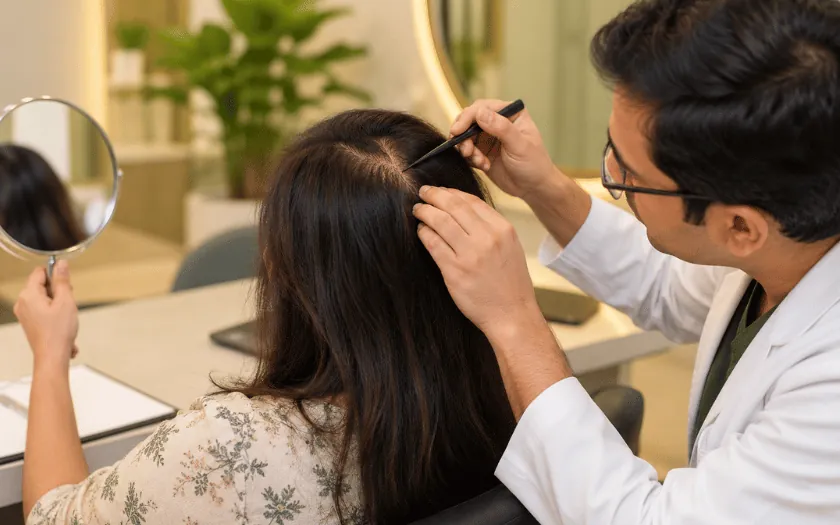 Diagnosis before grafts
How a female hair transplant differs
The technique is the same as for men: your own follicles are moved from a donor area, usually the back and sides of the scalp, into areas that need them. What differs is the thinking behind it.
In men, pattern loss usually spares the back of the scalp. In women, female pattern hair loss is more often diffuse. It tends to widen the central part and reduce ponytail volume while keeping the front hairline, and it can thin the donor zone as well. Moving hair from one thinning area to another may not improve anything, which is why many women are better served by medical treatment than by surgery.
Hair loss in women is also more often linked to other causes, such as iron deficiency, thyroid disease, PCOS, pregnancy, menopause, crash dieting, stress or tight hairstyles. These need to be found and managed first.
When a transplant may suit you
A hair transplant for women may be considered for:
- Hairline lowering: for a naturally high forehead, placing grafts to bring the hairline forward in a soft, rounded shape
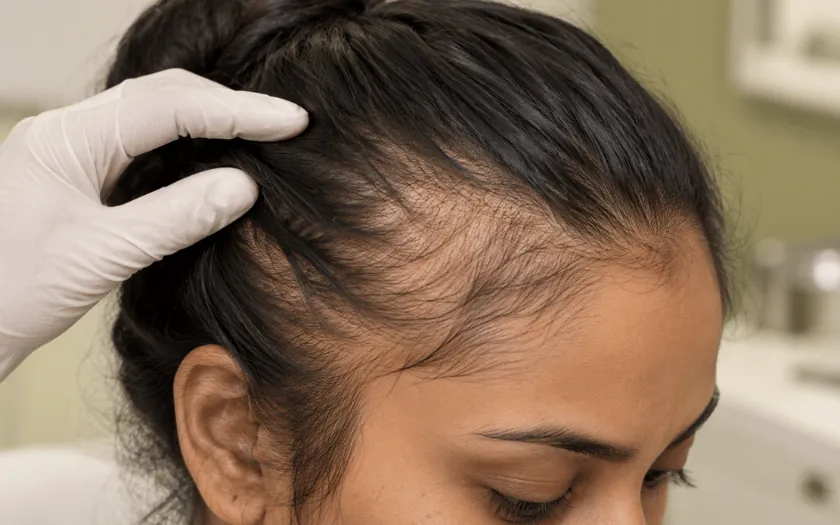
- Temporal recession: filling in thinned temples and softening the frame of the face
- Stable female pattern loss: when loss is localised, has stabilised and the donor area is healthy
- Traction alopecia: once the pulling hairstyle has stopped and the loss has been stable for some time
- Scar correction: after injury, burns or surgery such as a facelift or brow lift, once the scar has matured
Traction alopecia and scars
Traction alopecia comes from long term pulling by tight buns, braids, extensions or weaves, and often thins the hairline and temples first. In its early stages, hair may regrow once the pulling stops, so surgery is considered only when the loss has lasted and stayed stable after hairstyles have changed. If the same hairstyle continues, new grafts can be lost in the same way.
Scars behave differently from normal scalp. Blood supply in scar tissue can be lower, so fewer grafts may be placed per session and a second session is sometimes planned. Scars from conditions such as lichen planopilaris or frontal fibrosing alopecia need the condition to be inactive and stable first; read more on scarring alopecia.
Surgery is usually not advised when thinning is diffuse and includes the donor area, when shedding is active or unexplained, when an autoimmune or scarring condition is still active, or during pregnancy and breastfeeding.
Hormonal, nutritional and donor assessment
A female hair transplant consultation usually takes longer than a first visit for a man, because more causes need to be ruled out.
- History
Hair loss timeline, family history, periods, pregnancy and postpartum changes, contraception, menopause, diet, medicines and hair care habits.
- Scalp examination
The pattern is graded, often with the Ludwig or Sinclair scale, and the scalp is examined with trichoscopy for signs of miniaturisation, inflammation or scarring.
- Tests where indicated
Blood tests such as iron studies and thyroid function may be advised, and hormonal tests when there are signs such as irregular periods or acne. A scalp biopsy is occasionally needed.
- Careful donor assessment
Density and hair calibre at the back and sides are measured closely. If the donor zone is also thinning, this is explained openly and other options are discussed.
Read more about hair loss diagnosis and the causes of hair fall in women.
How the procedure is planned and done
Surgery is done under local anaesthesia. Grafts are usually taken by FUE or FUT, depending on the donor area and how you wear your hair. Many women prefer to keep their hair long, so options that avoid shaving the whole donor area, such as a narrow strip or long hair FUE, are often discussed.
Female hairline design
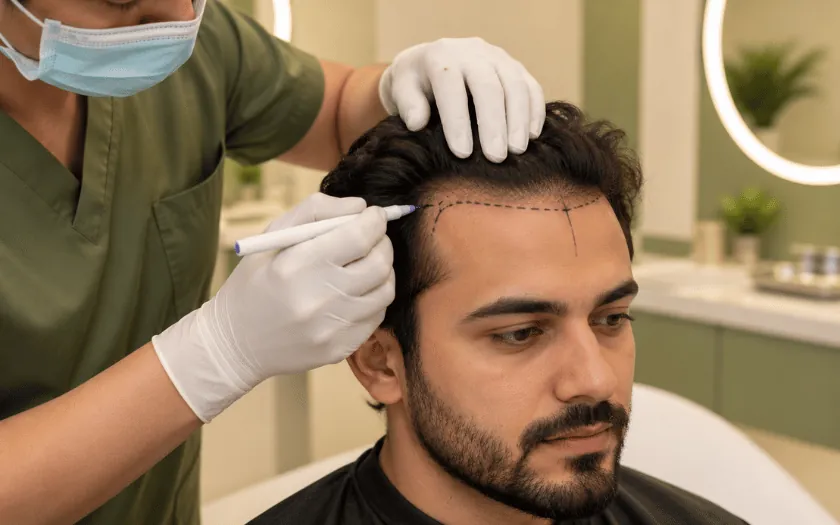
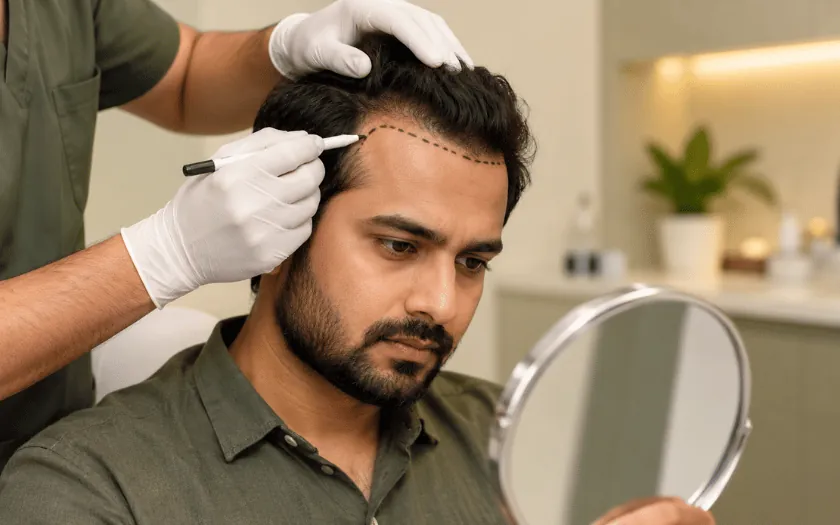
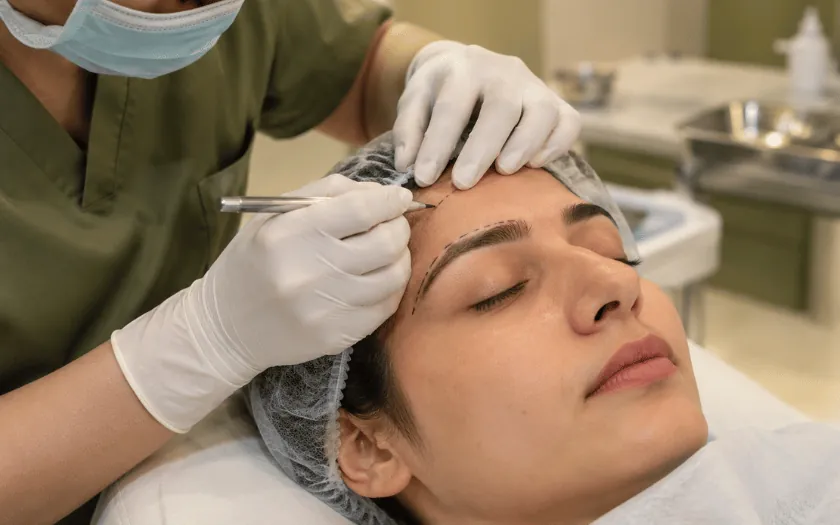
A female hairline is usually rounder and softer than a male one, with fine single hairs at the front, gentle irregularity and temples that are filled rather than recessed. Grafts are placed close together between existing hairs at a low angle, taking care not to damage the native hair around them. See hairline design for more.
Surgical hairline lowering
For some women with a high forehead, surgical hairline advancement, which removes a strip of forehead skin, may be discussed as an alternative or in combination with grafts. It may be offered or arranged after assessment, depending on scalp laxity and hair direction.
Recovery, results and side effects
- First two weeks: tenderness, mild swelling and small crusts, often hidden by existing hair
- Weeks 2 to 8: transplanted hairs commonly shed; the follicles remain
- Around 3 to 4 months: new growth often begins
- Around 12 months: results are usually judged; some cases take longer
Temporary shedding of surrounding native hair (shock loss) is more of a concern in women, because grafts are placed among existing hair. It usually recovers over months, but it can be upsetting and is discussed before surgery. Other possible side effects include swelling, itching, numbness, folliculitis or infection, patchy growth and visible donor marks. No surgery is risk free; see side effects and complications.
Results depend on the cause of loss, donor density, hair calibre and texture, the area treated and whether ongoing hair loss is managed. Medical treatment is often continued after surgery to protect native hair; medicines such as minoxidil or anti androgens are prescription decisions and some are not used around pregnancy.
Female hair transplant cost and alternatives
The cost of a female hair transplant is discussed after consultation. It depends on the area, the number of grafts, the technique, whether shaving is avoided, any tests or medical treatment needed first, and follow up care.
For many women, alternatives are the better first step: medical hair treatment, correction of nutritional deficiencies, supportive regenerative treatments, hair toppers and systems, medical wigs, hair fibres or scalp micropigmentation to reduce the contrast of a wide part.
Choosing a female hair transplant clinic and doctor
Some women prefer a lady doctor, others a senior doctor or specialist; what matters most is a careful diagnosis and an honest answer about suitability. At Elegance Clinic, transplants are planned by a plastic surgeon, consultations are private, and you can ask when booking whether a female team member can be present during examination. Consultations are held in Adajan and Vesu, Surat.
See a doctor promptly if hair loss is sudden, patchy, painful, itchy or comes with irregular periods, acne or unwanted facial hair, as these can point to causes that need treatment.
Suitability, risks and recovery differ for each patient and are discussed during consultation.
An honest answer, in private
Your cause, donor area and options are assessed at an in person consultation.
When it may help
Situations a female transplant may treat
Suitability is confirmed only after diagnosis and a donor assessment.


Questions women ask
Straight answers, before you decide.
Common questions about hair transplant for women. Your own suitability is confirmed only after an examination.
Usually not the whole head. A narrow donor strip or small shaved windows can often be hidden under longer hair, and some cases may suit long hair techniques. The options depend on your donor area and the number of grafts.
Sometimes, if the loss is stable and the donor area is healthy. Often, though, diffuse thinning responds better to medical treatment, and adding grafts among existing hair can cause temporary shock loss.
Surgery is usually postponed until after pregnancy and breastfeeding. Postpartum shedding also needs time to settle, as it often recovers on its own and can make hair loss look worse than it is.
It can. PCOS may contribute to ongoing pattern thinning, so it is usually assessed and managed first. A transplant may still be considered later if the loss is stable and the donor area is good.
A natural look depends on design and placement: fine single hairs at the front, a soft irregular edge and the correct angle. Density builds gradually, and a second session is sometimes needed.
Hair dye, heat styling and tight hairstyles are usually avoided for a few weeks while the scalp heals. You receive a timeline for your procedure, and tight hairstyles should be avoided long term if traction was a cause.
You can ask about this when booking. You can also ask whether a female team member can be present during examination, so that you feel comfortable discussing your concerns.
Book a consultation
Begin with a conversation.
Every plan starts with an in person assessment by Dr. Ashutosh Shah. Call or WhatsApp the clinic and our team will get back to you.
Book on WhatsApp
Chat with our team on WhatsApp about any treatment, consultation or appointment.
- Ask about any treatment
- Book a consultation
- Get directions to our clinics
WhatsApp opens with a short message ready to send. The clinic team replies during working hours.