
Patient groups
Hair transplant for men, planned for the decades ahead
From a receding hairline to a thinning crown, the plan follows your pattern, your age and your donor hair.
A hair transplant for men moves your own hair follicles from the back and sides of the scalp into areas thinned by male pattern hair loss. It can restore a hairline, the front of the scalp or the crown, but it tends to work better when the cause is diagnosed, the loss is stabilised and the donor hair is planned for a lifetime.
Last updated · Medical review: Dr. Ashutosh Shah, M.B.B.S., M.S., M.Ch., D.N.B. (Plastic Surgery), Gujarat Medical Council Reg. No. G-26257
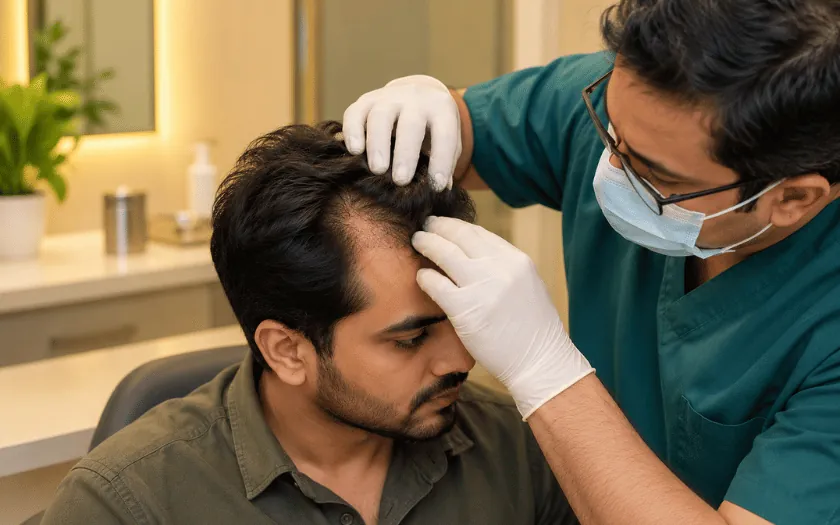 Plastic surgeon led planning
What a male hair transplant actually does
Most men who ask about surgery have androgenetic alopecia, often called male pattern hair loss. In men who are genetically sensitive, the hormone DHT gradually shrinks (miniaturises) hair follicles on the top of the scalp. Hairs become finer and shorter until some areas look thin or bare.
The hair at the back and sides of the scalp is usually far less sensitive to DHT. A male hair transplant takes follicles from this donor zone and places them where they are needed. Transplanted follicles tend to keep the character of the area they came from, which is why they usually continue to grow.
A transplant redistributes hair. It does not create new follicles, and it does not stop the native hair around the grafts from thinning. That single fact shapes almost every decision in planning, and it is why the cause and pattern of your hair loss are assessed before any graft count is discussed.
Who it suits, and who should wait
A hair transplant for men may be suitable when:
- The diagnosis is male pattern hair loss or another cause that is stable and suited to surgery
- The loss has slowed or stabilised, often with medical treatment
- The donor area has enough healthy, dense hair to share
- Your goals match what your donor supply can realistically achieve
- You are in good general health for a procedure under local anaesthesia
Surgery may need to wait, or may not be the right choice, if:
- You are young and the future pattern of your loss is still unclear
- Hair loss is shedding fast, or has another cause such as a deficiency, thyroid problem or alopecia areata
- The donor area itself is thinning
- A scalp condition needs treatment first
- You expect the density of your teens across a large bald area
Saying "not yet" is sometimes the most useful advice a man in his early twenties can receive. Medical treatment and a period of observation often come first.
Hairline, frontal, crown and advanced loss
Male pattern loss is often described with the Norwood scale, which grades loss from mild temple recession to extensive hair loss. The grade helps, but the plan also depends on your age, hair type and donor density.
Receding hairline and temples
A receding hairline transplant rebuilds the frontal edge. The hairline is designed to suit your face now and to still look natural as you age, which usually means a mature, slightly irregular line rather than a low, straight one.
Frontal hair loss
The front third of the scalp frames the face and often matters most to appearance. It is usually given priority when grafts are limited.
Crown hair transplant
The crown can keep expanding for years and takes many grafts to cover, because hair there grows in a spiral. Crown work is approached with caution, often after the front, and usually alongside medical treatment.
Advanced grades
With extensive loss, not every area can be covered to full density. Grafts are placed in priority zones, sessions may be staged, and FUT, FUE or a combination may be used to make the most of the donor supply. Beard grafts, scalp micropigmentation or a hair system may be combined in suitable cases.
Assessment and the procedure
- Diagnosis
Your history, family pattern and scalp are examined, often with trichoscopy. Blood tests are advised only when the history suggests another cause.
- Donor assessment
Density, hair calibre and the safe donor zone are checked, and a lifetime graft budget is estimated.
- Design and plan
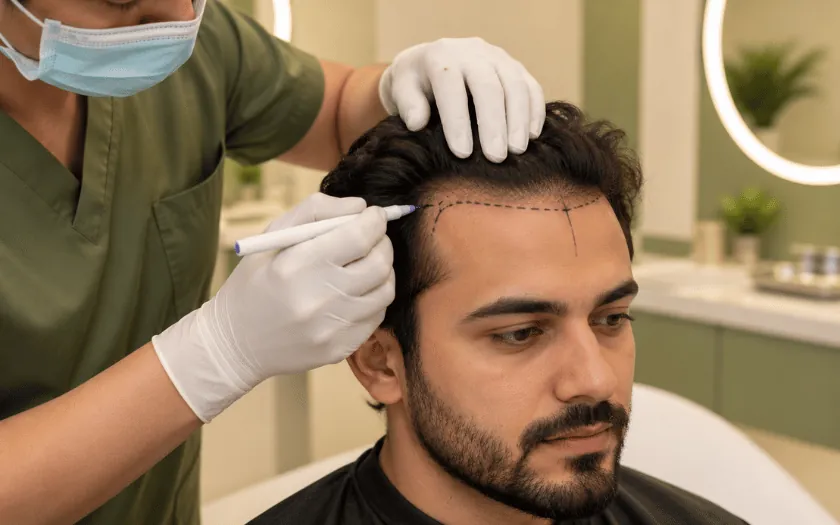
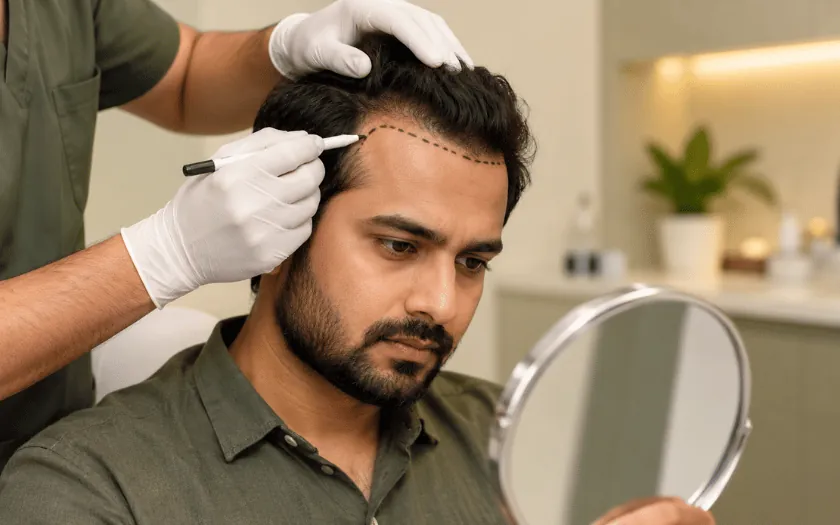
The hairline and target areas are drawn, and the technique (FUE, FUT or both) is chosen for your donor area and hairstyle.
- Surgery under local anaesthesia
Grafts are harvested, sorted, and placed into small sites made at the natural angle and direction of growth. You stay awake through the procedure.
- Aftercare and review
You go home with written instructions and review visits to follow healing and growth.
Read more about FUE and FUT. Neither is better for every man; the right choice depends on your donor area and long term needs.
Why combined treatment protects the result
Because native hair can keep thinning, many men do better when surgery is paired with medical treatment. Options your doctor may discuss include minoxidil, finasteride and, as supportive care, PRP or device based therapy.
Finasteride lowers DHT and can help slow pattern loss, but it can have side effects, including sexual side effects and mood changes in some men, and it is not suitable for everyone. Whether any medicine is right for you is a prescription decision made with your doctor after discussing benefits and risks.
Recovery, results and side effects
Recovery is usually gradual and predictable, although timelines vary from person to person:
- First days: tenderness, some swelling of the forehead and small crusts around the grafts
- First two weeks: crusts settle with gentle washing as instructed; many men with desk jobs return to work within days
- Weeks 2 to 8: most transplanted hairs commonly shed; the follicles remain beneath the skin
- Around 3 to 4 months: new growth often starts, fine at first
- Around 12 months: results are usually judged, with the crown sometimes taking longer
Possible side effects include pain, swelling, minor bleeding, itching, temporary numbness, folliculitis or infection, temporary shedding of existing hair (shock loss), patchy or slower growth, and a visible donor scar or thinning if extraction is not controlled. No surgery is risk free. See hair transplant side effects and complications for more detail.
What affects results
Results vary with donor density and hair calibre, hair colour and curl, the size of the area, graft handling, placement angle, how well you follow aftercare, and whether native hair loss is controlled over the years that follow.
Male hair transplant cost and the alternatives
The cost of a male hair transplant is discussed only after consultation, because it depends on the area to be covered, the number of grafts planned, the technique, whether sessions are staged, any medical treatment alongside surgery, and follow up care. A lower quote for a very large graft number can be a warning sign rather than a saving, because donor hair that is overharvested cannot be replaced.
Alternatives include medical hair treatment alone, supportive regenerative treatment, scalp micropigmentation for the look of density, and hair systems. For some men these are a better first step, or a better long term choice, than surgery.
Choosing a male hair transplant clinic and doctor
If you are looking for a male hair transplant specialist, a senior doctor or simply a clinic near you, ask who diagnoses your hair loss, who designs the hairline, who performs each step of surgery and how your donor hair is protected. At Elegance Clinic, transplants are planned by a plastic surgeon with more than 22 years of surgical experience, and consultations are held at two centres in Surat, Adajan and Vesu. Our guide on how to choose a hair transplant clinic lists more questions to ask.
See a doctor sooner rather than later if hair loss is sudden, patchy, painful or itchy, or comes with other symptoms, since these can point to causes that need medical treatment rather than surgery.
Suitability, risks and recovery differ for each patient and are discussed during consultation.
Talk it through, privately
Your pattern, donor area and options are explained at an in person consultation.
Areas we plan
Where a male transplant is focused
Which areas are treated, and in what order, is decided after your scalp and donor area are examined.


Questions men ask
Straight answers, before you decide.
Common questions about hair transplant for men. Your own plan is confirmed only after an examination.
There is no single right age. What matters more is whether the pattern of loss is clear and stable. Younger men often start with medical treatment and observation, and if surgery is chosen later, the hairline is kept conservative.
Transplanted hair usually keeps growing, but the hair behind it may continue to thin. That is why the hairline is designed to age well and why medical treatment is often advised to protect native hair.
Usually the front, because it frames the face and the crown can keep expanding. Crown work is considered when the donor supply allows and the loss is under control.
It is not compulsory. It may be suggested to slow further pattern loss, but it has possible side effects and is not suitable for everyone. The decision is made with your doctor after weighing benefits and risks.
In the first one to two weeks, small crusts and redness may be visible. After that the grafts shed and regrow gradually, so change tends to look natural over months rather than overnight.
In selected men with limited scalp donor hair, beard grafts may add coverage, mostly in the middle of the scalp or the crown. Beard hair differs in thickness and texture, so it is a supplement rather than a replacement for scalp donor hair.
Light activity is usually allowed early on, while heavy lifting, intense exercise and swimming are typically paused for a period to protect the grafts. You receive a timeline suited to your procedure.
Book a consultation
Begin with a conversation.
Every plan starts with an in person assessment by Dr. Ashutosh Shah. Call or WhatsApp the clinic and our team will get back to you.
Book on WhatsApp
Chat with our team on WhatsApp about any treatment, consultation or appointment.
- Ask about any treatment
- Book a consultation
- Get directions to our clinics
WhatsApp opens with a short message ready to send. The clinic team replies during working hours.