
Hair Transplant
Can a Hair Transplant Fail? Reasons, Warning Signs and Next Steps
Yes, a hair transplant can fail or give weaker growth than expected. Poor growth usually has a cause, and results should only be judged 10 to 18 months after surgery.
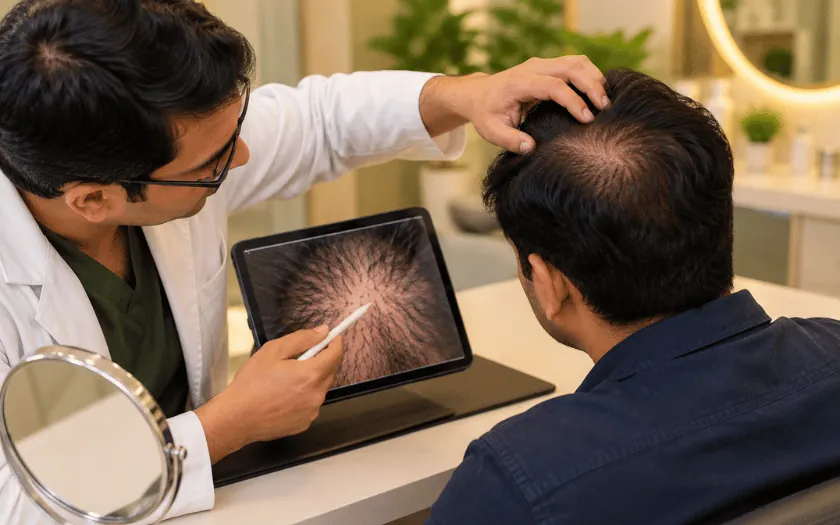
Yes, a hair transplant can fail, although most disappointing outcomes are partial rather than total. Failure usually means poor graft growth, low density, an unnatural look or continued thinning around the grafts. Because transplanted hair takes around 10 to 18 months to mature, a result should not be judged too early.
- Shedding of transplanted hair in the first few weeks is normal and is not failure.
- Most causes of poor growth relate to diagnosis, planning, graft handling, health factors or aftercare.
- Native hair can keep thinning after surgery, which can make a good transplant look weaker over time.
- If growth is poor, the first step is a careful review of the cause before any further surgery.
What does failure mean after a hair transplant?
Patients use the word failure for several different problems. It helps to separate them, because each has a different cause and a different solution.
- Poor graft survival: fewer transplanted hairs grow than expected.
- Low density: the grafts grow, but the area still looks thin because too few grafts were placed for the size of the area.
- Poor design: a hairline that is too low, too straight or in the wrong direction can look unnatural even with good growth.
- Progressive loss: the transplanted hair survives, but the native hair around it keeps thinning, leaving islands of hair.
- Donor problems: visible scarring or a thinned donor area after overharvesting.
Only the first of these is true graft failure. The others are problems of planning, expectations or ongoing hair loss.
Why can a hair transplant fail?
Published reviews of complications describe several factors that can reduce graft survival. No single factor explains every case, and sometimes the cause is not clear.
Graft handling during surgery
Each graft is a small piece of living tissue. Grafts can be harmed by drying out, crushing, damage during extraction (called transection) or spending too long outside the body before placement. Careful technique and an organised surgical team help reduce these risks.
Health and lifestyle factors
Smoking, poorly controlled diabetes and high blood pressure have been linked with weaker healing and graft growth. The blood supply to the scalp matters, and scar tissue from earlier surgery or injury can reduce it.
The wrong diagnosis
A transplant is designed for pattern hair loss, the hereditary type. It is not suitable for conditions such as alopecia areata, and active scarring alopecia must be stable before surgery is considered. If the underlying condition is still active, grafts may be lost.
Aftercare problems
Rubbing or picking at grafts in the first days, untreated infection and ignoring washing instructions can affect early healing. Following the aftercare plan closely matters.
Is it poor growth after hair transplant, or is it too early?
Many patients worry that their hair transplant has failed when it is simply too early. A typical timeline, which varies from person to person, looks like this:
- First 2 to 8 weeks: most transplanted hairs shed. The roots stay in the scalp.
- Around 3 to 4 months: new, fine hairs begin to appear.
- 6 to 9 months: growth becomes clearer and hairs thicken.
- 10 to 18 months: the result is usually close to final, and the crown often takes longest.
Before 12 months, slow growth is usually a matter of patience rather than failure. A review with your surgeon, ideally with standardised photos taken before surgery, gives a fair comparison.
Warning signs worth reviewing with your surgeon
- Very little new growth at 9 to 12 months, especially in the front.
- Patchy growth, with some areas good and others almost empty.
- Redness, pus, pain or swelling that persists or increases.
- Thinning spreading around the transplanted area.
- A donor area that looks see through or patchy.
You can read more about infection, folliculitis and other problems on our page about hair transplant complications and how they are managed.
How can the risk of failure be reduced?
No surgery is risk free, and results cannot be guaranteed. Several steps do lower the chance of a disappointing outcome:
- An accurate diagnosis first. A proper hair loss diagnosis confirms that the pattern is suitable for surgery.
- A realistic plan. The number of grafts should match both the area and what the donor zone can safely give over a lifetime.
- Protecting the donor area. Good donor area planning avoids overharvesting that cannot be undone.
- Controlling health factors. Stopping smoking and controlling diabetes or blood pressure before surgery helps healing.
- Treating ongoing loss. Medical treatment for native hair, where suitable, helps the result hold up over time.
- Careful aftercare. A structured post transplant maintenance plan supports both grafts and native hair.
What to do after a failed transplant
If growth is poor after 12 to 18 months, try not to rush into another procedure. A calm, stepwise approach usually works better.
- Get a full assessment. A surgeon examines the recipient and donor areas, often with magnification, and reviews the original operation details if available.
- Find the likely cause. Poor survival, low density, progressive loss and poor design each need a different answer.
- Treat active problems first. Infection, inflammation or an underlying scalp condition should be settled before surgery.
- Check the donor supply. Further surgery is only possible if enough donor hair remains.
- Consider the options. These may include medical treatment, a carefully planned revision hair transplant, correction of an unnatural hairline, or non surgical options such as scalp micropigmentation.
Revision surgery is often more complex than a first procedure, because of scar tissue and a smaller donor reserve. It needs honest expectations on both sides.
When should you see a doctor?
See your surgeon or a doctor promptly if you notice spreading redness, pus, fever, severe pain or swelling around the eyes that keeps worsening. These can signal infection and need early treatment. For growth concerns, a planned review at around 6, 12 and 18 months is reasonable.
At Elegance Hair Restoration Centre, Dr. Ashutosh Shah, a plastic surgeon with more than 22 years of experience including corrective and scar cases, assesses patients who are unhappy with an earlier result. Book a consultation at Elegance Hair Restoration Centre in Surat to discuss your result and your options calmly.
Related treatments and conditions
Sources
- NHS: Hair transplant
- International Journal of Trichology (PMC): Complications of hair restoration surgery, a retrospective analysis
- American Academy of Dermatology: Hair transplant results and candidates
- Journal of Cutaneous and Aesthetic Surgery (PMC): Donor harvesting, follicular unit excision
This article is for general information only. Treatment depends on each patient’s condition and should be decided after consultation with a qualified doctor. Medically reviewed by Dr. Ashutosh Shah, M.B.B.S., M.S., M.Ch., D.N.B. (Plastic Surgery), Gujarat Medical Council Reg. No. G-26257. See the medical disclaimer.
More in Hair Transplant
Questions patients ask
Straight answers, before you decide.
These are the questions that come up most often in consultation. If yours is not here, send it on WhatsApp and the team will reply.
Yes. Most transplanted hairs shed within the first two to eight weeks. This is expected and happens because the hair shaft enters a resting phase after being moved. The follicle stays under the skin, and new hair usually starts to appear from around three to four months. Shedding at this stage is not a sign that the procedure has failed.
Most surgeons advise waiting at least 12 months, and up to 18 months for the crown, before judging the final result. Hair grows slowly and thickens over time, so early photos can be misleading. Comparing standardised photos taken before surgery with photos at 12 months gives the fairest picture.
Smoking reduces blood flow and oxygen to healing tissue, and it has been linked with weaker graft growth and slower wound healing. It is one of several factors rather than the only cause. Stopping smoking for a period before and after surgery is usually advised, and your surgeon can tell you how long.
Sometimes. A second procedure can add density or correct a poorly designed hairline, but only if enough donor hair remains and the cause of the first failure has been understood. Scar tissue can make revision work more demanding, so outcomes vary and a careful assessment is needed first.
No. Even if further surgery is not advisable, other options may help. Medical treatment can support remaining native hair, and non surgical choices such as scalp micropigmentation, hair fibres or hair systems can improve the look of thin areas. A doctor can help you weigh these against your goals.