
Reconstructive hair restoration
Scar hair transplant
Bringing hair back into scars on the scalp, brows and beard, planned around how scar tissue heals.
A scar hair transplant places healthy follicles from your own donor area into a scar where hair no longer grows. It can help hide trauma, burn, surgical, cleft and old FUT scars, but scar tissue behaves differently from normal skin, so suitability depends on the maturity, blood supply and cause of each scar.
Last updated · Medical review: Dr. Ashutosh Shah, M.B.B.S., M.S., M.Ch., D.N.B. (Plastic Surgery), Gujarat Medical Council Reg. No. G-26257
 Reconstructive approach
What is a scar hair transplant?
When skin heals after an injury, burn or operation, the follicles in that area may be destroyed and replaced with scar tissue. The scar then stays bald, and it can stand out clearly against the surrounding hair. A scar hair transplant moves follicles, usually from the back and sides of the scalp, into the scar so that hair can grow there again.
The idea is simple, but the tissue is not. Scar tissue often has a poorer blood supply, can be thicker, thinner or tighter than normal skin, and may accept grafts less reliably. For this reason, scar work is planned more cautiously than a routine transplant, often at a lower density and sometimes over more than one session.
If the scar was caused by an inflammatory scalp disease rather than an injury, the approach is different again. That situation is covered on our scarring alopecia page.
Scars that may be treated
- Trauma and accident scars: from falls, road accidents or other injuries to the scalp, brows or beard
- Burn scars: once fully healed and mature, assessed carefully for thickness and blood supply
- Surgical scars: including neurosurgical scars on the scalp and scars along the hairline or around the ears after facelift surgery
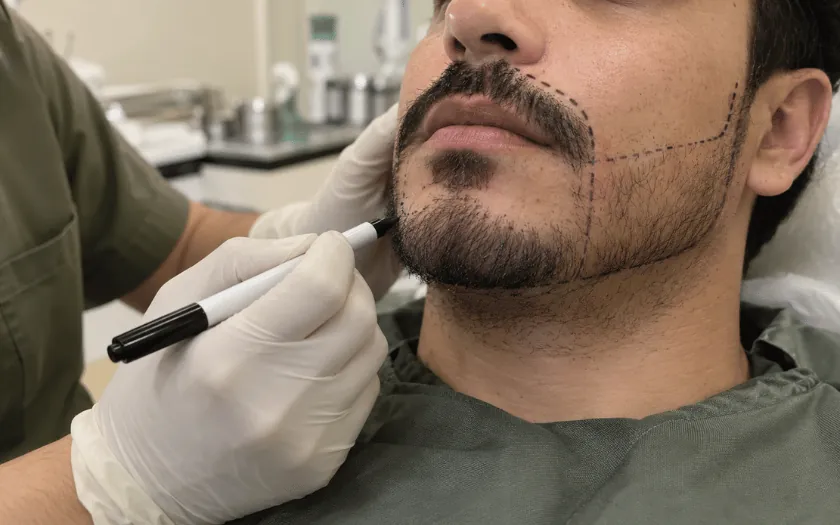
- Cleft related scars: on the upper lip, where a moustache transplant can help hide the scar in men
- Previous FUT scars: a linear donor scar that has widened or is visible with short hair
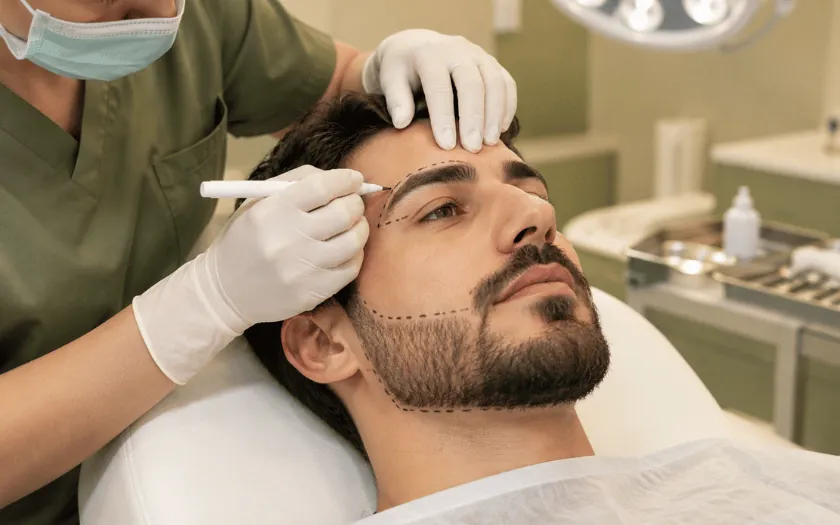
- Scars in the eyebrows or beard: small gaps that break an otherwise full brow or beard
Each type behaves a little differently. A thin surgical line often accepts grafts well, while a large burn scar may need a test session, staged work or reconstructive surgery first.
Who it may suit, and who should wait
- A mature scar that is flat, pale and no longer changing
- Reasonable blood supply and some movement of the skin
- A healthy scalp donor area with hair to spare
- Realistic expectations of improved coverage
- A recent scar that is still red, raised or changing
- Active scarring alopecia or other scalp inflammation
- A very thick, shiny or tight scar with poor blood supply
- A history of keloid or problem scarring, which needs careful discussion
- Scars after radiation, where the skin may be fragile
- A large scar that is better treated by reconstructive surgery
Scars usually take many months to mature, and sometimes longer. The right time for surgery is judged on examination rather than by a fixed date.
How a scar is assessed
A scar hair transplant consultation looks at the scar itself as much as at the hair. Points that are checked include:
- Maturity: colour, firmness and whether the scar is still changing
- Blood supply: how well the tissue is likely to feed new grafts
- Thickness and tightness: whether the scar moves over the underlying tissue
- Size and site: the area to cover and how visible it is with your usual hairstyle
- Cause: injury, burn, surgery or an inflammatory condition that may need medical care or a biopsy
- Donor supply: how many grafts can be used now while protecting your future needs
From this, a plan is agreed. It may be a single session, a small test session, staged sessions, or reconstructive surgery before or instead of grafting.
How a scar hair transplant is done
- Test grafting when needed
For uncertain scars, a small number of grafts may be placed first to see how the scar accepts them before a larger session.
- Local anaesthesia
The scar and donor area are numbed. Scar tissue can respond differently to anaesthetic, so this is done gently.
- Harvesting grafts
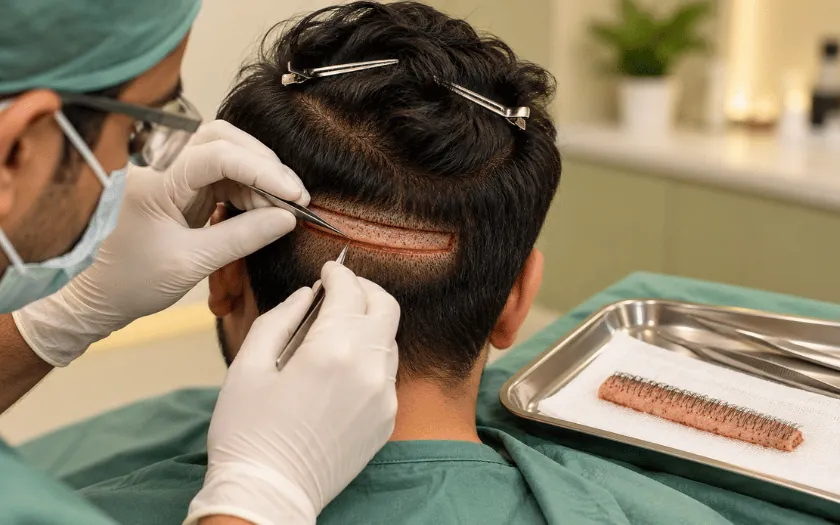
Grafts are taken by FUE, or from a strip in selected cases, and chosen to match the hair around the scar.
- Spaced placement
Sites are made with care and grafts are spaced more widely than in normal scalp, so the scar's limited blood supply is not overloaded.
- Review and further stages
Growth is reviewed over the following months. Further sessions can add density once blood supply has improved.
Old FUT scars
A widened FUT scar can often be softened by placing FUE grafts into it. In some cases scar revision to narrow the line is discussed as well. Where grafting is not enough, scalp micropigmentation can help camouflage the line.
Recovery and results
Recovery is similar to other transplants, but the timeline in scar tissue can be slower and less predictable. Typical experiences include small crusts for about a week to ten days, some redness, shedding of transplanted hairs in the first weeks, and new growth after a few months. Results are usually judged at around a year, and later sessions are planned only after that review.
A realistic aim is a scar that is less noticeable and better covered, rather than the density of scalp that was never injured. Results depend on the scar's blood supply, its thickness, the number of sessions, donor quality and how closely aftercare is followed.
Risks, cost factors and alternatives
No surgery is risk free, and scar work is more demanding than routine transplantation. Possible side effects include lower or patchy graft survival, the need for further sessions, infection, delayed healing, redness that lasts longer than usual, temporary numbness, and visible donor marks.
The cost of a scar hair transplant depends on the size and type of the scar, the number of grafts, whether a test session or staged sessions are needed, any reconstructive surgery, and follow up care. It can only be discussed after assessment.
Alternatives to grafting
- Scar revision to narrow or soften a scar
- Excision of smaller scars, closed along the direction of hair growth
- Tissue expansion or flap surgery for larger scalp scars, in selected cases
- Scalp micropigmentation or permanent makeup to camouflage the scar
- Hair systems or wigs, especially while waiting for a scar to mature
These may be offered or arranged after assessment, depending on the scar and your preferences.
Choosing a scar hair transplant doctor or centre
Scar work sits between hair transplant surgery and reconstructive surgery. When you look for a scar hair transplant doctor, consultant or centre, ask how the scar will be assessed, whether test grafting or staging is considered, and what options exist if grafting is not suitable.
- Your plan is made by Dr. Ashutosh Shah, a plastic, cosmetic and hair transplant surgeon (M.S., M.Ch., DNB) with more than 22 years of surgical experience
- Experience across primary, advanced, corrective and scar hair transplantation
- Plastic surgery training in wound healing, scar behaviour and tissue handling
- Grafting and scar revision can be weighed together in one plan
- Consultations at two centres in Surat: Adajan and Vesu
To schedule a scar hair transplant consultation, you can book online, call, or send photos of your scar on WhatsApp for an initial view. Appointments depend on availability, and a final plan is always made in person. Read more about why a plastic surgeon may be helpful for complex cases.
Suitability, risks and recovery differ for each patient and are discussed during consultation.
Living with a scar where hair does not grow?
Whether hair can grow in your scar is decided only after an in person examination.
Where scars occur
Scars we assess for grafting
Each scar is judged on its maturity, blood supply and the hair around it.

Scar hair transplant questions
Still have a question?
Answers to what patients ask about hair transplants into scars. Your own plan is confirmed only after an examination.
Scars usually need many months to mature, and sometimes longer. Surgery is timed by examination, once the scar is flat, pale and no longer changing, rather than by a fixed date.
Growth in scar tissue is often less predictable because of its weaker blood supply. Grafts are spaced more widely, and a test session may be suggested to see how your scar responds.
Often it can be softened with FUE grafts placed into the line. Scar revision or scalp micropigmentation may also be discussed, alone or together with grafting.
In men who want a moustache, grafts can often be placed into a mature cleft related scar on the upper lip. Scar quality and any planned further lip surgery are considered first.
A tendency to keloid or problem scarring raises the risk of new scarring in the donor and recipient areas. It needs careful discussion, and sometimes a small test area, before any decision.
Hairstyling, hair systems, wigs or cosmetic camouflage can cover the area while you wait. Gentle sun protection of the scar is also commonly advised.
Bring any records of the injury or operation, dates of earlier treatment, a list of current medicines and photos of how the scar has changed over time.
Book a consultation
Begin with a conversation.
Every plan starts with an in person assessment by Dr. Ashutosh Shah. Call or WhatsApp the clinic and our team will get back to you.
Book on WhatsApp
Chat with our team on WhatsApp about any treatment, consultation or appointment.
- Ask about any treatment
- Book a consultation
- Get directions to our clinics
WhatsApp opens with a short message ready to send. The clinic team replies during working hours.