
Types of hair transplant
Body hair transplant, when the scalp donor is not enough
Beard or chest hair as a supplementary source, with honest expectations.
A body hair transplant uses FUE to take grafts from the beard, chest or other body areas and place them on the scalp. It is mainly a supplementary donor source for people whose scalp donor hair is limited, because body hair differs from scalp hair in thickness, curl, growth cycle and length.
Last updated · Medical review: Dr. Ashutosh Shah, M.B.B.S., M.S., M.Ch., D.N.B. (Plastic Surgery), Gujarat Medical Council Reg. No. G-26257
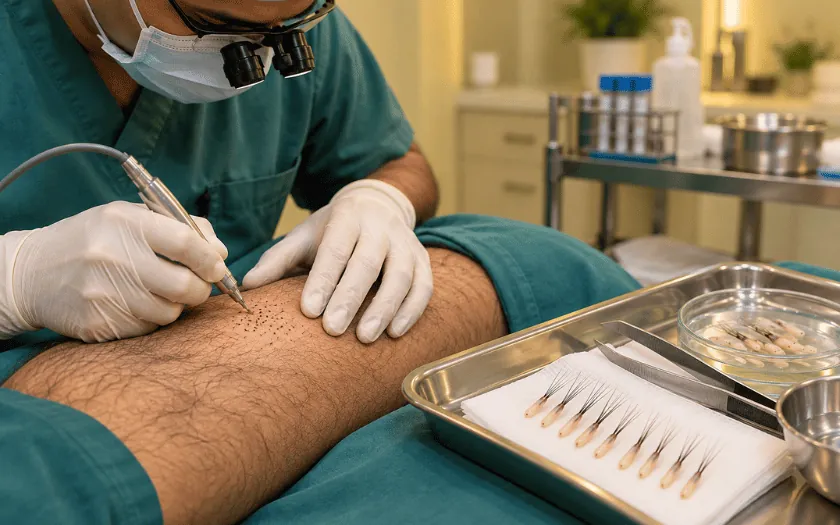 A supplementary donor source
What is a body hair transplant?
Most hair transplants take grafts from the back and sides of the scalp. In some people that donor area is too limited to cover the area of loss, or it has already been used in earlier surgery. In these situations, hair from elsewhere on the body can add extra grafts. The grafts are taken one by one using FUE, since a strip cannot be taken from these areas in the same way.
Body hair is not a replacement for scalp donor hair. It is more helpful to think of it as an extra reserve that can add coverage in selected areas when used with care, as part of a lifetime plan for your donor supply.
Beard, chest and other donor sites
Beard to scalp
Beard hair is the most commonly used body donor source. Hair from under the chin and the neck is often thick and strong, and taking grafts from these areas can leave the visible beard largely unchanged when extraction is spread carefully. The thickness of beard hair can help add a sense of volume, particularly in the crown.
Chest to scalp
Chest hair is the next most commonly used source in suitable men. It is often finer than beard hair and may be more curly. How useful it is depends on how dense and thick the chest hair is.
Other donor sites
Hair from the abdomen, shoulders, arms or legs is considered only case by case. These hairs are often fine and short, so their value for the scalp is limited.
How body hair differs from scalp hair
- Calibre: body hair may be thicker, as with beard, or finer, as with limbs
- Curl: chest and body hair is often more curly than scalp hair
- Growth cycle: body hair usually has a shorter growth phase, so it tends to stay shorter
- Length: the final length it reaches on the scalp may be less than scalp hair
- Grouping: body hair more often grows as single hairs rather than in groups
- Angle: it grows at a sharper angle to the skin, which makes extraction more demanding
Because of these differences, body hair rarely looks identical to scalp hair. It is usually placed in the crown, in the middle of the scalp or behind the hairline, rather than at the very front edge. It can also help soften an old FUT scar or add to repair work.
Who a body hair transplant may suit
- Advanced hair loss where the scalp donor cannot cover the planned area
- People whose scalp donor has been depleted by earlier surgery
- Repair cases needing extra grafts for camouflage or density
- Men with dense, good quality beard or chest hair
It may not suit people with sparse or very fine body hair, a tendency to form raised or dark scars, active skin conditions in the donor area, or expectations of scalp like density at the hairline. Hair loss should be diagnosed and stabilised or treated before any surgery.
How the procedure is done
- Donor assessment
Scalp and body donor areas are examined for density, calibre and curl, and a small test extraction may be considered in some cases.
- Planning
Where body grafts will go is planned in advance, usually alongside scalp grafts.
- Local anaesthesia and FUE extraction
Grafts are extracted one by one, spread thinly to avoid visible patches.
- Placement
Body grafts are placed where their texture blends most naturally, and scalp grafts are kept for the front.
- Aftercare
Care instructions cover both the scalp and the body donor sites, with review visits.
Extraction from the body often takes longer than from the scalp, so sessions are planned with that in mind.
Recovery, side effects and results
Body donor sites form small crusts that usually settle within the first one to two weeks. The small marks left behind may be lighter or darker than the surrounding skin, and they can be more noticeable on the body than on the scalp. The scalp area heals as with any FUE, with shedding in the first weeks, new growth often after a few months and the result usually judged at around a year or longer.
No surgery is risk free. Possible side effects include pain, swelling, itching, infection or folliculitis, ingrown hairs, changes in skin colour at donor sites, raised scars in people prone to them, patchy thinning of the beard or chest if too much is taken, and lower or less predictable growth than with scalp grafts. Results vary, and the texture of body hair means it adds coverage rather than matching scalp hair.
Alternatives to body hair grafts
Before body hair is used, it is worth checking whether the scalp donor can be used more fully, for example with FUT or a hybrid of FUT and FUE. Medical treatment can help protect native hair so fewer grafts are needed. For people with very limited donor supply, scalp micropigmentation can add the look of density, and hair systems suit some who prefer a non surgical route.
Cost factors and choosing a clinic
Cost is discussed after consultation. It depends on the total number of grafts, how many come from the body, the time body extraction takes, whether it is combined with scalp FUE or FUT, and follow up care.
When comparing a body hair transplant clinic, doctor or specialist, ask how body grafts will be used, where they will be placed and how the beard or chest will be protected from visible thinning. Ask who is the senior doctor responsible for your surgery. If you prefer a lady doctor or a male doctor for your examination, you can ask when you book. At Elegance Clinic, body hair FUE is one of the approaches that may be used when scalp donor hair is limited, planned by a plastic surgeon as part of your lifetime donor budget.
Suitability, risks and recovery differ for each patient and are discussed during consultation.
Running short of donor hair?
Your scalp and body donor areas are examined together before any plan is made.
Donor sources
Where body grafts can come from
Which sources suit you is decided after both scalp and body are examined.
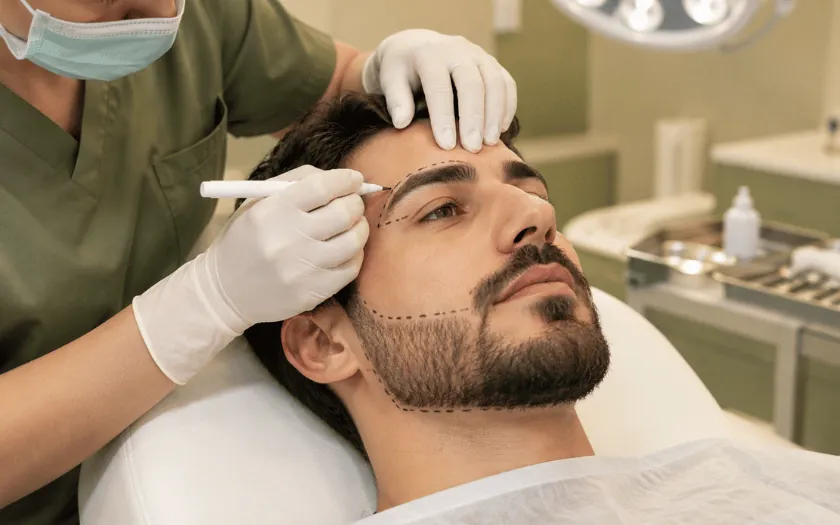
Body hair questions
Still have a question?
Answers to what patients ask most about using body hair. Your own plan is confirmed only after an examination.
Extraction is usually taken from under the chin and neck and spread thinly, so the visible beard often looks much the same. Taking too many can cause thinning, which is why limits are planned.
It often does not reach the length of scalp hair, because its growth phase tends to be shorter. How long it grows varies from person to person.
It is usually avoided at the very front, where texture differences show most. Fine scalp grafts are preferred there when available.
It is uncommon, because most women have fine body hair. Female hair loss also needs careful diagnosis before any transplant is considered.
They are small, but they can be lighter or darker than the skin around them and may be more noticeable than scalp marks, particularly on the chest.
Grafts generally keep the characteristics of the area they came from, so body hair continues to behave like body hair, including its texture and cycle.
Book a consultation
Begin with a conversation.
Every plan starts with an in person assessment by Dr. Ashutosh Shah. Call or WhatsApp the clinic and our team will get back to you.
Book on WhatsApp
Chat with our team on WhatsApp about any treatment, consultation or appointment.
- Ask about any treatment
- Book a consultation
- Get directions to our clinics
WhatsApp opens with a short message ready to send. The clinic team replies during working hours.