
Hair Transplant
Hair Transplant vs SMP: Which Option Suits Your Hair Loss?
Hair transplant vs SMP: a transplant moves your own growing hair to thin areas, while scalp micropigmentation uses pigment dots to mimic shaved hair without growing any.
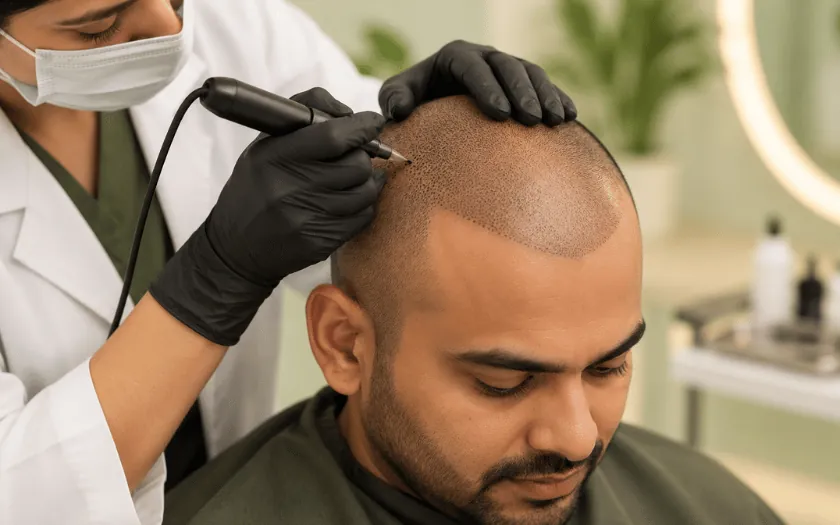
Hair transplant vs SMP comes down to one key difference. A hair transplant moves your own living hair follicles to thinning areas, so real hair grows there. Scalp micropigmentation (SMP) places tiny dots of pigment in the skin to look like closely shaved hair, but it does not grow any hair at all.
- A hair transplant relocates growing follicles from the donor area. SMP is a cosmetic tattoo technique that camouflages hair loss.
- SMP often suits people who like a very short or shaved look, or who have limited donor hair.
- A transplant suits people who want hair they can grow and style, and who have a stable, adequate donor area.
- The two can be combined in selected patients.
- Neither option stops ongoing hair loss, so diagnosis and long term planning still matter.
What is the difference between a hair transplant and SMP?
How a hair transplant works
In a hair transplant, the surgeon removes small groups of hair follicles, called follicular units, from the donor area at the back and sides of the scalp. Hair from this zone is usually more resistant to DHT, the hormone that drives pattern hair loss. The grafts are then placed into tiny openings in the thinning area, where they can grow like normal hair.
The most common method today is FUE (follicular unit excision), where grafts are taken one at a time. Our page on FUE hair transplant surgery explains the steps in detail. The procedure is done under local anaesthesia and most people stay awake. New hair takes months to show. Many people see clear growth between six and nine months, and for some it takes around a year.
How SMP works
Scalp micropigmentation uses a fine needle to place very small deposits of pigment into the dermis, the layer of skin just below the surface. Each dot imitates the tip of a short cut hair. When it is done well, it can make a shaved head look fuller or reduce the contrast between thin hair and a pale scalp. It is a form of camouflage, not hair restoration.
Hair transplant vs SMP: a side by side view
| Point | Hair transplant | SMP |
|---|---|---|
| What it gives you | Real hair that grows | The look of short hair or density |
| Hair length | Can be grown and styled | Looks most convincing with very short or shaved hair |
| Donor hair needed | Yes, an adequate and stable donor area | No |
| Type of procedure | Surgical, under local anaesthesia | Non surgical, usually done over a few sessions |
| When results show | Gradually, over many months | Visible after each session |
| Upkeep | Ongoing care of native hair | Pigment can fade; touch up sessions are often needed |
| Main risks | Swelling, infection, donor scarring, poor growth | Allergy, pigment spreading or colour change, unnatural dots |
Who is SMP suitable for?
SMP can be a sensible choice for people who:
- Have advanced hair loss and not enough donor hair for the coverage they want.
- Already prefer a clean shaved or buzz cut look.
- Want to camouflage scars from injury, previous surgery or an old FUT strip.
- Have diffuse thinning and want to reduce how much scalp shows through the hair.
- Have a scarring hair loss condition that has been stable for some time, as advised by their doctor.
SMP is less suitable if you want to grow your hair longer later, because long hair and pigment dots do not blend well. Pigment is also hard to remove, and poorly done SMP can be difficult to correct. You can read more about the technique on our scalp micropigmentation page.
Who is a hair transplant suitable for?
A hair transplant is often considered for people who:
- Have pattern hair loss that has been diagnosed and is reasonably stable.
- Have enough good quality donor hair.
- Want natural hair they can cut, comb and style.
- Are in good general health.
- Accept that results take time and cannot be guaranteed.
It helps to remember what a transplant does and does not do. It redistributes existing donor hair. It does not create new follicles, and it does not stop your native hair from thinning. Because donor hair is limited, it should be planned for a lifetime, not only for today. Our guide to donor area planning covers this in more depth.
Can you combine SMP with a hair transplant?
Yes, in selected patients the two work together. Common examples include:
- Adding the look of density. SMP between transplanted hairs in the crown can reduce scalp show where grafts are spread thinly.
- Camouflaging donor scars. SMP can soften the look of a linear FUT scar or small FUE dots when hair is worn short.
- Stretching limited donor supply. Grafts can frame the face with a hairline, while SMP adds the impression of fullness behind it.
Order matters. In most cases the transplant is done first and allowed to grow, so the pigment can be matched to the final hair pattern. Planning both steps together avoids pigment being placed where hair will later grow.
What are the risks and limits of each option?
Hair transplant
No surgery is risk free. Possible problems include swelling, bleeding, infection, folliculitis (inflamed hair follicles), temporary numbness, donor area scarring and poorer growth than expected. Temporary shedding of transplanted hair a few weeks after surgery is normal. Some people also notice temporary shedding of nearby native hair, known as shock loss.
SMP
Pigment can fade over the years, change tone with sun exposure, or blur and spread beyond the dot. Allergic reactions to pigment can occur. Infection is possible if hygiene is poor. Dots that are too large, too dark or placed in a harsh straight line can look unnatural. Correcting a poor result is often difficult.
How do I decide between SMP or a transplant?
A few honest questions usually point the way:
- How do you like to wear your hair: very short, or with some length?
- How much donor hair do you have, and what is its quality?
- Is your hair loss still progressing quickly?
- How do you feel about ongoing maintenance, such as touch ups or medicines?
- What matters more to you: real hair, or the quickest visual change?
The answer should start with a proper diagnosis. Not all hair loss is pattern hair loss, and some conditions need medical treatment first. Our page on hair loss diagnosis explains how the cause is worked out.
When should you see a doctor first?
See a doctor before choosing either option if your hair loss is sudden, patchy, itchy or painful, or if the scalp is red, scaly or scarred. Conditions such as alopecia areata or scarring alopecia may need treatment and a period of stability first. Pigment placed over active disease can hide a problem that needs care.
At Elegance Hair Restoration Centre, Dr. Ashutosh Shah, a plastic surgeon with more than 22 years of experience, assesses your scalp, donor area and goals before suggesting a hair transplant, SMP, medical treatment or a mix of these. You can also compare surgical options on our hair transplant overview. Book a consultation at Elegance Hair Restoration Centre in Surat to discuss your options calmly and in person.
Related treatments and conditions
Sources
- PMC (NIH): Micropigmentation
- PMC (NIH): Perceptions and Experiences of Scalp Micropigmentation Among Dermatology Outpatients With Hair Loss
- American Academy of Dermatology: Hair transplant
- PMC (NIH): Complications in Hair Transplantation
This article is for general information only. Treatment depends on each patient’s condition and should be decided after consultation with a qualified doctor. Medically reviewed by Dr. Ashutosh Shah, M.B.B.S., M.S., M.Ch., D.N.B. (Plastic Surgery), Gujarat Medical Council Reg. No. G-26257. See the medical disclaimer.
More in Hair Transplant
Questions patients ask
Straight answers, before you decide.
These are the questions that come up most often in consultation. If yours is not here, send it on WhatsApp and the team will reply.
From normal viewing distance, well done SMP can look like closely shaved hair or a fuller scalp. Up close, it is flat pigment and has no texture, so it does not feel like hair. It looks most convincing when the real hair around it is kept very short, and when the dot size, spacing and shade suit your skin and hair colour.
SMP is long lasting but it does fade. Over time the body slowly clears some pigment, and sun exposure can change its tone. Many people need touch up sessions every few years to keep the colour even. How quickly it fades varies with skin type, sun exposure, skin care products and the pigment used.
It is often possible. Existing pigment can make it a little harder to judge thinning and to plan where grafts should go, so tell your surgeon about any SMP you have had. Your surgeon will look at your donor area, your pattern of loss and how the pigment will sit with new hair before advising you.
SMP can help some women with diffuse thinning by reducing how much scalp shows through longer hair. It does not add hair or volume. Because female hair loss has many possible causes, such as thyroid problems, iron deficiency or hormonal conditions, a medical assessment should come first so any treatable cause is not missed.
SMP is often used to soften the appearance of a linear FUT scar or scattered FUE dots, especially for people who like short hair. Scar tissue can take pigment differently from normal skin, so more than one session may be needed and results vary. The scar should be fully healed and settled before pigment is placed.