
Understanding Hair Loss
Thyroid and Hair Loss: How an Underactive or Overactive Thyroid Affects Your Hair
Thyroid and hair loss are linked because thyroid hormones help control the hair growth cycle. Both an underactive and an overactive thyroid can cause diffuse shedding, which often improves with treatment.
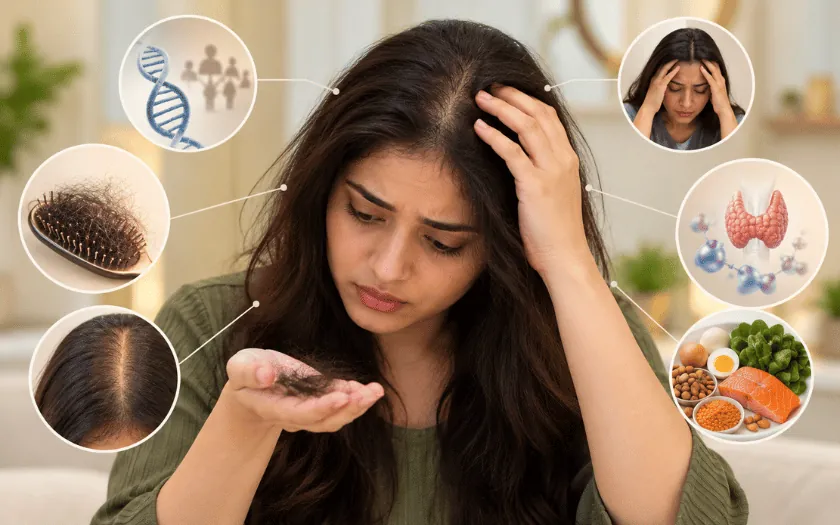
Thyroid and hair loss are linked because thyroid hormones help regulate the hair growth cycle. Both an underactive thyroid (hypothyroidism) and an overactive thyroid (hyperthyroidism) can push hairs into the resting phase early, causing diffuse shedding across the scalp. Once thyroid levels are brought into the normal range, hair loss often settles, although regrowth takes months.
- Both low and high thyroid hormone levels can cause hair shedding.
- Thyroid hair loss is usually diffuse, not patchy.
- A simple blood test can check thyroid function.
- With treatment, shedding often stops, but visible regrowth is slow.
How does the thyroid affect hair?
The thyroid is a small gland in the neck. It makes hormones that control how fast the body uses energy. Hair follicles are among the most active cells in the body, and they respond to changes in thyroid hormone levels, even mild ones.
When levels are too low or too high, follicles can leave the growth phase early and enter the resting phase. A few months later these hairs shed. This process is a type of telogen effluvium, the same kind of shedding seen after illness or childbirth.
Why the shedding can seem delayed
Hairs that enter the resting phase stay on the scalp for around two to four months before they fall. This means shedding may begin some time after thyroid levels first changed, and it may also continue for a while after treatment has started. Many people only link the two when a blood test is done for another reason, such as tiredness or weight change. Keeping a note of when symptoms began, when shedding started and when any medicine was started or adjusted can help your doctor piece the picture together.
Thyroid conditions can develop at any age. They may appear gradually, so hair changes are sometimes one of the first things a person notices.
What does thyroid hair loss look like?
Thyroid related hair loss is usually spread evenly across the scalp rather than in bald patches. The quality of the hair can change too.
Hypothyroidism hair fall
With an underactive thyroid, people may notice:
- Hair that grows slowly and feels coarse, dry and brittle
- Hair that breaks easily
- General thinning across the scalp
- Thinning of the outer third of the eyebrows
Other symptoms can include tiredness, feeling cold, weight gain, constipation, dry skin and heavier or irregular periods.
Hyperthyroidism hair thinning
With an overactive thyroid, hair may become fine, soft and silky, and shed more than usual. Other symptoms can include weight loss, a fast heartbeat, feeling hot, tremor, anxiety and sweating.
Can thyroid problems cause patchy hair loss?
Thyroid imbalance itself usually causes diffuse shedding. However, autoimmune thyroid conditions, such as Hashimoto thyroiditis, are seen more often in people with alopecia areata, a condition in which the immune system causes round, smooth bald patches. If you have patchy loss and a thyroid condition, both may need to be assessed separately.
Thyroid problems can also sit alongside other causes of thinning, such as low iron or female pattern hair loss. When more than one factor is present, treating the thyroid alone may not fully restore hair.
How is thyroid hair loss diagnosed?
A doctor will usually ask about your symptoms, family history, recent illnesses, weight changes, periods and medicines. They will examine your scalp and may use trichoscopy, a magnified scalp examination, to look at hair thickness and the pattern of loss.
Blood tests commonly include:
- Thyroid stimulating hormone (TSH) and thyroid hormone levels
- Thyroid antibodies, when an autoimmune cause is suspected
- Iron studies including ferritin, vitamin B12 and other markers as needed
Our page on hair loss diagnosis explains what to expect at an assessment.
Does thyroid hair loss grow back?
Often, yes. Once thyroid hormone levels are corrected with appropriate treatment, the shedding frequently settles and follicles return to their normal cycle. Because hair grows slowly, it can take several months before new growth becomes visible and longer before overall thickness improves.
There are some limits:
- Thyroid disease that has been untreated for a long time may leave some follicles less able to recover.
- If another condition, such as pattern hair loss, is also present, that thinning will continue unless it is treated too.
- Shedding may continue for a short time after starting treatment while the hair cycle resets. Your doctor can advise you on this.
What helps while your thyroid is being treated?
The most important step is treating the thyroid condition itself with your doctor or endocrinologist. Thyroid medicines and doses are adjusted based on blood tests, so regular follow up matters. Alongside this:
- Correct other deficiencies found on blood tests, such as low iron
- Eat balanced meals with enough protein
- Handle hair gently and avoid tight hairstyles and harsh chemical treatments
- Be patient, as the hair cycle takes months to respond
If thinning continues once thyroid levels are stable, medical hair treatments may be discussed. Supportive options such as PRP hair treatment may be considered for some people, but they are not a substitute for correcting the thyroid problem and finding the full cause.
When should you see a doctor?
See a doctor if you notice increased shedding together with symptoms such as tiredness, weight change, feeling unusually hot or cold, palpitations or a swelling in the neck. Also seek advice if you already have a thyroid condition and your hair is still thinning despite normal blood results, as another cause may be present.
If you are concerned about hair loss linked to your thyroid, book a consultation at Elegance Hair Restoration Centre in Surat to have your hair and scalp assessed alongside your thyroid history. You can book an appointment at our Adajan or Vesu centre.
Related treatments and conditions
Sources
- PMC (NIH): Impact of thyroid dysfunction on hair disorders
- American Academy of Dermatology: Thyroid disease, a checklist of skin, hair and nail changes
- DermNet: Telogen effluvium
This article is for general information only. Treatment depends on each patient’s condition and should be decided after consultation with a qualified doctor. Medically reviewed by Dr. Ashutosh Shah, M.B.B.S., M.S., M.Ch., D.N.B. (Plastic Surgery), Gujarat Medical Council Reg. No. G-26257. See the medical disclaimer.
More in Understanding Hair Loss
Questions patients ask
Straight answers, before you decide.
These are the questions that come up most often in consultation. If yours is not here, send it on WhatsApp and the team will reply.
It varies. Shedding often slows once thyroid levels are stable, but because hair grows slowly, visible regrowth usually takes several months, and fuller thickness can take longer. Regular blood tests help keep levels in range. If there is no improvement after thyroid levels have been normal for some months, another cause should be checked.
Some people notice shedding in the early months after starting or changing thyroid treatment, often as the hair cycle adjusts to new hormone levels. This usually settles. Never stop or change thyroid medicine on your own. Speak to the doctor who prescribes it, who can check your levels and look for other causes.
Yes. Thyroid hair loss is usually diffuse shedding across the whole scalp, while pattern hair loss follows typical areas such as the temples and crown in men or the central parting in women. The two can occur together, which is why a scalp examination is useful alongside thyroid blood tests.
A transplant is not the first step for thyroid related shedding, because the hair often recovers once the thyroid is treated. Surgery may be considered later only if a separate, stable cause of thinning such as pattern hair loss remains. Thyroid levels should be well controlled before any elective procedure.