
Regenerative hair treatment
PRP treatment for hair in Surat
A supportive therapy from your own blood, planned around a clear diagnosis.
PRP treatment for hair in Surat uses platelet rich plasma prepared from a small sample of your own blood and injected into thinning areas of the scalp. It is a supportive treatment, most often considered for early to moderate pattern hair loss alongside medicines, and results vary from person to person.
Last updated · Medical review: Dr. Ashutosh Shah, M.B.B.S., M.S., M.Ch., D.N.B. (Plastic Surgery), Gujarat Medical Council Reg. No. G-26257
 Diagnosis before injection
What is PRP for hair loss?
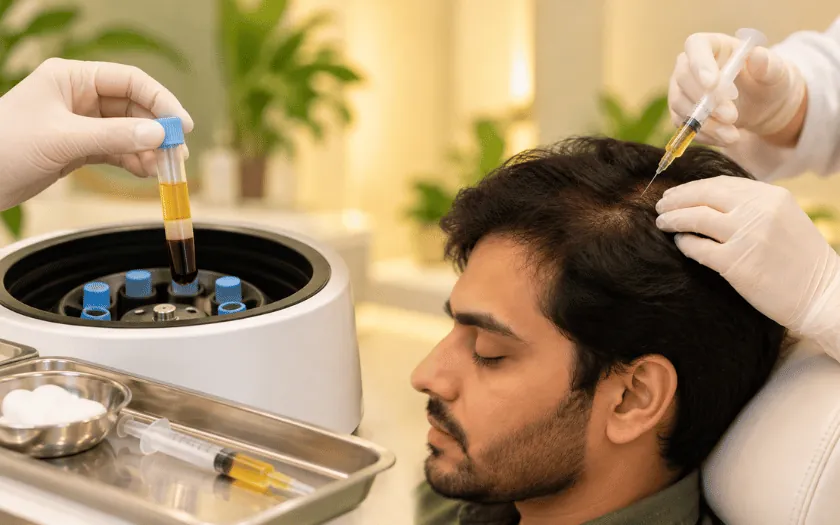
Platelets are small cells in the blood that help with healing. They carry proteins called growth factors, which signal to surrounding tissue. In PRP, a sample of your blood is spun in a centrifuge so the platelets become concentrated in a small amount of plasma. That plasma is then placed into the scalp with fine injections.
The idea is that growth factors may support hair follicles that are shrinking but still alive, helping them stay in the growth phase for longer and produce thicker hairs. Research on PRP for pattern hair loss is more extensive than for many newer injectables, yet studies differ in how PRP is prepared, how often it is given and how results are measured. That is why it is presented here as a supportive option rather than a cure.
PRP does not create new follicles. Where hair has been lost completely and the scalp is smooth and shiny, there is usually little for it to work on. It also does not treat the underlying cause of every type of hair fall, which is why a proper hair loss diagnosis comes first.
Who PRP may suit, and who it may not
A PRP hair treatment consultation starts with the question of whether PRP makes sense for your type of hair loss at all. It is most often considered for:
- Men and women with early to moderate pattern hair loss where follicles are still present
- People already using medical treatment who want to add a supportive therapy
- People who cannot use, or prefer to limit, certain medicines, after the trade offs are discussed
- Selected patients around a hair transplant, as an optional support
PRP may not be suitable, or may need extra care, if you have:
- A blood or platelet disorder, or you take blood thinning medicines
- An active scalp infection or an inflamed scalp condition that needs treatment first
- Certain chronic illnesses, active cancer treatment or a serious infection
- Pregnancy or breastfeeding
- Scarring alopecia that is still active, or hair loss from a thyroid problem or deficiency that has not been corrected
In these situations another route is usually more sensible, and that should be said plainly at consultation.
How you are assessed first
Before any injection, your history is taken: when the hair loss began, family history, recent illness or weight loss, periods and pregnancy for women, medicines and hair care habits. The scalp is examined, often with dermoscopy, to look at hair calibre, miniaturisation and signs of inflammation or scarring.
Blood tests are advised only where they are relevant, for example to check iron stores, thyroid function or vitamin levels, rather than as a fixed panel for everyone. Standard photographs are taken so that any change can be judged fairly later. If PRP is not likely to help your pattern of loss, this is the point where you should hear it.
How a PRP session is done
- Preparing for the day
You are told which medicines to review beforehand, and advised to eat normally and stay hydrated. Blood thinning painkillers may need to be avoided for a period if your doctor agrees it is safe.
- Drawing the blood
A small sample is taken from a vein in the arm, much like a routine blood test.
- Processing
The sample is spun in a centrifuge using a closed, sterile system so the platelet rich layer can be separated on the same day.
- Scalp injections
The scalp is cleaned, numbing or cooling may be used for comfort, and the plasma is placed across the thinning areas with fine needles.
- Going home
Most people go back to their day soon after, with simple instructions on washing, avoiding heavy exercise briefly and what to watch for.
Treatment schedule and maintenance
An initial course of a few sessions spaced several weeks apart is common, followed by a review with photographs. If there is a meaningful benefit, occasional maintenance sessions may be suggested, because the effect of PRP fades over time. If there is no benefit at review, stopping is a reasonable choice.
Side effects and possible risks
Because PRP comes from your own blood, allergic reactions to the plasma itself are unlikely. Side effects usually come from the injections and tend to be short lived:
- Pain or discomfort during the injections
- Scalp tenderness, redness or mild swelling for a day or two
- Mild headache
- Small bruises or pinpoint bleeding at injection sites
- Temporary increase in shedding in some people
Infection is uncommon when sterile technique is used, but no injected treatment is free of risk. Increasing pain, spreading redness, fever or discharge should be reported promptly. People who feel faint with blood tests should mention it, so the blood draw can be done lying down.
PRP versus other treatment options
For pattern hair loss, medicines such as minoxidil and, in suitable men, finasteride remain the foundation of treatment where they suit you. PRP is generally added to that foundation rather than used in place of it.
- Both are made from your own platelets
- They are prepared and processed differently
- There is no clear proof that one suits everyone better
- Preparation quality and diagnosis matter more than the label
- Medical treatment chosen for your diagnosis
- Low level laser or other device based therapy
- Nutritional correction where a deficiency is found
- A hair transplant when loss is stable and donor hair allows
Other injectables, such as mesotherapy or exosome products, have different evidence behind them and should be weighed one by one. Our regenerative and adjunctive therapies page explains each of them.
PRP hair treatment cost factors
The cost of PRP is discussed after your consultation, once it is clear whether it suits you. It depends on the number of sessions in the initial course, whether maintenance sessions are needed, the preparation system used, whether PRP is combined with other treatments, and the follow up and photographs involved. Be cautious about packages sold before any diagnosis, or pressure to pay for many sessions at once.
PRP at our Surat clinic
Looking for a PRP hair treatment clinic or doctor near you in Surat is a reasonable starting point, but the more useful question is who will examine your scalp and tell you honestly whether PRP is worth it. At Elegance, hair loss care is led by Dr. Ashutosh Shah, a plastic, cosmetic and hair transplant surgeon with more than 22 years of experience, practising in Surat since 2004.
- Diagnosis and relevant tests come before any injection
- PRP may be offered where suitable after assessment, alongside medical care
- Sessions follow sterile preparation and injection practice
- Progress is judged with standard photographs at review
- Consultations at two centres in Surat: Adajan and Vesu
When to see a doctor sooner: sudden or patchy hair loss, hair loss with scalp pain or scaling, or thinning with irregular periods or other body changes should be checked by a doctor before any cosmetic treatment is considered.
Suitability, risks and recovery differ for each patient and are discussed during consultation.
Want to know if PRP suits you?
Request a PRP consultation to find out whether it fits your hair loss plan.
PRP questions
Still have a question?
Answers to what patients often ask about PRP for hair. Whether it suits you is decided only after an examination.
Most people feel stinging or pressure from the injections. Numbing cream, cooling or local anaesthetic may be used to make it more comfortable, and tenderness afterwards usually settles within a day or two.
Changes, if they happen, are gradual. Reduced shedding may come first, and any change in density usually takes several months to judge using photographs taken the same way each time.
You are usually asked to wait a short time before washing and to avoid harsh products, heavy exercise and steam for the rest of the day. Follow the written instructions you are given.
It may be considered for female pattern hair loss, usually alongside other treatment. Hormonal problems, iron deficiency or thyroid issues should be checked first, and PRP is avoided in pregnancy and breastfeeding.
PRP does not cause hair loss when stopped, but any benefit tends to fade over time as the underlying hair loss continues. That is why medical treatment is usually kept as the foundation.
Alopecia areata is an autoimmune condition with its own recognised treatments. PRP has been studied in it, but the evidence is limited, so it is not a first choice and is considered only after proper assessment.
Ask what is causing your hair loss, whether PRP is likely to help it, how the plasma is prepared, how many sessions are planned, the total cost including maintenance, and how progress will be measured.
Book a consultation
Begin with a conversation.
Every plan starts with an in person assessment by Dr. Ashutosh Shah. Call or WhatsApp the clinic and our team will get back to you.
Book on WhatsApp
Chat with our team on WhatsApp about any treatment, consultation or appointment.
- Ask about any treatment
- Book a consultation
- Get directions to our clinics
WhatsApp opens with a short message ready to send. The clinic team replies during working hours.