
Treatments
How Does PRP for Hair Work? What the Evidence Shows
How does PRP for hair work? Plasma rich in your own platelets is injected into thinning areas, where growth factors may support weak follicles. Results vary, and it is usually a supportive treatment.
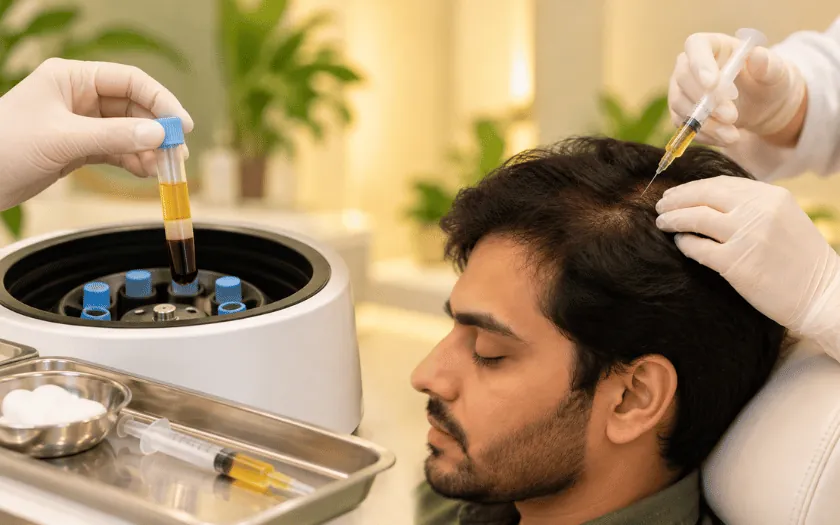
PRP for hair works by concentrating the platelets from a small sample of your own blood and injecting that plasma into thinning areas of the scalp. Platelets release growth factors that may support weakened hair follicles and help them stay in the growth phase for longer. It can help some people with early pattern thinning, but results vary and it supports, rather than replaces, a proper diagnosis and proven medicines.
Key takeaways
- PRP stands for platelet rich plasma, made from your own blood.
- It tends to help most when thinning is recent and follicles are still alive.
- Research is promising but mixed, and there is no single agreed protocol.
- It often works better alongside medical treatment than on its own.
What is PRP for hair?
PRP is a treatment that uses part of your own blood. A small amount of blood is drawn from the arm, much like a routine blood test. It is then spun in a machine called a centrifuge, which separates the red cells from the plasma.
The part of the plasma that holds a higher number of platelets is collected. Platelets are tiny blood cells known for helping wounds heal. This concentrated plasma is then injected into the scalp with a fine needle.
Because the material comes from your own body, allergic reactions to the plasma itself are unlikely. That does not make it suitable for everyone, and it still needs a medical assessment first.
How does PRP for hair work inside the scalp?
Platelets carry small packets of proteins called growth factors. When they are activated, they release these proteins into the surrounding tissue. Researchers believe several effects may follow:
- Longer growth phase. Growth factors may help follicles stay in anagen, the active growing stage of the hair growth cycle, for longer.
- Better blood supply. Some growth factors encourage new small blood vessels around the follicle.
- Support for follicle cells. They may stimulate the stem cells that sit near the base of each follicle.
In pattern hair loss, the hormone DHT slowly shrinks follicles so they grow thinner, shorter hairs. This process is called miniaturisation. PRP does not block DHT. Instead, it may help follicles that are shrinking but still alive to produce thicker hair for a time.
Does PRP work for hair? What the research says
Several reviews of clinical studies suggest PRP can increase hair count and hair thickness in people with androgenetic alopecia, the common inherited pattern of thinning. Many studies report visible change around the third month.
The research also has clear limits:
- Many studies are small and follow patients for a short time.
- Clinics prepare PRP in different ways, so results are hard to compare.
- Some studies found that gains faded when sessions stopped.
- A meta analysis concluded that stronger trials and agreed protocols are still needed.
In simple terms, PRP is a reasonable option for some patients, but it is not a proven substitute for established treatments. Studies suggest it may add benefit when combined with minoxidil for hair loss or other medicines that a doctor prescribes.
Who may benefit, and who may not?
PRP tends to suit people whose thinning is recent and mild to moderate. A follicle that has been inactive for many years is much harder to wake up. It is often considered for:
- Early male pattern hair loss or female pattern thinning
- People already using medicines who want added support
- Some patients before or after a hair transplant, as part of a wider plan
PRP may be less suitable or unsuitable when:
- The scalp is already smooth and shiny, with no visible fine hairs left
- Hair loss comes from an untreated cause such as a thyroid problem, low iron or an active scalp disease
- You have a blood or platelet disorder, or take blood thinning medicines
- There is an active infection on the scalp
This is why a careful hair loss diagnosis comes first. Treating the wrong cause wastes time and money.
What happens during PRP sessions for hair?
A typical visit follows a simple sequence:
- The doctor reviews your scalp and confirms the areas to treat.
- A small blood sample is drawn from the arm.
- The blood is spun and the platelet rich layer is collected.
- The scalp is cleaned, and numbing may be used for comfort.
- The plasma is injected in small amounts across the thinning zone.
The whole visit usually takes around an hour. Most people return to normal routines the same day. Mild soreness, tightness or pinpoint bleeding can occur for a day or two.
How many PRP sessions for hair are usual?
There is no single fixed schedule. Studies and clinics often describe an initial course of monthly sessions for a few months, followed by maintenance sessions spaced further apart. Your doctor sets the plan based on your pattern of loss, age, response and other treatments.
PRP hair treatment results: what timeline is realistic?
Hair grows slowly, so early change is subtle. Many patients first notice less shedding. Improvement in thickness, if it comes, is often judged after about three to six months. Standardised photographs taken at each visit help compare progress fairly.
Results vary from person to person. Some people see a useful gain, some see a modest change, and some see little. Because pattern hair loss continues over time, benefits may fade without ongoing care.
Are there risks or side effects?
PRP is generally well tolerated. The most common effects are temporary:
- Discomfort or tenderness at injection sites
- Mild swelling, redness or a feeling of pressure
- Small bruises or pinpoint bleeding
- A mild headache after the session
Infection is uncommon when sterile technique is used. Like any injection, it is not risk free. Tell your doctor about all medicines and supplements, including blood thinners and painkillers.
What affects the cost of PRP?
The cost depends on several factors:
- The number of sessions in your plan
- The size of the area being treated
- The preparation system and technique used
- Whether PRP is combined with other treatments
The exact cost can be discussed after consultation and a scalp assessment.
When should you see a doctor about thinning hair?
See a doctor if you notice a widening parting, a receding hairline, patches of loss, sudden heavy shedding, or scalp pain, redness or scaling. Early assessment gives more choices, because living follicles respond better than dormant ones. A doctor can also check for causes that PRP alone cannot fix. You can read more about the procedure on our PRP hair treatment page.
Book a consultation at Elegance Hair Restoration Centre in Surat to discuss your options. Dr. Ashutosh Shah, a plastic and hair transplant surgeon with more than 22 years of experience, can assess your scalp and explain whether PRP fits into your plan. Book a consultation in Surat.
Related treatments and conditions
Sources
- PMC: Platelet rich plasma for androgenetic alopecia, a review of the literature and proposed treatment protocol
- PMC: A meta analysis on evidence of platelet rich plasma for androgenetic alopecia
- Cleveland Clinic: Hair loss got you down? Platelet rich plasma may regrow it
This article is for general information only. Treatment depends on each patient’s condition and should be decided after consultation with a qualified doctor. Medically reviewed by Dr. Ashutosh Shah, M.B.B.S., M.S., M.Ch., D.N.B. (Plastic Surgery), Gujarat Medical Council Reg. No. G-26257. See the medical disclaimer.
More in Treatments
Questions patients ask
Straight answers, before you decide.
These are the questions that come up most often in consultation. If yours is not here, send it on WhatsApp and the team will reply.
Most people feel a pricking or pressure sensation during the injections. Numbing methods can reduce discomfort, and soreness usually settles within a day or two. The experience differs from person to person, so it helps to discuss comfort options with the doctor before the first session.
It is unlikely. PRP may support follicles that are thinning but still active. Where the scalp is smooth and follicles have been inactive for years, there is little left to stimulate. In such areas, other options such as surgery or cosmetic solutions are usually discussed instead.
Some studies report that gains decline months after sessions stop, because pattern hair loss keeps progressing. Many people need maintenance sessions and continued medical treatment to hold their improvement. How long results last varies, and a doctor can review progress with photographs at follow up visits.
Many doctors advise waiting several hours, often until the next day, before washing the scalp. Avoid harsh products, heavy sweating and hot showers for a short time. Follow the aftercare advice given by your own treating doctor, since instructions can differ between practices.
Yes, women with pattern thinning are often considered for PRP. Female hair loss can also be linked to iron levels, thyroid function, hormones or recent illness, so blood tests and a scalp examination are important first. PRP then works as one part of a wider plan.