
Types of hair transplant
Sapphire FUE hair transplant, what the blade really changes
Sapphire is the material of the blade, not a new way of growing hair.
A sapphire FUE hair transplant is an FUE procedure in which the tiny recipient sites are made with fine blades of synthetic sapphire instead of steel. The blade is one small part of the operation. Your result depends much more on planning, graft handling, angle, direction, density and surgical skill than on the blade material.
Last updated · Medical review: Dr. Ashutosh Shah, M.B.B.S., M.S., M.Ch., D.N.B. (Plastic Surgery), Gujarat Medical Council Reg. No. G-26257
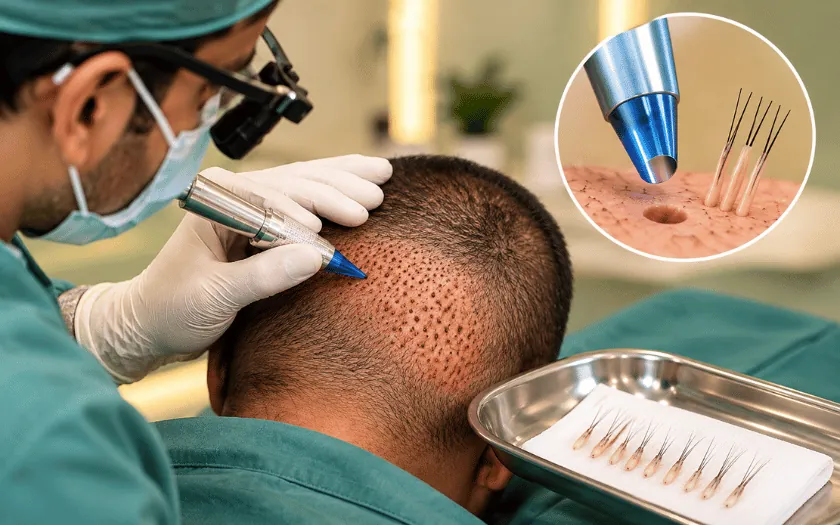 A blade choice within FUE
What is a sapphire FUE hair transplant?
In any FUE transplant there are three main steps: grafts are extracted one by one from the donor area, tiny openings called recipient sites are made in the thinning area, and the grafts are placed into those sites. Sapphire FUE changes only the second step. The sites are made with small blades cut from synthetic sapphire crystal rather than with steel blades or fine needles.
The name is sometimes presented as a separate, advanced type of transplant. It is fairer to see it as a choice of instrument. Harvesting is still FUE, donor hair is still limited, and the same rules about hairline design and lifetime planning apply.
Why recipient sites matter so much
Recipient sites decide how the transplanted hair will look. Their angle and direction set how each hair will lie. Their depth and size affect how snugly each graft sits. Their spacing and pattern decide density and how natural the transition is between the hairline and the hair behind it.
- Angle: hair near the front usually lies low and forward, and a wrong angle can look unnatural
- Direction: the crown has a whorl, and the temples change direction
- Size: sites are matched to the size of each graft
- Density: too dense can harm blood supply, too sparse can look thin
- Irregular design: a soft, slightly irregular front edge looks more natural than a straight line
All of this is decided by the surgeon, whatever blade is used. A sapphire blade in careless hands will not rescue a poorly planned hairline, and a well planned case can do well with steel blades or needles.
Sapphire versus steel, a fair comparison
- Very fine, smooth cutting edges
- Blades hold their sharpness through a session
- May create neat slits with little tissue trauma
- Can be made in small sizes to match grafts
- Good comparative evidence against steel is limited
- Steel blades and needles also make fine, precise sites
- Growth depends mainly on graft handling and planning
- A blade does not change donor limits or overharvesting risk
Some people find claims of faster healing or better growth with sapphire persuasive. Any difference, if present, is likely to be small compared with the effect of skill, planning and aftercare. It is reasonable to ask for the reasoning behind any claim you are given.
Who may consider sapphire FUE
Because sapphire FUE is simply FUE with a particular blade, the same suitability rules apply. It may be considered if:
- Your hair loss has a clear diagnosis and has stabilised or is being treated
- Your donor area has enough healthy hair to share over your lifetime
- You prefer FUE because you wear your hair short at the back
- The areas to be treated suit an FUE session size
It may not be the right choice if hair loss is still progressing without treatment, if a scalp condition needs care first, if the donor area is limited, or if expectations of density are beyond what your donor supply can safely give.
How the procedure is done
- Assessment and hairline design
Diagnosis, donor examination and a hairline drawn for your age and face.
- Local anaesthesia
The donor and recipient areas are numbed.
- FUE extraction
Grafts are taken one by one, spread evenly within the safe donor zone.
- Sapphire site creation
Recipient slits are made with sapphire blades at the planned angle, direction and density.
- Graft placement and aftercare
Grafts are placed, and you go home with written care instructions and review visits.
Sapphire FUE recovery, side effects and results
Recovery follows the usual FUE pattern. Small crusts in the recipient area often settle within the first one to two weeks, redness fades over the following weeks, and many people return to desk work within days. Transplanted hairs commonly shed in the first weeks, new growth often starts after a few months, and the result is usually judged at around a year.
No surgery is risk free. Possible effects include pain, swelling, minor bleeding, itching, temporary numbness, infection or folliculitis, shock loss of nearby native hair, patchy or slow growth and donor thinning if too many grafts are taken. The blade material does not remove these risks. Results vary and depend on the cause of loss, donor quality, graft survival and protection of native hair with medical treatment where advised.
Alternatives and when to see a doctor
Recipient sites can also be made with steel blades or fine needles, and grafts can be placed with forceps or implanters, as in DHI. FUT or a hybrid of FUT and FUE may suit people who need more grafts over time. Some people are better served by medical treatment first, or by non surgical options such as scalp micropigmentation.
See a doctor if your hairline is receding, your crown or parting is thinning, hair is falling in patches, or your scalp is itchy, red or scaly. A diagnosis comes before any decision about blades or techniques.
Cost factors and choosing a clinic
Cost is discussed after consultation and depends on the number of grafts, the area covered, the time the session takes, any combined techniques and follow up care. The blade itself is a small part of the overall work, so a large price difference based only on the word sapphire deserves a clear explanation.
When comparing a sapphire FUE hair transplant clinic, doctor or specialist, ask who designs the hairline, who makes the recipient sites and who is the senior doctor accountable for your surgery. If you would prefer a lady doctor or a male doctor for your examination, you can ask when you book. At Elegance Clinic, sapphire blade FUE is one of the approaches that may be used, and the instrument is chosen by a plastic surgeon to suit your case.
Suitability, risks and recovery differ for each patient and are discussed during consultation.
Planning matters more than the blade.
Your hairline, density and donor plan are decided in person, then the right instruments are chosen.
Sapphire FUE questions
Still have a question?
Answers to what patients ask most about sapphire blades. Your own plan is confirmed only after an examination.
No. It is FUE in which the recipient sites are made with sapphire blades. Extraction, placement and aftercare follow the same principles.
Some people report neat, quick healing, but good comparative evidence is limited. Healing depends more on site size, density, technique and aftercare.
Density is limited by your donor supply and by how closely grafts can be placed while keeping good blood supply. The blade does not change those limits.
No. Sapphire blades are used in the recipient area. Donor marks come from FUE extraction, which is the same either way.
It can be, if the diagnosis supports surgery and the donor area is stable. Women often need careful donor assessment and may prefer approaches that limit shaving.
Ask who designs the hairline and makes the sites, how many grafts are planned, how the donor area is protected, and what exactly the price includes.
Book a consultation
Begin with a conversation.
Every plan starts with an in person assessment by Dr. Ashutosh Shah. Call or WhatsApp the clinic and our team will get back to you.
Book on WhatsApp
Chat with our team on WhatsApp about any treatment, consultation or appointment.
- Ask about any treatment
- Book a consultation
- Get directions to our clinics
WhatsApp opens with a short message ready to send. The clinic team replies during working hours.