
Types of hair transplant
Bio FUE hair transplant, what the name usually means
A package name, not a standard medical category.
A bio FUE hair transplant is not a universally defined procedure. The term is used by some clinics for FUE combined with PRP, growth factors or other supportive treatments. The transplant itself is still FUE, so the useful question is not the name but exactly what is included and why.
Last updated · Medical review: Dr. Ashutosh Shah, M.B.B.S., M.S., M.Ch., D.N.B. (Plastic Surgery), Gujarat Medical Council Reg. No. G-26257
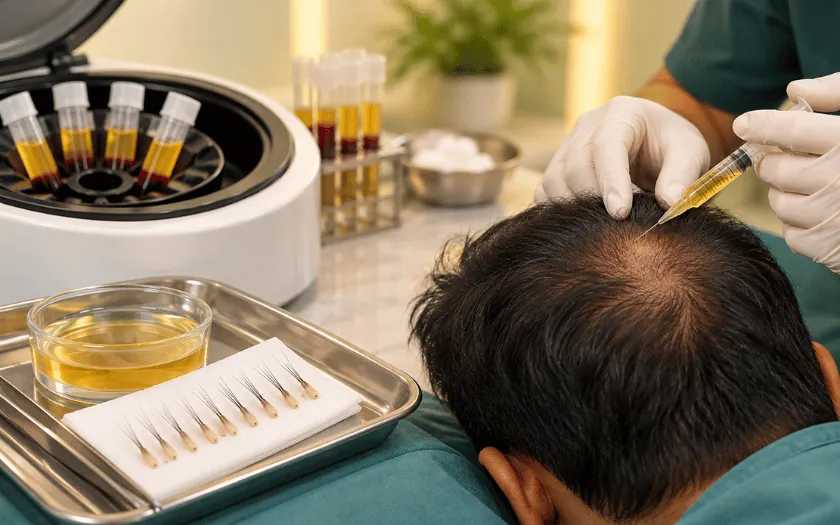 FUE, plus what exactly?
What clinics mean by bio FUE hair transplant
There is no single agreed medical definition of bio FUE. When the term is used, it usually describes a standard FUE transplant with one or more supportive treatments added before, during or after the procedure. These may include:
- PRP, platelet rich plasma prepared from your own blood
- Growth factor concentrate, another platelet derived preparation
- Solutions in which grafts are stored while outside the body
- A course of scalp injections in the months after surgery
Because each clinic can use the name differently, two packages called bio FUE may contain quite different things. This page explains the parts that are commonly included, so you can judge each one on its own merits.
The transplant is still FUE
Whatever is added, the core operation is follicular unit extraction. Grafts are removed one by one from the donor area, recipient sites are made in the thinning area, and grafts are placed into them. The things that shape your result are the same as in any FUE:
- A correct diagnosis and stable or treated hair loss
- A hairline designed for your age, face and likely future loss
- Careful extraction spread across the safe donor zone
- Gentle graft handling and limited time outside the body
- Correct angle, direction and density of placement
- Protection of native hair with medical treatment where advised
No supportive treatment can make up for weak planning or poor graft handling, and none changes the limit of your donor supply.
PRP and growth factors: what the evidence says
PRP has been studied more than most supportive treatments for hair. Some studies suggest it may help healing or growth after a transplant, but results vary from person to person, and preparation methods differ widely between clinics. Growth factor concentrate is also platelet based and is processed differently; its evidence is more limited.
Newer products promoted as stem cell or exosome treatments are emerging, and they should not be presented as a promise of regeneration. A calm way to see all of these is as optional additions that may support a well planned transplant in selected patients, not as the reason a transplant works.
PRP may not suit people with blood or platelet disorders, those on blood thinning medicines, people with an active scalp infection or during pregnancy. These points are checked before it is offered. You can read more on the regenerative hair treatment page.
Who may consider FUE with supportive treatment
Adding PRP or a similar treatment may be discussed for:
- People having FUE who also have early thinning in native hair around the transplanted area
- Patients who wish to try a supportive option alongside medicines after surgery
- Selected cases where the surgeon feels it may support healing
It is not needed for a transplant to succeed, and it is not a substitute for diagnosis or for proven medical treatment. People whose hair loss is undiagnosed, actively progressing or caused by a scalp condition need that addressed first, with or without any package name.
How it is done and recovery
- Assessment
Diagnosis, donor examination, hairline design and a clear discussion of what supportive treatment, if any, is advised and why.
- FUE procedure
Grafts are extracted and placed under local anaesthesia, following the usual FUE steps.
- Supportive treatment
If chosen, PRP or a similar preparation is made from a blood sample and injected at the planned time.
- Follow up
Review visits track healing, shedding and growth, and further sessions are discussed only if they make sense.
Recovery is broadly the same as FUE. Crusts often settle within the first one to two weeks, transplanted hairs commonly shed in the first weeks, new growth often starts after a few months, and the result is usually judged at around a year.
Side effects and risks
No surgery is risk free. FUE can cause pain, swelling, minor bleeding, itching, temporary numbness, infection or folliculitis, shock loss of nearby native hair, patchy growth and donor thinning if too many grafts are taken. Scalp injections can add temporary pain, tenderness, bruising at the blood draw or injection sites and, rarely, infection. Results vary, and an added treatment does not make them certain.
Alternatives and when to see a doctor
A standard FUE, FUT or a hybrid of both can be planned without any package name, with supportive treatment added separately only if it helps. For early thinning, medical treatment, and sometimes PRP on its own, may be tried before surgery is considered. Non surgical options such as scalp micropigmentation or hair systems suit some people who do not want surgery.
See a doctor if you notice steady thinning, a receding hairline, patchy loss or sudden heavy shedding. Heavy shedding can have causes such as illness, stress, nutritional deficiency or thyroid problems, which need assessment before any transplant is discussed.
Cost factors and questions to ask
Cost is discussed after consultation. It depends on the number of grafts, the area covered, which supportive treatments are included, how many sessions of them are planned and follow up care. Ask for each part to be listed separately, so you can see what you are paying for.
When comparing a bio FUE hair transplant clinic, doctor or specialist, ask what exactly the name includes, what evidence supports each part, who performs each step and who is the senior doctor responsible. If you prefer a lady doctor or a male doctor for your examination, you can ask when you book. At Elegance Clinic, FUE is planned by a plastic surgeon, and any supportive treatment such as PRP is discussed as a separate, optional part of the plan after assessment, only where it is suitable.
Suitability, risks and recovery differ for each patient and are discussed during consultation.
Want a clear list, not a label?
Your plan explains every part of the treatment and the reason for it.
Bio FUE questions
Still have a question?
Answers to what patients ask most about bio FUE packages. Your own plan is confirmed only after an examination.
The surgery is the same FUE. Any difference comes from the added treatments, whose benefit varies from person to person and is not certain.
Usually not. Most packages add platelet based treatments such as PRP. Products promoted as stem cell or exosome treatments are emerging and should not be seen as a promise of regrowth.
Yes, PRP can be discussed separately after a transplant in selected cases. It is optional, and the transplant does not depend on it.
Shedding of transplanted hairs in the first weeks is a normal part of healing. There is no reliable way to prevent it, whatever a package is called.
Women first need a clear diagnosis, since diffuse thinning often responds to medical care and may not suit surgery. Supportive treatments may be discussed as part of that plan.
It should list the number of grafts, each supportive treatment and how many sessions, who performs each step, and what follow up is included.
Book a consultation
Begin with a conversation.
Every plan starts with an in person assessment by Dr. Ashutosh Shah. Call or WhatsApp the clinic and our team will get back to you.
Book on WhatsApp
Chat with our team on WhatsApp about any treatment, consultation or appointment.
- Ask about any treatment
- Book a consultation
- Get directions to our clinics
WhatsApp opens with a short message ready to send. The clinic team replies during working hours.