
Scalp conditions
Dandruff treatment and seborrhoeic dermatitis
Flakes and itching are common, treatable and nothing to be embarrassed about.
Good dandruff treatment starts with knowing what the flakes are. Dandruff and its more inflamed form, seborrhoeic dermatitis, are common, not contagious and not caused by poor hygiene. They tend to come and go, so the aim is to settle a flare and then keep the scalp calm with a simple routine that suits your hair.
Last updated · Medical review: Dr. Ashutosh Shah, M.B.B.S., M.S., M.Ch., D.N.B. (Plastic Surgery), Gujarat Medical Council Reg. No. G-26257
 Control, not a one time cure
What is dandruff, and how is it different from seborrhoeic dermatitis?
Dandruff is the visible shedding of small flakes of skin from the scalp, often with itching. The outer layer of the scalp renews itself all the time, but when it turns over faster than usual and the cells clump together, the flakes become large enough to see on the hair, shoulders and collar.
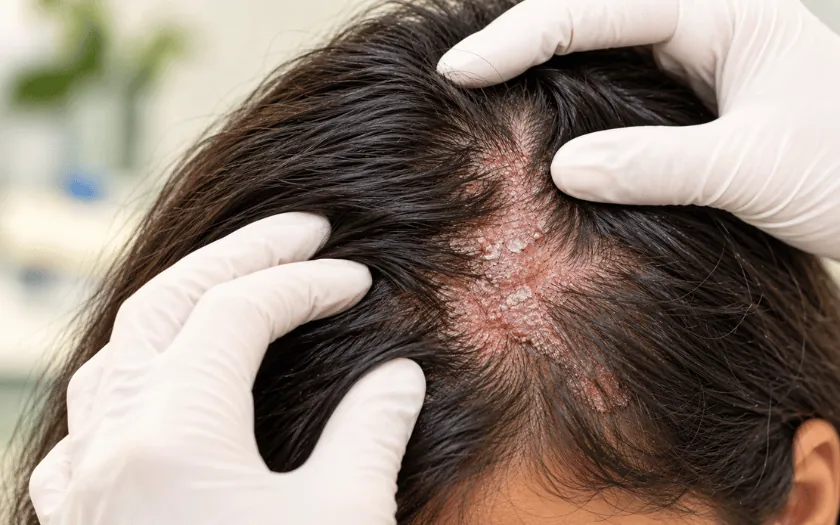
Seborrhoeic dermatitis sits at the more inflamed end of the same spectrum. As well as flakes, it causes redness and greasy scale, and it can affect other oily areas of the face and body, such as the eyebrows, the folds beside the nose, behind the ears, the beard area and the centre of the chest. The two are better thought of as mild and more active forms of one tendency rather than separate diseases.
Neither condition is an infection that spreads between people. Sharing a comb or a pillow will not pass it on, and it is not a sign that you wash too little.
Dandruff causes and common triggers
The exact cause is not fully understood, but several factors work together:
- Scalp oil. The condition is most common where oil glands are active, which is why it often begins after puberty.
- Malassezia yeast. A normal yeast that lives on everyone's skin feeds on scalp oil. Some people react to it with inflammation and faster skin turnover.
- Individual sensitivity. Why one person flakes and another does not seems to depend on how their skin barrier and immune response behave.
- Weather. Flares are common in humid months and in dry winter weather.
- Stress, tiredness and illness. Many people notice a flare during busy or unwell periods.
- Heavy oils and some styling products. Leaving thick oils on the scalp for long periods can feed the yeast in some people.
Seborrhoeic dermatitis can be more persistent or more widespread in people with certain nervous system conditions, such as Parkinson's disease, and in people whose immunity is lowered. A sudden severe case that does not settle is a reason to see a doctor rather than keep changing shampoos.
Signs: oily versus dry dandruff
People often describe two kinds of dandruff, and knowing which you have helps when choosing products.
- Yellowish, greasy flakes that stick to the scalp and hair
- Scalp that feels oily soon after washing
- Redness along the hairline, eyebrows or sides of the nose
- More typical of seborrhoeic dermatitis
- Fine, white, powdery flakes that fall easily
- Tight or dry feeling scalp, often worse in winter
- Little visible redness
- Can overlap with simple dry scalp or product irritation
Itching, scaling and redness
Itching is often the most troublesome symptom, and it tends to be worse on the crown and along the front hairline. Scratching can break the skin, make the scalp sore and occasionally let bacteria in. Redness is a sign that inflammation, not just flaking, is present, which usually means seborrhoeic dermatitis rather than mild dandruff.
Conditions that can look similar
White flakes are not always dandruff. Scalp psoriasis, a fungal infection of the scalp, an allergy to hair dye or a new product, and head lice eggs can all be mistaken for it. The treatment for each is different, which is why a scalp that does not respond deserves a proper look.
How dandruff and seborrhoeic dermatitis are diagnosed
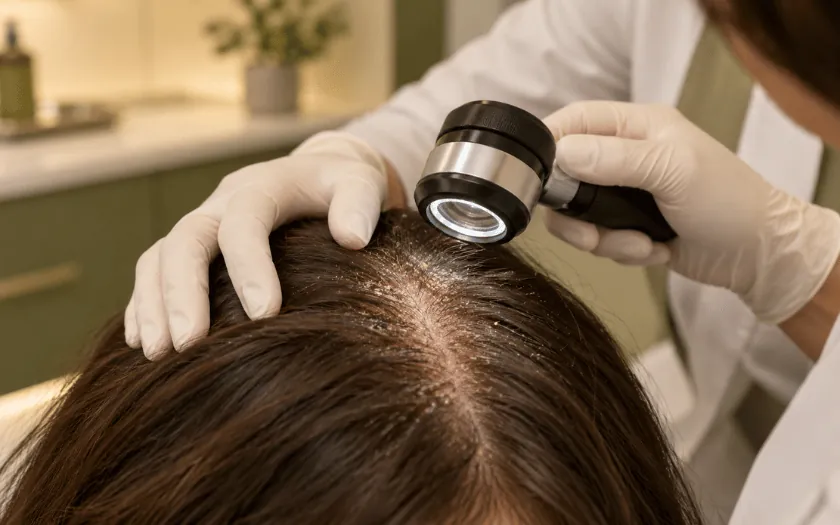
Diagnosis is usually clinical, which means it is made by talking with you and examining the scalp. The doctor may ask when the flaking started, whether it changes with the seasons, which shampoos and oils you use, whether your face, ears or chest are affected, and whether anyone in the family has psoriasis.
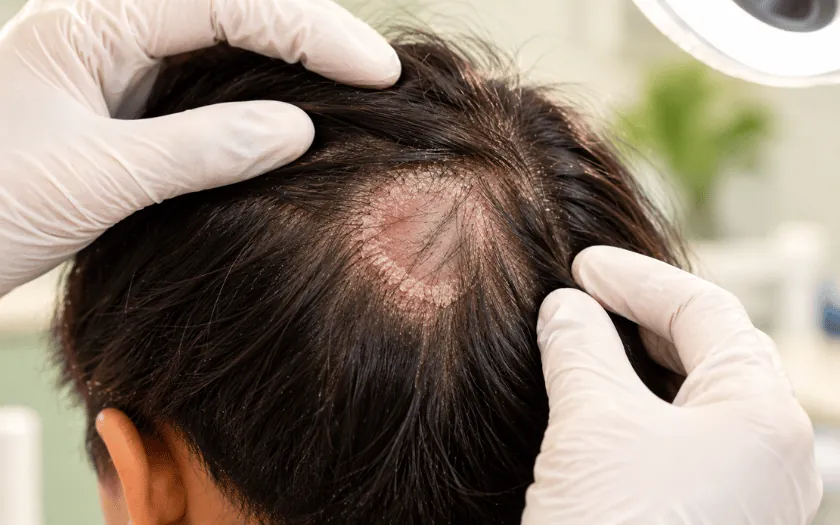
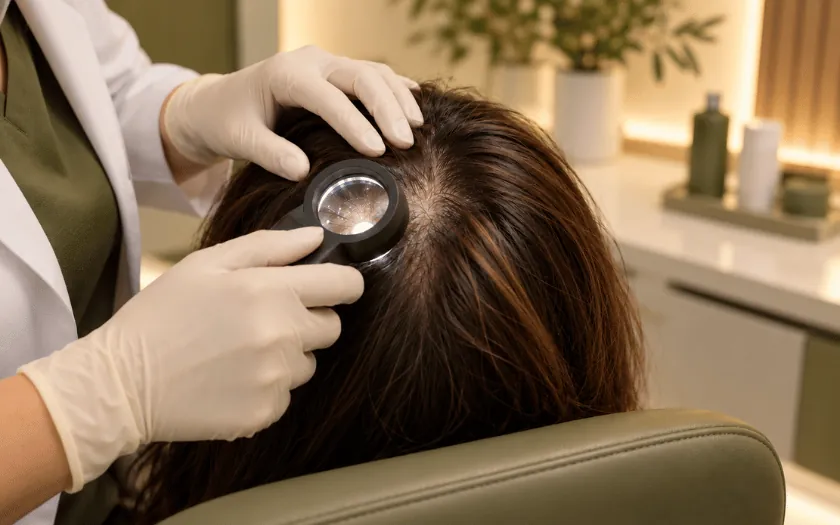
A magnified examination of the scalp, called trichoscopy, can help separate seborrhoeic dermatitis from psoriasis and can show the hair and follicles at the same time. Tests are not needed for most people. A scraping for fungus, a swab or rarely a small biopsy may be suggested when the picture is unusual, when there is patchy hair loss, or when treatment has not helped.
Dandruff treatment options and seborrhoeic dermatitis treatment
Treatment is matched to how active the scalp is and to your hair type. It often combines two parts: calming the current flare and preventing the next one. Medicine choices, strength and how long to use them are decided by your doctor.
- Medicated antifungal shampoo
Shampoos containing ingredients such as ketoconazole, ciclopirox, selenium sulphide or zinc pyrithione reduce the yeast on the scalp. They work better when lathered onto the scalp itself and left for a few minutes before rinsing, rather than washed straight off.
- Scale softening care
Where scale is thick, a keratolytic preparation, for example one with salicylic acid, may be suggested to loosen flakes so that other treatments can reach the skin.
- Anti inflammatory treatment for flares
When the scalp is red and very itchy, a short course of a prescription anti inflammatory lotion or foam may be advised. These are used for limited periods as directed, because long unsupervised use of strong preparations can thin the skin.
- Gentle everyday cleansing
Between medicated washes, a mild shampoo and a light conditioner applied to the lengths rather than the scalp keep the hair comfortable without adding oil to the skin.
- Treating the face and body
If the eyebrows, ears, beard area or chest are involved, suitable creams or washes for those areas may be added.
Preventing recurrence
Seborrhoeic dermatitis tends to return, so control is the realistic goal. Once the scalp is calm, many people keep using a medicated shampoo once or twice a week as advised, return to more frequent use at the first sign of a flare, avoid leaving heavy oils on the scalp overnight, and wash more regularly in humid weather or after sweating. Keeping to a steady routine often works better than switching products every few weeks.
What about home remedies?
Many kitchen and herbal remedies are shared online. Some may soothe the scalp for a while, but evidence for most is limited, and several, including lemon juice, strong oils and undiluted essential oils, can irritate or cause allergy. If you choose to try something, patch test first and stop if the scalp becomes sore or redder.
Can dandruff cause hair loss?
Dandruff itself does not destroy hair follicles, and it does not cause permanent hair loss. However, a very inflamed, itchy scalp can be associated with increased shedding, and frequent scratching can break hairs. This kind of shedding usually settles as the scalp is brought under control.
Seborrhoeic dermatitis is also common in people who have pattern hair loss, and the two can be confused. Someone may blame dandruff for thinning that is really genetic, or overlook a treatable scalp problem while focusing on hair fall. Assessing both together gives a clearer picture. Before treatments such as PRP, microneedling or a hair transplant, an inflamed scalp is usually settled first, because a calm scalp heals and responds more predictably.
When to see a doctor, and what affects the cost
Mild dandruff often improves with a suitable shampoo used correctly. It is worth booking an examination if:
- Flaking or itching has not improved after several weeks of regular medicated shampoo
- The scalp is red, sore, weeping or crusted
- Thick, silvery or sharply outlined patches appear, or your nails or elbows are affected
- You notice patchy hair loss, broken hairs or increased shedding
- The rash spreads to the face, ears or body
- It is affecting a baby, or a child with patches of hair loss
The cost of seborrhoeic dermatitis treatment in Surat, or anywhere, depends on factors rather than a single figure: whether tests are needed, which shampoos and prescription products are chosen, whether the face or body also need treatment, how many review visits are needed and whether hair loss is being treated at the same time. These are explained after your consultation.
Suitability, risks and recovery differ for each patient and are discussed during consultation.
Flakes keep coming back?
An in person examination can tell dandruff apart from psoriasis, infection and allergy.
Scalp care options
What dandruff care may include
Which of these suit you is decided after your scalp has been examined.
Dandruff questions
Still have a question?
Answers to what people ask most about dandruff and seborrhoeic dermatitis. Your own diagnosis is confirmed only after an examination.
No. Dandruff is linked to scalp oil, a normal skin yeast and individual sensitivity. Washing more regularly can reduce visible flakes, but infrequent washing is not the cause.
Often not. Heavy oils left on the scalp can feed the yeast linked to flaking and may make oily dandruff worse. If you like using oil, applying it to the lengths of the hair rather than the scalp is usually gentler.
Seborrhoeic dermatitis is a tendency rather than a one off problem. Medicated shampoos control it while they are used, so many people need a maintenance routine once or twice a week to keep flares away.
Some mild products are designed for frequent use, while stronger medicated shampoos are usually used a few times a week and then reduced. Follow the product directions or your doctor's advice, and switch to a gentle shampoo on the other days if your hair feels dry.
There is no single food that causes or cures dandruff. A balanced diet supports skin health generally, but medicated scalp care and a steady routine usually make the biggest difference.
Yes. In babies it is often called cradle cap and shows as greasy yellow scales. It is usually harmless and often settles on its own, but check with a doctor before using medicated products on an infant.
Yes, an inflamed or flaking scalp is usually settled before surgery or scalp procedures. A calm scalp is easier to keep clean afterwards and tends to heal more comfortably.
Book a consultation
Begin with a conversation.
Every plan starts with an in person assessment by Dr. Ashutosh Shah. Call or WhatsApp the clinic and our team will get back to you.
Book on WhatsApp
Chat with our team on WhatsApp about any treatment, consultation or appointment.
- Ask about any treatment
- Book a consultation
- Get directions to our clinics
WhatsApp opens with a short message ready to send. The clinic team replies during working hours.