
Hair Transplant
Hair Transplant Age Limit: Is There a Right Age for Surgery?
There is no fixed hair transplant age limit. What matters more is how predictable your hair loss is, the strength of your donor area and your general health.
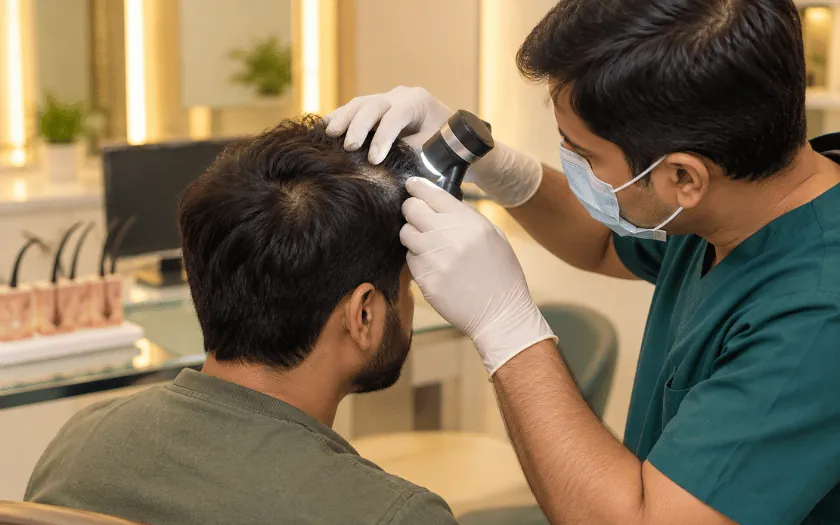
There is no single hair transplant age limit written into medical rules. Adults of many ages can be suitable, from their twenties to their sixties and beyond. What matters more than the number is how stable and predictable your hair loss is, how strong your donor area is and how healthy you are for minor surgery.
- Age alone rarely decides suitability, but it changes the planning.
- In the early twenties, hair loss is often still changing, so many surgeons advise medical treatment and waiting.
- After 50, the pattern is usually clearer, but donor density and health need careful checks.
- Donor hair is limited and should be planned for a lifetime, not only for today.
Is there a hair transplant age limit?
No formal upper or lower age limit applies to every patient, apart from the general principle that surgery for cosmetic hair loss is done in adults who can give informed consent. Instead, surgeons weigh a set of questions at every age:
- What type of hair loss is this, and is it hereditary pattern loss?
- How fast is it progressing, and what is it likely to look like in 10 or 20 years?
- How many donor grafts can be safely used over a lifetime?
- Is the person healthy enough for a long procedure under local anaesthesia?
- Are expectations realistic?
Why does age matter in hair transplant planning?
Hereditary hair loss, known as male pattern hair loss in men, is usually progressive. It tends to continue over many years. A transplant moves donor hair to the thinning area, but it does not stop the native hair around it from thinning further.
This creates a planning problem for younger patients. If a low, dense hairline is created at a young age and the hair behind it keeps receding, the transplanted hair can end up as an isolated strip with thin areas behind it. Correcting this later needs more donor hair, which may not be available.
Can you have a hair transplant at 20?
It is possible in selected cases, but most surgeons are cautious. The American Academy of Dermatology notes that younger men with hair loss may be asked to wait and start a hair loss medicine first. Reasons include:
- The final pattern is unknown. Loss that starts early can be extensive later on.
- Donor supply is limited. Using many grafts early leaves fewer for areas that thin later.
- Hairline design is harder. A hairline that suits a 20 year old face may look unnatural at 45.
- Medical treatment can help. Medicines may slow loss and sometimes improve density, giving time for the pattern to show itself.
When a young patient is suitable, the plan is usually conservative: a mature, age appropriate hairline, a moderate number of grafts and medical treatment for native hair. Our page on medical hair treatment explains these options.
What is the right age for a hair transplant?
There is no ideal birthday. A more useful idea is the right stage. A transplant is often more predictable when:
- The pattern of loss has been reasonably stable for a period, often a year or more.
- A doctor has confirmed the diagnosis and ruled out other causes.
- Medical treatment has been tried or discussed where appropriate.
- The donor area has good density, measured with magnification.
- You understand that more treatment may be needed later.
For many people this point comes somewhere in the late twenties to forties, but it varies widely and is best judged individually.
Hair transplant after 50: what changes?
Older patients can do well, and in some ways planning is simpler because the pattern of loss is clearer. There are points to check carefully:
Donor density
Donor hair can thin with age. A surgeon checks whether the donor area can supply enough grafts without looking see through afterwards.
General health
Blood pressure, diabetes, heart conditions and medicines such as blood thinners are reviewed. Many of these can be managed, but they need to be controlled before surgery.
Grey hair and skin
Grey or white hair can give reasonable coverage when skin colour and hair colour contrast less. Healing may be slightly slower in some older patients.
Realistic goals
A natural, slightly higher and softer hairline usually suits an older face better than a low, straight line. Good hairline design takes age into account.
Does age affect women considering a transplant?
Women often notice thinning around hormonal changes, including after pregnancy and around menopause. The loss is frequently diffuse, and sometimes the donor area is also affected. Age matters less than finding the cause, since thyroid, iron and hormonal factors can all play a part. A transplant is considered only when the donor area is stable and the thinning is suitable.
How age shapes the donor plan
Everyone has a limited number of donor follicles. A lifetime plan asks how these should be used across decades, not just in one session. Careful donor area planning keeps some reserve for future needs, especially for younger patients whose loss may progress.
Cost factors at different ages
Age itself does not set the cost. The main factors are the size of the area, the number of grafts, the technique, whether more than one session is likely and any medical treatment needed alongside surgery. The exact cost can be discussed after consultation and assessment.
When should you see a doctor?
See a doctor if hair loss is sudden, patchy, itchy or painful, or if it starts in your teens. These signs suggest a cause other than simple pattern loss and need assessment before any talk of surgery.
Book a consultation at Elegance Hair Restoration Centre in Surat to discuss your hair loss pattern and whether now is the right time to consider a transplant.
Related treatments and conditions
Sources
- American Academy of Dermatology: Hair transplant results and candidates
- NHS: Hair loss
- NHS: Hair transplant
This article is for general information only. Treatment depends on each patient’s condition and should be decided after consultation with a qualified doctor. Medically reviewed by Dr. Ashutosh Shah, M.B.B.S., M.S., M.Ch., D.N.B. (Plastic Surgery), Gujarat Medical Council Reg. No. G-26257. See the medical disclaimer.
More in Hair Transplant
Questions patients ask
Straight answers, before you decide.
These are the questions that come up most often in consultation. If yours is not here, send it on WhatsApp and the team will reply.
In most cases, yes. At 18 the future pattern of hereditary hair loss is very hard to predict, and early surgery can use up donor hair that may be needed later. Most doctors recommend a diagnosis, medical treatment and a period of observation first. Surgery is considered only in unusual, carefully selected situations.
Yes, age over 60 does not rule it out. Suitability depends on general health, medicines, donor density and goals. Heart conditions, blood pressure and diabetes need to be well controlled. Many older patients choose a moderate, natural looking result that frames the face rather than a very dense one.
It is quite possible. Because pattern hair loss often continues, younger patients may need further treatment later to keep a natural look as native hair thins. Medical treatment can slow this process for some people. A good plan explains this possibility at the start.
Healthy grafts can grow well at many ages. Growth depends more on graft handling, the blood supply of the scalp, smoking and general health than on age alone. Older patients may heal a little more slowly, and donor density may be lower, which affects how many grafts can be taken.